
Toto Free Press — Tomorrow’s News Today
Toto Free Press — Tomorrow’s News Today
🚨 BREAKING — THE WAR IS ENDING, AND THE TERMS ARE TRUMP’S
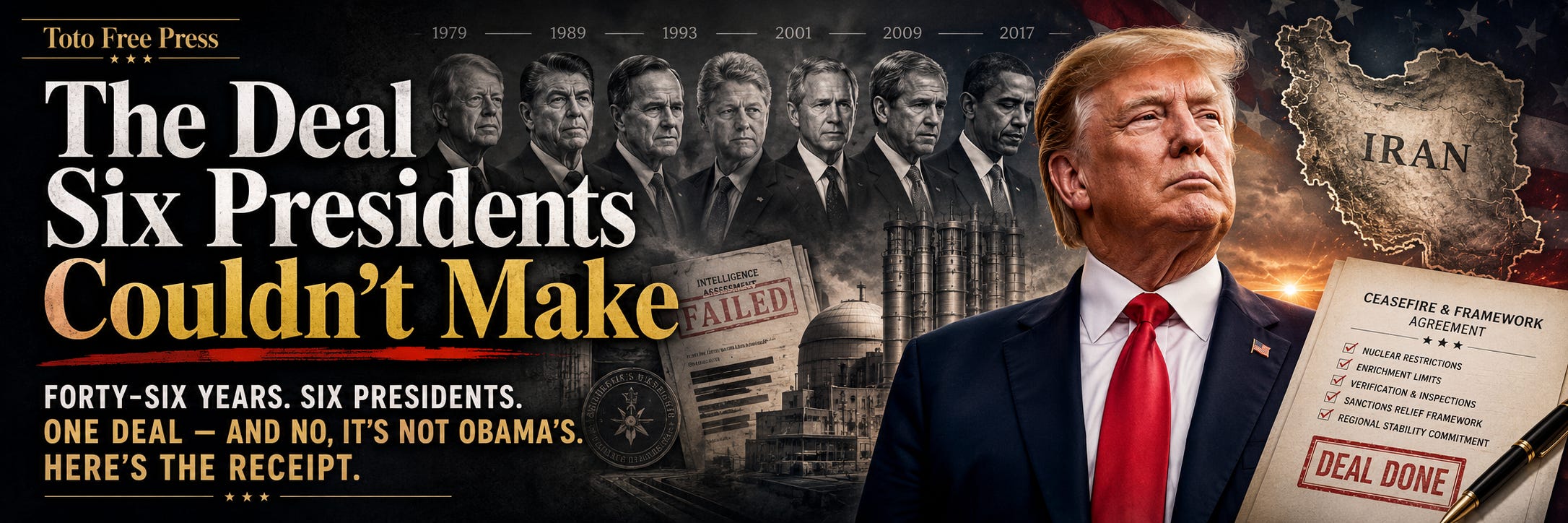
☑️ The framework to end the war is DONE. The signature ceremony is coming June 19. The hard part begins now — and this time, the clock is not Iran’s friend.
☑️ Trump wants the uranium GONE. Not managed. Not blessed. Not calendared. Gone. Whether the regime is sitting on 200 kilograms or 440, the fight is no longer over how much poison the scorpion keeps — it’s over whether the poison comes out. And it’s buried under granite so deep that the United States is the only nation on Earth with the bombers to reach it.
☑️ NO weapons path. NO sunset. Civilian-level only, no road to a bomb, and — unlike Obama’s deal — no timer hidden in the machinery counting down to industrial enrichment.
☑️ NOT ONE DIME of YOUR money. They PERFORM, then they get relief — and the reconstruction billions come from the Gulf, not your paycheck. No American tax dollars on a pallet. No American tax dollars on a plane. The Arab states pay to rebuild what they begged us to bomb. The opposite of pallets of cash on a midnight tarmac.
☑️ Iran’s war machine — HAMMERED. Its navy mauled, its missile capacity gutted, its terror network dragged into the light. This could be the crowning achievement of the Trump presidency.
There are two ways to deal with a scorpion.
One man stares at the scorpion, admires its patience, and signs a piece of paper promising to leave it alone for ten years — and hands it a wallet full of cash on the way out the door, calling it diplomacy.
The other man pins the tail to the table, demands the venom, and says: we will dig the poison out by the roots.
In 2015, Barack Obama met the scorpion. In 2026, Donald Trump pinned the tail.
And now you know — the rest of the story they hope you never put side by side.
The Claim They’re Already Making
Watch the press this week. They are already reaching for the same tired line: “It’s basically the same deal Obama made. Trump just slapped his name on it.”
That is the lie. And like every good lie, it works only on people who never read the first one.
So tonight we read them both. Out loud. Clause for clause. And we let the documents do what the documents always do — tell the truth on the people who hoped you’d never compare them.
Obama’s Deal: The Speed Bump
Let us begin where honesty demands — with the actual text of the Joint Comprehensive Plan of Action, signed July 14, 2015.
Here is what Obama actually agreed to, and these are not my numbers — they are the deal’s own numbers:
-
Iran got to keep enriching. The JCPOA permitted Iran to enrich uranium on its own soil, capped at 3.67 percent purity, holding roughly 5,060 operating centrifuges and a 300-kilogram stockpile. Read that again. The centerpiece of the so-called “nuclear deal” was that Iran kept its nuclear program running. It was permission with a leash, not prevention.
-
The leash had an expiration date. This is the part they bury. The JCPOA was built on what are called sunset clauses — provisions under which the restrictions simply switch themselves off as the calendar turns. Caps on centrifuges easing after ten years. Enrichment limits expiring after fifteen. A glide path back to industrial-scale enrichment by 2030. Critics didn’t call it a stop sign. They called it a speed bump. One arms-control analysis laid the dates out plainly: enrichment caps gone by 2030, surveillance of centrifuge production sites gone by 2035, monitoring of uranium mines gone by 2040.
-
In plain English: the deal didn’t stop the bomb. It scheduled it. It put Iran’s nuclear weapon on layaway and called the down payment “peace.”
-
And then there was the cash. Obama’s own description of what he gave away was sanctions relief and the unfreezing of Iranian assets — billions in value released to the regime. Trump put it more bluntly than I ever could: the old deal, in his words, “gave Iran massive amounts of CASH, and a clear and open path to a Nuclear Weapon.”
-
The scope was a thimble. The JCPOA addressed the nuclear file and nothing else. Not the ballistic missiles. Not Hezbollah. Not the proxies bleeding the region. The most dangerous regime in the Middle East got sanctions relief, and in exchange the world got a fifteen-year countdown clock and a regime free to fund terror with the rest of its calendar.
That is the deal they want you to believe Trump just copied. And the record of what that timer actually produced is the best argument against them: by 2023, Iran’s enriched stockpile had blown past more than twelve times the JCPOA-permitted level, and analysts were measuring its breakout time to a bomb’s worth of material not in years, not in months, but in days. That is not a deal that failed in theory. That is a deal that failed in front of us, on the clock it set itself.
Trump’s Deal: Pull It Out By the Roots
Now turn the page. Here is the framework Trump and Iran reached this June — and watch how every single pillar of Obama’s deal gets inverted.
-
No path to a weapon. They’ll come at you on this one, so plant your feet. Obama blessed enrichment — permanent, sovereign, his to keep, capped at a number that expired upward until the leash fell off on its own by 2031. Trump’s framework slams that door. Civilian power, low level, no road to a warhead, and no calendar promising Iran the keys back when the cameras leave. One deal handed the scorpion a program and a stopwatch. The other left it a light bulb and nothing else. And the poison it’s already brewed — call it two hundred kilos, call it four hundred and forty, call it enough sixty-percent uranium to put a cold sweat on every sane government breathing — that comes out. Obama would have let Iran enrich its way toward the line on a timer. Trump is reaching in to pull the material off the board. The fight was never about how much poison the scorpion keeps. The fight is whether the poison comes out. You don’t reschedule a bomb. You dig up the dust.
-
No sunset. No expiration. No countdown clock. This is the heart of it. Obama’s deal was designed to switch off. Trump tore the timer out of the wall. The entire critique that defined the JCPOA — that it expired into a weapon — is the exact flaw Trump built his framework to eliminate. Where Obama signed a fifteen-year pause, Trump went after a settlement with no built-in surrender date.
-
No pallets of cash up front. Here’s a line the evening news will never read you. The President said it himself, plain as a slap: “Unlike Obama’s Hundreds of Billions of Dollars in payments to them, including 1.7 billion Dollars in green, cold cash, no money will exchange hands.” Now watch the spin machine go to work. It was a settlement. It was an old arms dispute from 1979. It was unfrozen assets, not a gift. Fine. Dress it in every fig leaf the State Department keeps in the drawer. Strip all of it away and you’re still left staring at the same photograph: four hundred million dollars in foreign cash, stacked on wooden pallets, loaded onto an unmarked plane, and flown into Tehran in the dead of night — the same day Iran handed back American prisoners — while Washington sold the country a nuclear countdown and called it peace. That’s not my characterization. That’s the receipt. And when Iran sat down at this table and stuck out its hand for the same treatment, Trump didn’t reach for his wallet. He reached for the blockade. Obama led with the check. Trump led with the blockade. Iran’s advisors are publicly furious about exactly this — one called it “betraying diplomacy” because Trump wouldn’t release the frozen assets on Tehran’s schedule. When the regime is angry that you won’t pay them, you are negotiating from strength. That’s the tell.
“But Toto,” they’ll whine, “there’s still money on the table — relief, unfrozen funds, the Gulf’s reconstruction billions.” Yes. There is. And now hear the part that ought to make every American taxpayer stand up and cheer: not one dime of it is yours. Read that again. The reconstruction money — the hundreds of billions to rebuild the rubble — comes out of the Gulf, out of the Arab states who spent years begging us to handle this regime. Saudi money. Emirati money. Qatari money. Not the money that comes out of your paycheck every two weeks. Obama reached into the American-backed till and shipped the regime cash and unfrozen assets while you footed the bill. Trump made the neighbors pay for the neighborhood. And here is the difference a child could see and a Democrat never will: every dollar of it comes after. After Iran performs. After the uranium moves. After the inspectors confirm it. Obama wrote the check and prayed the scorpion would behave. Trump locked the vault and told the scorpion to earn it — with somebody else’s money. One is a ransom. The other is a reward. One bet your tax dollars on an enemy’s goodwill. The other bet on nothing but the enemy’s behavior — and didn’t charge you a cent.
And the moment the deal closed, the President said it himself — straight at the people who were already trying to spin it: “Iran has agreed to never have a Nuclear Weapon! Also, the story that the U.S. is paying Iran 300 million Dollars is Fake News, put out by the Dumocrats!” There it is, from the top. They reached for the oldest play in the Obama-era book — Trump’s secretly cutting them a check, just like the pallets of cash on the tarmac in 2016 — and he cut them off before the lie could leave the runway. Because that was their deal. Cash on a plane in the dead of night was Obama’s signature, not Trump’s. They’re projecting their own playbook onto the one man who refused to run it.
Leverage, not lubrication. Obama removed the pressure to get the signature. Trump kept the pressure on through the signature. A naval blockade on the Strait of Hormuz. A 50-percent tariff threat against any nation arming Iran. Mines to be cleared from the waterway within thirty days before the U.S. lifts a thing. The strait reopens because Iran complies — not as a gift in advance, but as a reward for performance. That is the difference between a hostage negotiation and a business deal.
The scope went wide. Where the JCPOA touched only centrifuges, the 2026 framework reaches toward the missiles, the proxies, the regional behavior — the very things Obama left untouched while the region burned. A senior administration official confirmed the framework was built to include Israel and Iran’s terror proxies in its terms.
And This Morning — The Clock Starts
I want you to mark the date, because the doubters will need a date too. This very morning — June 15 — Pakistan’s prime minister, the man who brokered it, announced the United States and Iran had reached the deal, set for formal signature on June 19 in Switzerland. The ceasefire holds. The order has gone out to lift the naval blockade and reopen the Strait of Hormuz — the artery through which a fifth of the world’s oil flows, the one Iran choked shut. The mines are being cleared, the oil is moving, and the markets exhaled.
Is it finished? No. And I’ll be the one to tell you so, because I don’t traffic in the fairy tales the other side feeds its audience. This is a framework, not a monument with the cement cured. The hard questions — how the uranium walks out the door, how enrichment gets capped and counted, the missiles, the proxies — all of it goes into a sixty-day window. The press thinks it found a gotcha. “Trump left the hard part for later,” they crow, pleased with themselves.
And my answer to them is: good. Look at the shape of the thing he built. The strait opened first — that was Iran’s reward for backing down. The money stays locked until Iran performs. And the clock ticking now is not Obama’s clock. Obama’s clock counted down to a bomb — every year that crawled by dragged Iran closer to industrial enrichment, by treaty, with our signature on it. Trump’s clock counts down to something else entirely: compliance, or exposure. Every single day, Iran either does what it swore it would do, or it stands naked in front of the whole world as the side that broke faith — the B-2s still parked in the region, the ultimate alternative still sitting right there on the table. You can argue about how the sixty days end. You cannot argue about which clock you’d rather have running. One president bet the farm on a scorpion’s goodwill and wrote the check first. The other bet on nothing but the scorpion’s behavior, and kept his hand on the gun while he waited to see it.
One Goal. One Promise. One Trillion Dollars.
Now let me tell you what this whole thing was for — because the legacy media has spent three months trying to make you forget.
This war was not cheap. Credible estimates — and I mean Harvard economists, not talk-radio guesses — put the all-in cost to the United States as high as one trillion dollars. A leading Harvard economist said it plainly: she was certain we would spend a trillion on the Iran war, and that we may have already racked it up. A trillion dollars. The price of a war the size of a nation’s economy.
So you had better understand what that trillion was spent to buy. Because here is the part they keep burying under the body counts and the hand-wringing:
The goal was never to occupy Iran. The goal was never to nation-build. The goal was never to plant an American flag in Tehran and stay for twenty years like the architects of Iraq and Afghanistan wanted.
The goal — the entire goal — was one sentence long: Iran will never have a nuclear weapon.
And lest anyone accuse me of inventing that, the White House itself laid out the mission’s purpose in plain numbered order when Operation Epic Fury began in March 2026:
-
destroy Iran’s missile capability,
-
destroy its navy,
-
ensure the regime can never obtain a nuclear weapon, and
-
end its ability to arm, fund, and direct terror armies beyond its borders.
Look at that list and then look at the deal Trump just signed — they are the same four targets. The military operation and the diplomatic settlement were never two different things. They were one strategy with one aim: pull the poison out by the roots and leave nothing on a timer.
Trump said it himself, in his own words, while the oil markets churned and the critics screamed: his interest, “of far greater interest and importance to me, as President,” was “stopping an evil Empire, Iran, from having Nuclear Weapons, and destroying the Middle East and, indeed, the World.”
And here is the line that ought to land like a hammer: this is a promise he campaigned on. He told the American people he would never let Iran go nuclear — that he tore up Obama’s countdown clock in 2018 precisely because it scheduled the weapon instead of stopping it. The critics called it a bluff. The experts called it reckless. The diplomats called it impossible.
And now the uranium is on the table to come out, the timer is gone, and Iran is angry — angry that the cash didn’t come, angry that the pressure didn’t lift. That is what a kept promise looks like in motion. Another box, checked. Another thing he said he’d do — and the doing is underway, on his terms instead of theirs.
A trillion dollars is a staggering sum. But ask yourself the only question that matters: what is the price of a nuclear weapon in the hands of the men who chant death to America? There is no number high enough. The man who understood that — who refused to schedule the bomb and went instead to dig it up by the roots — is the same man who told you, years ago, exactly what he would do. And the deal now on the table is built on his terms, not theirs.
We Have Read This Chapter Before
Here is the history they never taught you — and it is the whole argument in miniature.
Before Iran, before the ayatollahs, before any of it, this young republic faced the exact same enemy wearing an older coat: the Barbary pirates of the Islamic world. For thirty years, from 1785 to 1815, they seized our ships and chained our sailors. And what did America do at first? We negotiated. Thomas Jefferson, our ambassador to France, sat down to talk it out — and got nowhere. George Washington took the presidency and the negotiations went nowhere still. Roughly two out of every five captured American sailors died in that captivity while the talking dragged on.
Thirty years of diplomacy. Thirty years of ransom and tribute. Thirty years of the simple man passing on.
And how did it finally end? Not with a better-worded treaty. Not with a cleverer envoy. It ended when Commodore Stephen Decatur sailed into Algiers in 1815 with a squadron of ten warships at his back and the memory of a war just won, and dictated the terms. And mark how completely the table turned: for thirty years America had paid tribute to be left alone — and Decatur’s treaty ended the tribute entirely and required the Dey to pay compensation to us. The ransom money ran backwards, up the barrel of a gun. The Dey of Algiers signed not because we asked nicely but because we had become, at last, too strong to rob. Strength closed the deal that three decades of negotiation could not.
Now read it as the parable it is. For ten years after Obama’s deal, America negotiated with the modern Barbary state — the regime that has tested us for forty-six years, the one that calls us the Great Satan and chains its hatred to a bomb. We sent envoys. We sent pallets of cash. We scheduled the weapon and called it diplomacy. And it got us nowhere — the trucks were still rolling out of Fordow with hundreds of kilograms of enriched uranium, unaccounted for, while the experts congratulated themselves.
It took a Decatur. It took a man who understood the one thing the diplomats never will: that some enemies do not sign because you persuaded them — they sign because you have made it impossible to do anything else.
History does not repeat. But it rhymes. And this rhyme is two hundred years old.
The Honest Ledger
I won’t insult you the way they insult their audience — by pretending there’s no overlap at all. Of course there is. Both deals trade something for something; that’s been the shape of every bargain struck since Cain haggled with Abel. And yes, Iran is already out there telling a different story than Washington is, and the fine print is still getting wrestled over behind closed doors. I know it. I’m telling you anyway, because I’m not afraid of the parts the other side thinks are my weakness.
Here’s what no amount of spin can touch:
Obama’s deal scheduled the bomb.
Trump’s deal puts the material on the table to come out.
Obama’s deal expired.
Trump’s deal has no off-switch.
Obama paid up front.
Trump pays nothing until Iran performs.
Obama closed his eyes to the missiles and the proxies.
Trump put them on the table.
Obama built no way to reverse the clock once it started ticking toward a weapon. Trump built the whole thing around reversibility — Iran is rewarded for performance, not for promises.
One man handed the scorpion a wallet and prayed. The other pinned the tail and demanded the venom.
You can call that “the same deal” only if you are paid to.
And if the next sixty days hold — if the uranium comes out, if the timer stays dead, if the regime performs the way the framework demands — then understand what we are looking at. Every president since 1979 stared at this same scorpion.
Carter watched it take our embassy.
Reagan, Bush, Clinton, Bush again, Obama, all of them managed it, contained it, negotiated with it, paid it. Forty-six years of American presidents who could not, or would not, end the threat. And one man walked in, refused the old playbook, kept the gun on the table, and brought the most dangerous regime in the Middle East to terms it had never once accepted — no weapons path, no expiration, no cash up front, its war machine hammered — navy mauled, missile production gutted, terror network dragged into the light. If it holds, that is not just a deal. That is the possible crowning achievement of the Trump administration — and the thing six presidents before him could not do.
The Posture of the Heart
And here, beloved, is where Professor Toto steps back and Pastor Vaughn picks up the microphone — because this is bigger than oil prices and bigger than a press cycle.
Scripture says in Proverbs that “a prudent man foreseeth the evil, and hideth himself: but the simple pass on, and are punished.” The difference between these two deals is not merely policy. It is the difference between the prudent man and the simple one. One foresaw the evil and built no countdown clock into his treaty. The other passed on, signed the timer, and called it peace in our time.
YAHWEH does not measure a covenant by how good it feels on the day of signing. He measures it by what it produces in the generation that inherits it. To the victor goes the spoil — but only the victor who fought the right battle, on the right terms, refusing to bless the very thing he was sent to stop.
We were warned that men would “call evil good, and good evil.” For a decade we were told that the deal which scheduled a bomb was peace, and the man who tore up that schedule was a warmonger. The posture of the heart reveals itself not in the applause of the moment, but in the fruit of the years.
Watch the fruit. Pray for those who must finish what was started. And never, ever let them tell you the two deals were the same.
And now you know… the BEST of the story.
Professor Toto writes at professortoto.substack.com. His book Before the Beginning is available now on Amazon — get one for your pastor, your skeptic, and your brother-in-law who still thinks the timer was peace.