



Toto Free Press — Tomorrow’s News Today
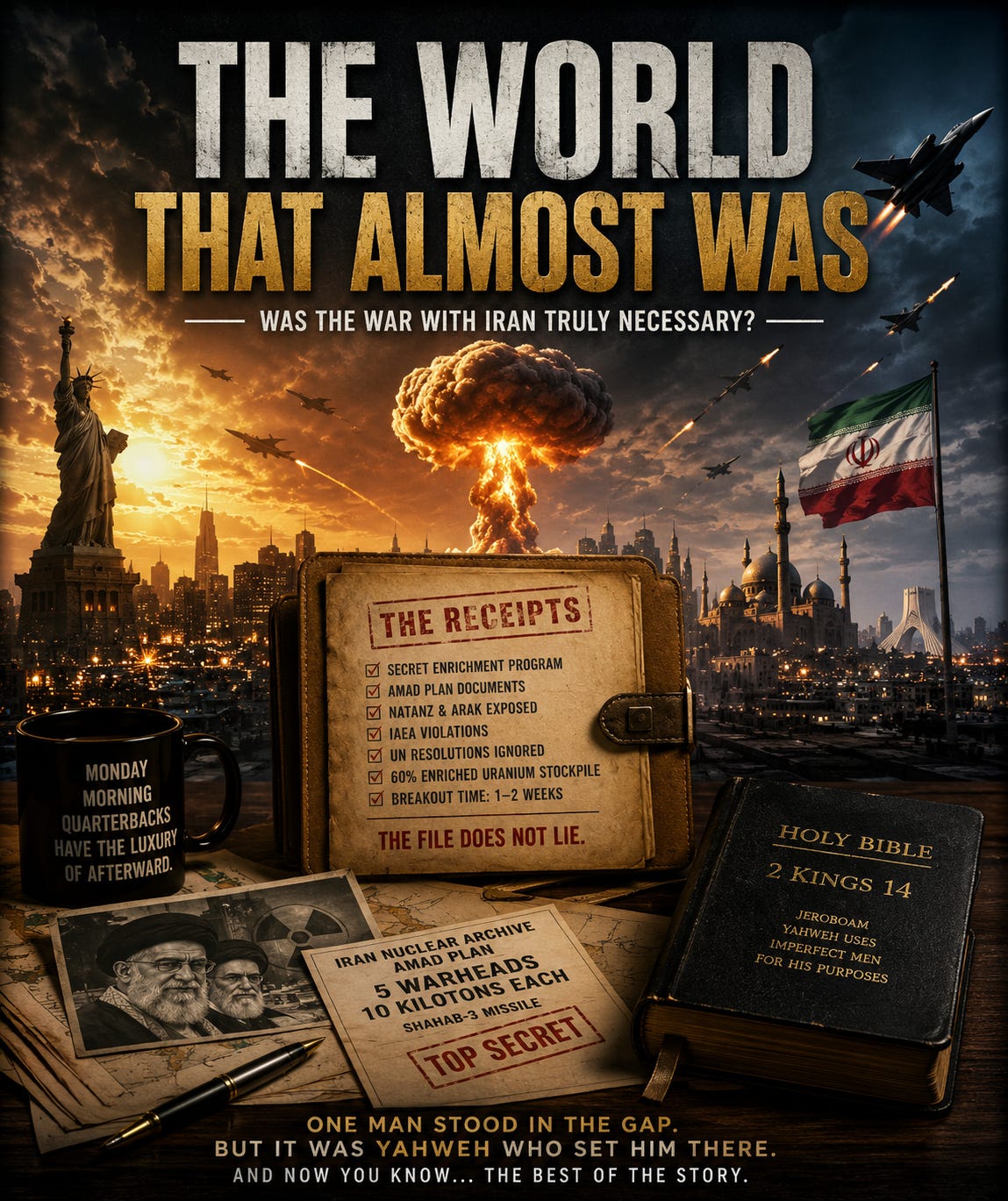
It is the easiest job in the world, being a quarterback on Monday morning.
The game is won, the clock has run out, the crowd is filing toward the exits — and now, only now with the scoreboard settled, here come the geniuses down from the cheap seats to explain how they’d have called every play. “We never should have thrown that pass. We never should have gone for it on fourth down. We never should have gone to war with Iran at all.” I have a word for that kind of courage. I call it afterward.
Because here is what the Monday-morning quarterbacks need you to forget: the victory they are now sneering at is the very thing that gave them the safety to sneer. It is a luxury bought with someone else’s nerve. So before they rewrite the history of a war that was won, let us walk back through why it had to be fought — slowly, with the receipts laid out on the table, one by one.
And now you know — the rest of the story they hope you’ll forget now that the danger has passed.
The Lie They’re Selling Now
The new line is simple, and it’s already everywhere: “There was never really a threat. Iran was years away. The whole thing was manufactured. We went to war over nothing.”
That is not analysis. That is amnesia — and in some cases, it is something worse than amnesia. Because the record of what Iran was doing is not hidden. It is not classified. It is not a matter of opinion. It is forty years of documented, catalogued, inspector-verified evidence sitting in the files of the International Atomic Energy Agency, and any honest man can read it.
So let’s read it.
The Receipts
Pull the file. Start at the beginning.
-
The late 1980s. While the world was watching the Cold War end, the Islamic Republic quietly began building a secret uranium enrichment program — importing the equipment and the know-how from Pakistan and China, and hiding every bit of it from the inspectors it was legally bound to inform. That is not a peaceful energy program. That is a man digging a tunnel under his neighbor’s fence in the dark.
-
The 1990s and early 2000s. Iran ran a covert, coordinated nuclear weapons project. It had a name — the Amad Plan. Not a power-plant program. A warhead program. And we are not guessing at its purpose, because in a 2018 operation Israeli intelligence walked a hundred thousand of the regime’s own documents out of a Tehran warehouse — and according to those seized Iranian records, since reported across Western and Israeli press, the regime’s own paperwork spelled out the goal in cold ink: build five nuclear warheads, each in the range of ten kilotons — two-thirds the bomb that leveled Hiroshima, apiece — mount them on the Shahab-3 ballistic missile, and detonate one in an underground test in the desert. Five warheads. Written down. Planned. Weaponization work run in secret, in direct violation of the treaty Iran had signed with its own hand.
-
2002. The lid came off. The hidden enrichment plant at Natanz and the heavy-water facility at Arak — the one suited to produce plutonium — were exposed to the world. Iran had built them in secret and told no one, exactly as the safeguards agreement forbade.
-
2003. International inspectors walked into Natanz and found it: traces of highly enriched uranium — the kind that does not belong in any peaceful power program. Iran’s explanation? Oh, that must have come from contaminated equipment we imported. The dog ate the homework.
-
2006 and onward. Iran broke the IAEA seals at Natanz, threw out the cooperation, and restarted enrichment in open defiance. The United Nations Security Council — not Fox News, not a campaign rally, the UN — passed binding resolution after binding resolution demanding Iran stop: a half-dozen of them across the decade, the first in 2006, each one met with the same answer. Iran’s president went to a podium and announced the regime could now produce nuclear fuel on an industrial scale, and dared the world to do something about it.
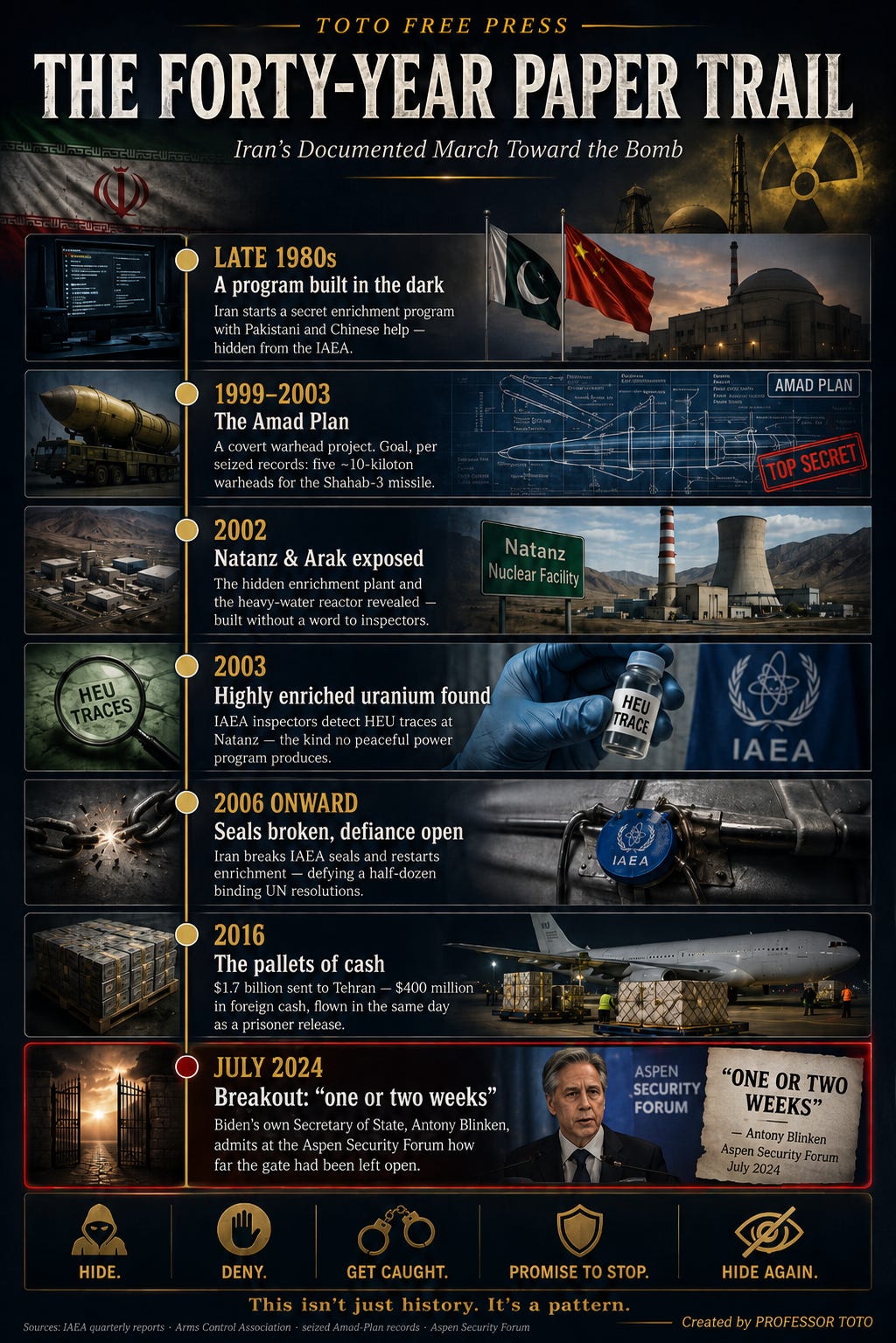
The years since. Even after the Obama deal, even after every promise, Iran enriched past every limit it had agreed to. By the last accounting the international inspectors were able to make before the strikes, the numbers were staggering — and they are not mine, they are the IAEA’s own: 408.6 kilograms of uranium enriched to 60 percent as of May 17, 2025, climbing to roughly 440.9 kilograms by mid-June, on the very eve of the attack. That is the only non-weapons state on earth sitting on a stockpile like that — enough, once enriched the rest of the way, to fuel something like nine warheads.
And do not take my word for how close the clock had gotten. Take the word of Antony Blinken — Joe Biden’s own Secretary of State — who stood at the Aspen Security Forum in July of 2024 and admitted that Iran’s breakout time was “now probably one or two weeks.” Now let me be precise, because precision is what makes a thing unanswerable: he was not saying Iran could screw together a finished, deliverable bomb in two weeks. The weaponization — the warhead, the miniaturization, the mating to a missile — that clock runs longer. What he was saying was worse in its own way: the uranium clock, the time to produce the fissile material for a weapon, was nearly at zero. The hardest, slowest part of building a bomb was almost done. That is the Biden administration’s own top diplomat, confessing on a public stage how far the gate had been left open — even as he tried to pin the blame on the one man who’d torn up Obama’s deal precisely because it was letting this happen.
That is the file. Four decades of it. Hide, deny, get caught, promise to stop, and hide again. A regime does not spend forty years lying to inspectors about a program it intends to use for hospitals and streetlights.
This was never a question of if Iran wanted the bomb. The receipts answer that. The only question was what kind of regime was reaching for it — and that is the question the armchair quarterbacks are most desperate that you never ask.
Why This Regime. Why It Could Never Be Allowed.
Here is where I must be precise, because the careless will hear what I am about to say and accuse me of slandering a faith. I am doing no such thing. So hear me clearly.
The peril of a nuclear Iran is not the peril of Islam. It is not the peril of the world’s Muslims, the overwhelming majority of whom want nothing to do with the men in Tehran. The regime that rules Iran is as far from the ordinary Muslim as the lunatics of Westboro are from the Christian sitting in the pew next to you on Sunday. Do not let anyone tell you Professor Toto said otherwise.
The peril is specific. The clerics who rule Iran hold to a particular and radical strain of Twelver Shia belief. At its center is the Mahdi — the Twelfth Imam — who, their doctrine teaches, vanished into hiddenness eleven centuries ago and will one day return to impose justice and rule over the whole earth. Now hold that belief gently; in itself it is just a belief, and millions hold the quiet version of it and harm no one.
But here is the strain that rules in Tehran, and here is why it changes everything: there are factions within that clerical leadership who teach that the Mahdi’s return can be hastened. That global chaos, cataclysm, and apocalyptic war are not catastrophes to be feared — they are the birth pangs of the messiah they await. That the worse the world burns, the closer the Hidden Imam comes to stepping out of the shadows.
And lest you think this is mere private mysticism, locked away in the hearts of a few old men — understand that they wrote it into the machinery of the state. Iran’s own 1979 constitution does not charge its Revolutionary Guard with merely defending Iran’s borders. It commissions the IRGC as an ideological army, tasked with the mission of extending the sovereignty of God’s law throughout the world. That is not my interpretation. That is their founding document. The apocalypse is not a fringe sermon in Tehran. It is a job description.
Sit with that. Because every nuclear standoff in human history has rested on one assumption: that the other man, however evil, wants to live. We survived the Cold War because the men in the Kremlin feared their own deaths and the deaths of their children. The bomb kept the peace because both sides agreed that the end of the world was the thing to be avoided.
Now hand the bomb to men who have built their theology around the belief that the end of the world is the thing to be welcomed — that the fire is not the failure of the plan but the fulfillment of it. Every lever of deterrence that kept us alive for seventy years snaps off in your hand. You cannot threaten a man with the very destruction he is praying for. You cannot deter a regime that reads the mushroom cloud as the dawn.
That is why this was never about uranium and centrifuges alone. That is why for generations — through Republican presidents and Democrat presidents alike — every administration said the same thing: Iran cannot be allowed to have it. They all saw the danger. They all spoke against it.
But seeing the danger and dealing with it are two different things.
Walk Into the Future With Me
Let me take you somewhere. Not to a fact or a file — to a future. A future that was three years away, maybe less. The one that was coming if no one had stood in its path. Walk into it with me for a moment, because you very nearly had to live in it.
It is an ordinary Tuesday, a few years from now. You drop the kids at school. You complain about the price of eggs. You half-listen to the radio on the way to work. And somewhere on the other side of the world, in a country most Americans can’t find on a map, a regime that spent forty years lying its way to a warhead finally has one — and a second, and a tenth. Not a rumor. Not a “breakout estimate.” A finished bomb, sitting on a finished missile, in the hands of men who teach their children that the end of the world is not to be feared but welcomed.
Now the Tuesdays change.
They change for the mother in Tel Aviv who stops letting her children sleep in separate rooms, because if it comes, she wants them together. They change for the sailor’s wife in Norfolk who watches the carrier groups sail toward a gulf that is now a nuclear tripwire, and wonders if the deterrence that protected her father’s generation means anything at all to men who do the math differently. They change for the family in Kansas — yes, Kansas, a thousand miles from any ocean — because a regime that welcomes the apocalypse does not respect the comfort of distance, and a single weapon smuggled into a single harbor changes every city’s arithmetic at once.
And here is the part that should put a cold hand on your heart: in that future, the men in Tehran would not have to use the bomb to win. They would only have to have it. Every demand backed by a mushroom cloud. Every act of terror now untouchable, because who strikes back at a nuclear power? Every ally we swore to protect now quietly calculating whether America’s word is worth the risk of a city. The whole free world forced to ask permission of the one regime on earth that is not afraid to die. That is not war. That is hostage-taking on a planetary scale — the entire world held at gunpoint by men who believe the trigger is a prayer.
Your children would have grown up in that world. Smaller. More afraid. Negotiating their freedoms downward, year by year, to a doomsday cult with a deliverable warhead. They would never have known what it cost — because the catastrophe that is prevented leaves no monument, holds no funeral, makes no headline. The disaster that doesn’t happen is the most thankless thing in all of politics. No one builds a statue to the fire that was never lit.
That was the future on the table. That was the road we were on. And the only reason your Tuesday next year will look like your Tuesday today — eggs and carpool and the radio you barely hear — is that one man stepped into that future and shut the door before you ever had to walk through it.
One Man
For forty years, the threat was named and the threat was managed and the threat was negotiated and the threat was studied and the threat grew. President after president stared at the file, understood exactly what it meant, and handed it to his successor a little fatter than he found it.
One man refused to pass it down the line.
One man looked at four decades of lies, looked at the breakout clock ticking toward zero, looked at the nature of the men holding the centrifuges and understood that you do not negotiate with a regime that welcomes the apocalypse — you disarm it. Donald Trump was willing to absorb the screaming, the Monday-morning quarterbacks, the manufactured outrage, and do the thing that six presidents before him knew needed doing and could not bring themselves to do.
Was the war necessary?
The receipts say yes. The forty-year file says yes. The breakout clock says yes. And the theology of the men who were reaching for the trigger says it louder than all the rest: yes. Because the one thing more dangerous than a bomb is a bomb in the hands of men who are not afraid to die — who, in fact, are counting on it.
The armchair quarterbacks get to ask “was it necessary” only because one man already answered the question with action, and won. They are alive and comfortable and free to second-guess precisely because he did not second-guess when it counted.
That is not luck. That is leadership. And history will know the difference, even if the cheap seats never do.
The work is not finished — the negotiators still have their sixty days, and a scorpion bears watching even with its tail pinned. But the trajectory was broken. Forty years of serial concealment, serial defiance, serial enrichment — that road was severed by the one decision six presidents would not make. Whatever comes next, Iran is not on the road it was on. And that changes everything.
And now let me step out of the professor’s chair for a moment, because there is a deeper thing here that the political analyst’s vocabulary cannot reach.
Open the Book to Second Kings, the fourteenth chapter. There you will find a king named Jeroboam — Jeroboam the son of Joash, the second of that name to sit on Israel’s throne. And Scripture does not flatter him. It says plainly that he did evil in the sight of YAHWEH. He was no saint. He was no model of righteousness. By every measure the religious would use to pick a deliverer, he was the wrong man.
And yet hear what the Word says of his reign: that YAHWEH “saw the affliction of Israel, that it was very bitter… And the LORD said not that he would blot out the name of Israel from under heaven: but he saved them by the hand of Jeroboam the son of Joash.”
By the hand of Jeroboam. An unlikely hand. An imperfect hand. A hand the pious would never have chosen. But the hand YAHWEH raised up in that hour — because the salvation was never about the worthiness of the vessel. It was about the purpose of the One doing the saving. God had determined that the name of Israel would not be wiped out from under heaven, and so He raised up a man — the man of that moment — to hold back the destruction.
Now you understand the pattern, because you have seen it before. You saw it in Cyrus, the pagan king Isaiah named by name more than a century and a half before he was born — before the empire that would produce him had even risen — anointed by YAHWEH to set the captives free. You see it again in our own hour. The posture of the heart of the man is between him and his God. But the hand — the hand that was raised up to hold back a destruction that would have wiped a free people from under heaven — that hand was not raised by accident. The God who said the name of Israel would not be blotted out is the same God who governs the rise and fall of every kingdom, who “removeth kings, and setteth up kings,” who has never once in all of history left His purposes to chance or to the courage of committees.
One man stood in the gap. But it was YAHWEH who set him there.
And now you know… the BEST of the story.
Professor Toto writes at professortoto.substack.com. His book Before the Beginning is available now on Amazon — get one for your pastor, your skeptic, and the armchair quarterback in your life who suddenly remembers he was against the war all along.