

By Professor Toto • TOTO FREE PRESS — “Tomorrow’s News Today”
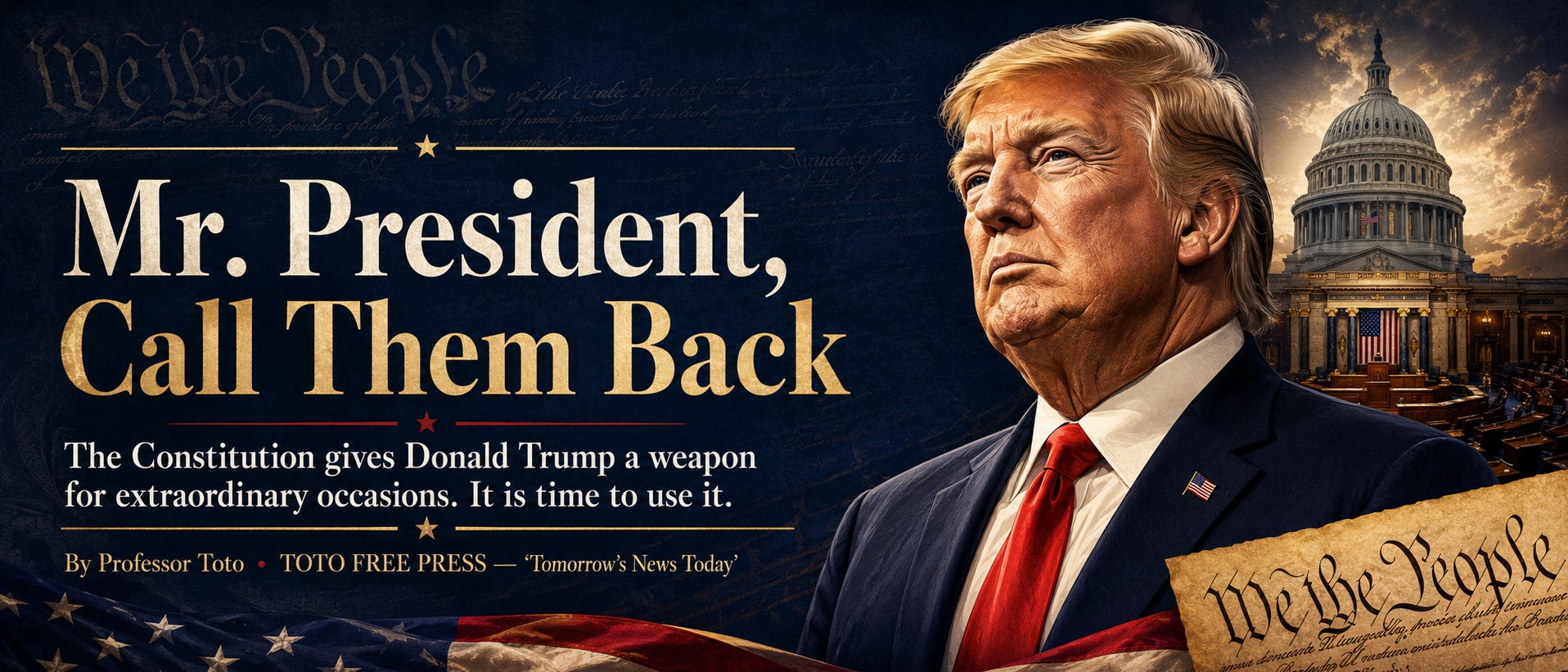
Mr. President, Call Them Back
A Senate majority already voted yes on the SAVE America Act. An unelected staffer and a sixty-vote tradition overruled them. The Constitution gives Donald Trump the answer.
By Professor Toto | TOTO FREE PRESS — “Tomorrow’s News Today”
“The Constitution does not require the President to sit quietly while a Senate majority is overruled by a procedural rule and an unelected referee.”
I. The Moment of Truth
There comes a time when the talking points, the cable panels, the Senate lunch meetings, and the polite Washington excuses must give way to a single demand:
Get back to work.
President Donald J. Trump has made the SAVE America Act — the Safeguard American Voter Eligibility Act — the top legislative priority of his second term. The House has passed it. A majority of the Senate has now voted for it. And it still is not law.
So let me point the President to a tool the Constitution already hands him.
Article II, Section 3 says the President may, “on extraordinary Occasions,” convene both Houses of Congress — or either one of them.
Read that again. Not CNN. Not the consultant class. Not the Senate parliamentarian. The Constitution itself gives the President of the United States the power to call Congress back into session when the occasion demands it.
If the integrity of American elections is not an extraordinary occasion, I would like someone in Washington to tell me what is.
II. What the Bill Does — and Why Now
The SAVE America Act is straightforward. It would require documentary proof of citizenship to register to vote in federal elections, require photo identification to cast a ballot, direct states to check the rolls against federal citizenship databases, and require federal ballots to be counted within thirty-six hours of Election Day.
Why now? Because confidence is the currency of a republic, and ours is running low. You need a photo ID to board a plane, open a bank account, or pick up a prescription. The SAVE Act asks for the same standard before you help choose the government. Senator John Kennedy put it plainly on the Senate floor: “The American people no longer have confidence in our elections.” You can argue about whether that loss of confidence is justified. You cannot argue that it exists.
The principle underneath the bill is one no sane republic should find controversial:
American elections should be decided by American citizens.
III. The Senate Already Showed Its Hand
The House did its job. Twice.
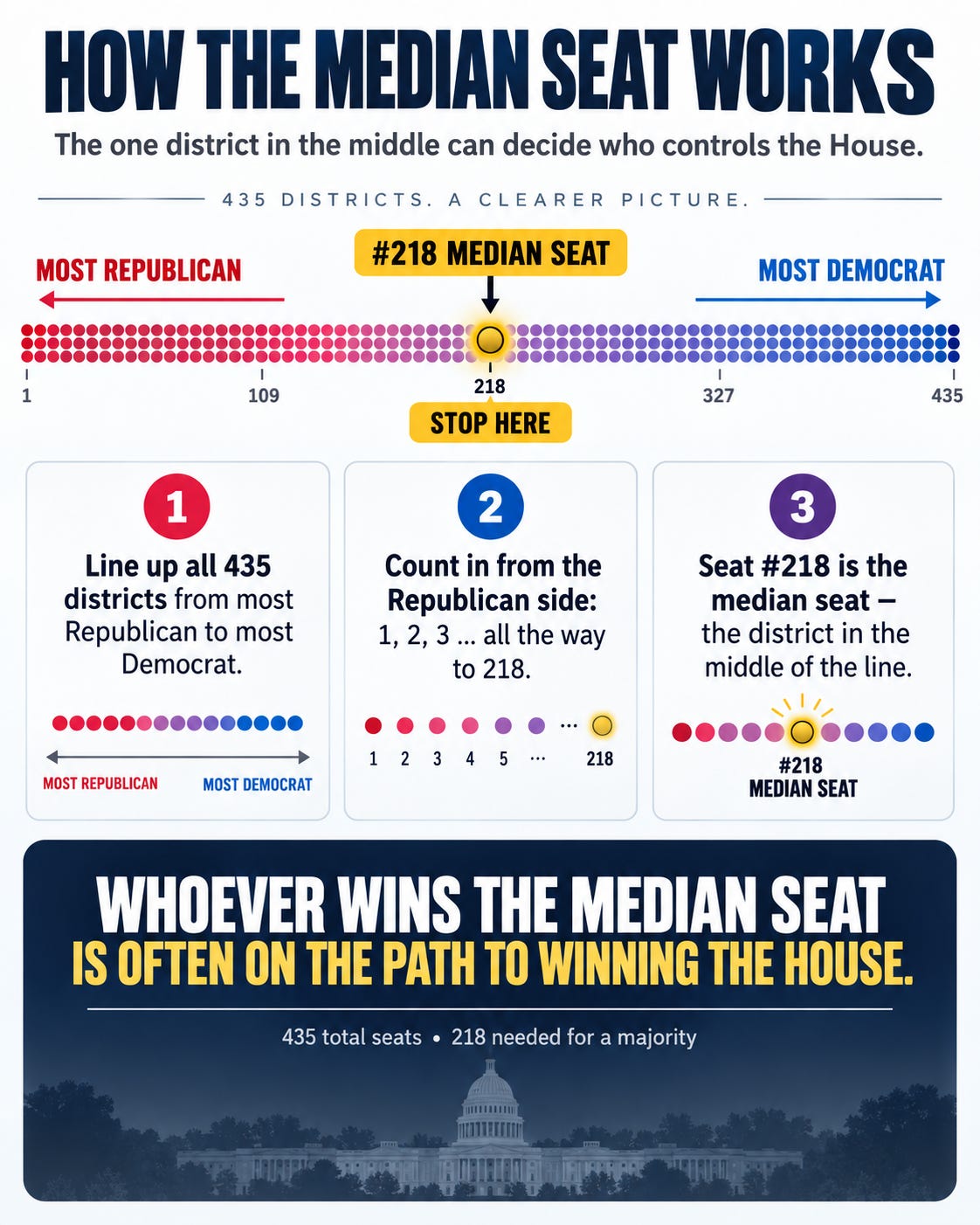
It passed an earlier version in April 2025, then passed the updated SAVE America Act again on February 11, 2026, by a vote of 218 to 213 — with a single Democrat, Rep. Henry Cuellar of Texas, crossing over.
The Senate did what the Senate does. It voted 51 to 48 to begin debate on March 17 — with Sen. Lisa Murkowski voting against even opening debate and Sen. Thom Tillis absent. Then came weeks of floor speeches and marathon sessions, and no law.
In April, Sen. Kennedy tried to fold the bill’s core into a budget package. That failed 48 to 50.
And then came the night that gave away the whole game.
IV. The Night the Majority Won — and Lost Anyway
During the Senate’s overnight “vote-a-rama” on the $70 billion immigration enforcement package in early June, Republicans tried twice.
First, Sen. Lindsey Graham offered an expanded version, loaded with extra provisions the President had demanded — curbs on mail-in voting, a ban on biological men in women’s sports. Four Republicans — Susan Collins, Lisa Murkowski, Mitch McConnell, and Thom Tillis — joined every Democrat. It could not reach fifty.
Then Sen. Mike Lee brought the clean, House-passed version to the floor. No riders. Just citizenship and voter ID.
Susan Collins flipped.
The bill hit fifty votes — with Vice President JD Vance sitting right there as the fifty-first.
Stop and absorb that. A majority of the United States Senate voted yes on the exact bill the House had already passed and the President was waiting to sign. As Lee said the moment it happened, “but for the Zombie Filibuster, the House-passed SAVE America Act would now be on its way to the White House for President Trump’s signature.”
So why isn’t it law? Two reasons, and you must hold them both in your head, because the panel shows will tell you neither.
V. The Two Locks on the Door
The first lock is the filibuster. Even with fifty votes and the Vice President in the chair, the bill was held to a sixty-vote threshold — a number that appears nowhere in the Constitution. It is a Senate tradition, nothing more. And when that tradition stood in the Democrats’ way in 2013, Harry Reid detonated it for judicial nominees without a second thought.
The second lock is one unelected staffer. The Senate parliamentarian, Elizabeth MacDonough — appointed years ago under Harry Reid — ruled that the SAVE Act could not pass through budget reconciliation at a simple majority. Her reasoning: under the chamber’s “Byrd Rule,” reconciliation is reserved for measures with a direct budgetary impact, and voter ID is policy, not budget. Its effect on the federal ledger, she found, was “merely incidental.”
That single ruling slammed the sixty-vote wall back into place. It is the same call she made against the Democrats’ minimum-wage push and amnesty plan in 2021 — so this is not partisanship on her part. But it exposes the absurdity cleanly: the elected majority said yes, and an appointed referee’s reading of a budget technicality is what kept a citizenship-verification bill off the President’s desk.
The President named the problem himself: “As long as she’s there, we will never get our desperately needed SAVE America Act approved… We have every right to change her, and should do so, immediately.” And there is precedent for exactly that — in 2001, Majority Leader Trent Lott replaced the sitting parliamentarian during a reconciliation fight. It has been done before.
So here is the situation in one sentence: the bill has the votes, and it is being held hostage by a tradition and a technicality.
VI. The Constitutional Weapon Has a History
Article II, Section 3 is not decorative. Presidents have used the power to convene Congress throughout American history.
George Washington convened the Senate by proclamation in 1791 and again in 1793. Abraham Lincoln summoned Congress into special session on July 4, 1861, to save the Union. Woodrow Wilson called one in 1917 to bring America into the World War. Franklin Roosevelt’s emergency session of 1933 produced the legislation of his first hundred days. Harry Truman, in 1948, hauled a do-nothing Congress back to town to face the issues it had ducked.
Federalist and Republican, Democrat and Whig — across two centuries, presidents have used this power to make a stalling legislature answer for itself in the open. The tool is old. The occasion is new. The authority is the same.
VII. This Is Accountability, Not Monarchy
Now the professional panic merchants will start.
“Trump is acting like a king!” He would be doing precisely what Washington, Lincoln, Wilson, Roosevelt, and Truman did before him.
“He can’t force the Senate to pass anything!” Correct — and that is the honest part nobody admits. When Truman called Congress back in 1948, it largely ignored him. The convening power guarantees sunlight, not passage. The President cannot dictate the vote. He can only drag the question into the daylight and make every senator own his answer.
That is the whole point. He can make the holdouts — Murkowski, McConnell, and Tillis — explain to the country why a bill with majority support should die in committee silence. He can make Senate Democrats say, on camera, why proof of citizenship to vote is a threat to democracy. He can make the institutionalists defend the parliamentarian out loud.
That is not tyranny. It is accountability — the one thing Washington fears more than any election.
VIII. The Filibuster Cannot Be a Suicide Pact
For years we have been told the Senate is the world’s greatest deliberative body. Fine. Then deliberate — in public, on the record, in front of the people who pay for the chamber.
The dirty secret is that the SAVE Act did not lose on the merits. It won a majority and was stopped by a sixty-vote rule that lets opponents block a popular bill without ever casting a public vote against voter ID. The modern filibuster is a silent veto. It lets a senator kill a bill while never having to defend the killing.
Senator Lee has offered the honest remedy: bring back the talking filibuster. If you want to block the will of the majority, stand on that floor and hold it with your own voice, the way it was done before the silent veto replaced courage with paperwork. Let the country watch you talk a citizenship bill to death. Then let the country decide what it thinks of you.
IX. The Left Understands Power. The Right Asks Permission.
Here is the part the consultants hate.
The Left understands power. They use the courts, the agencies, the bureaucracy, the media. And when the filibuster blocked them in 2013, they nuked it for judicial nominees and never looked back.
The Right too often wins the election and then asks the losers for permission to govern.
That is what Trump upended. He grasped what the consultant class never could: power unused is power surrendered. He has pressed every lever available — leverage on other bills, a face-to-face with the conference, public demands to revive the talking filibuster and to replace the parliamentarian. His House allies ground the floor to a halt rather than move on without the Senate.
That is commitment. But commitment without the constitutional trump card is incomplete. The convening power is the card. He should play it.
X. This Is Bigger Than One Bill
This is not really about one statute. It is about whether citizenship means anything, whether borders mean anything, whether an election is a sacred civic act or just paperwork the permanent class can manage around. It is about whether Republican leaders believe their own speeches.
You cannot call this a constitutional republic while being afraid to use the Constitution. You cannot call a bill your top priority and then let a majority’s yes be erased by a referee’s reading of a budget rule — quietly, with no one forced to answer for it.
This is a test. Not only for Trump. For every senator who claims to understand the hour.
XI. Mr. President — The First Forty-Eight Hours
The authority exists. The precedent is two centuries deep. The votes are already on the board. So here is the concrete ask, not a slogan but a sequence:
Within forty-eight hours, issue the proclamation under Article II, Section 3 convening the Senate. Name the date. Name the reason: a clean, up-or-down floor vote on the House-passed SAVE America Act.
Then keep them there. No recess, no adjournment, no slipping out of town until the vote is taken in the open and every name is recorded.
Then let the country read the roll call. Who stands for citizen-only elections, and who hides behind a sixty-vote tradition and an unelected referee.
The Constitution gives the President this power for extraordinary occasions.
This is one.
Use it.
Research Notes & Factual Addendum
The verified record underpinning this piece:
Claim Verified Fact House passage, Feb. 11, 2026 218–213; one Democrat (Cuellar, TX) voted yes Senate vote to begin debate, Mar. 17 51–48; Murkowski voted no; Tillis absent Kennedy reconciliation amendment (April) Failed 48–50 Graham expanded amendment (June vote-a-rama) Failed; could not reach 50 (Collins, Murkowski, McConnell, Tillis opposed) Lee clean House-passed version (June vote-a-rama) Reached 50 — Collins flipped yes; Vance available as 51st; blocked by 60-vote bar Why 50 wasn’t enough Parliamentarian MacDonough ruled SAVE Act violates the Byrd Rule — voter ID is “policy, not budget,” budgetary impact “merely incidental” — so it can’t ride reconciliation at a simple majority Lee quote “but for the Zombie Filibuster, the House-passed SAVE America Act would now be on its way to the White House for President Trump’s signature” Trump on the parliamentarian “We have every right to change her, and should do so, immediately… As long as she’s there, we will never get our desperately needed SAVE America Act approved” Precedent for replacing a parliamentarian Majority Leader Trent Lott removed parliamentarian Robert Dove during a 2001 reconciliation fight Reid precedent Senate Democrats eliminated the filibuster for judicial nominees in 2013 Article II, Sec. 3 history Used by presidents across two centuries — Washington (1791, 1793), Lincoln (1861), Wilson (1917), FDR (1933), Truman (1948)
Professor Toto | TOTO FREE PRESS — Tomorrow’s News Today MAN BEHIND THE MIC | Coming to you from the heart of TOTO-TOWN, where we do not bring you the news — we bring you the truth.