

By Professor Toto | TOTO FREE PRESS — “Tomorrow’s News Today
”
“For ninety-one years, the people you never voted for could defy the President you did vote for — and he could not fire them for it. As of today, that shield is broken.”
I. I Told You This Day Was Coming
Two years ago, from this very microphone, Professor Toto gave you a lesson the cable networks would never teach.
I told you that America was no longer governed only by the three branches you learned about in school. I told you a fourth branch had quietly grown up in the gaps — a sprawling government of bureaus and boards and commissions that write rules with the force of law, prosecute you for breaking them, and then sit in judgment of you when you fight back. Lawmaker, police, and judge, all in one office. And here was the part that should have kept you up at night:
You could not vote them out. And the President you did vote for could not fire them.
I called it government without a steering wheel. The lawyers had a fancier name for it. The Solicitor General of the United States stood before the Court and called it the “headless fourth branch” — a phrase that has haunted American government since a 1937 presidential commission first warned of a fourth branch “responsible to no one.”
Today — June 29, 2026 — the Supreme Court of the United States walked up to that headless branch and handed it back its accountability.
Remember where you heard it first.
II. What the Court Actually Did
In a case called Trump v. Slaughter, decided this morning by a vote of 6 to 3, the Supreme Court overruled a 1935 decision called Humphrey’s Executor v. United States.
If that name means nothing to you, good — that is the point. The most important chains on the American presidency for nearly a century were forged in a case almost no citizen had ever heard of.
Here is the plain-English version.
Back in 1935, the Court ruled — and here is the part worth holding onto, unanimously, all nine justices — that Congress could build agencies whose leaders the President was forbidden to fire, except in narrow cases of “inefficiency, neglect of duty, or malfeasance in office.” In practice that meant a commissioner could defy the elected President openly, push an agenda the voters rejected at the ballot box, and sit untouchable in the chair for years.
That is exactly what happened here. President Trump removed Federal Trade Commissioner Rebecca Slaughter in March 2025, saying her continued service was “inconsistent with [the] Administration’s priorities.” She sued, waving the 1935 precedent like a shield, and a federal court ordered her reinstated.
And today the Chief Justice of the United States took the shield away. The ruling flips the default: where the law once said the President needed cause to remove these commissioners, the Constitution now says they serve at his pleasure — at-will, like the rest of his executive officers. In the words of the majority opinion: “If anything more is left of Humphrey’s, we overrule it.”
There is no softer way to read that sentence. Ninety-one years of precedent — gone in eight words.
And notice the contrast that ninety-one years buys you. In 1935, every justice on the Court — liberal and conservative alike — believed this protection was constitutional. Roberts had tipped his hand back at the December argument, calling the old precedent “just a dried husk of whatever people used to think it was.” Today the husk was swept away.
III. The Reasoning Is Older Than the Precedent It Buried
Here is what the panel shows will not tell you tonight: the Court did not invent a new power. It restored an old one — one older than the 1935 case it overruled.
Chief Justice Roberts reached past the New Deal and put his hand on the Founding itself. He quoted the Constitution’s very first words on the subject: “The executive Power” shall be vested in “a President of the United States of America.”
Not a committee. Not a commission. Not a board of unelected experts insulated from the people. One person. One office. One name on the ballot the voters can reward or punish.
Roberts reminded the country that the Framers debated putting a plurality in the executive — a council, a committee — and rejected it. At the Constitutional Convention, Edmund Randolph fought for a multi-person executive; James Wilson argued that unity was the better safeguard against tyranny, because a divided executive would only “conceal faults and destroy responsibility.” Wilson won. The Founders chose accountability over diffusion — one set of hands on the wheel, precisely so the people would always know whom to blame.
And Roberts drew the line straight from that choice to this ruling, in the Court’s own words: “Subordinates who exercise the President’s power are subject to removal by him. Then, and only then, can they remain accountable to the President, and the President to the people.”
That is the heart of it. Accountability requires a name and a face. When power is smeared across a hundred unelected commissioners, no one is ever responsible — and a government where no one is responsible is a government the people cannot control.
IV. Why This Is the Story of the Year
Understand the scale of what changed today.
This ruling does not stop at the FTC. Legal analysts say it reaches roughly two dozen multimember agencies across the federal government. And these are not abstractions — these are the bodies whose names you already know: the National Labor Relations Board, the Consumer Product Safety Commission, the Federal Communications Commission, the Securities and Exchange Commission, the Federal Energy Regulatory Commission, the Nuclear Regulatory Commission. The bodies that regulate labor disputes, product recalls, broadcast licenses, the stock market, the power grid, and the reactors. For ninety-one years their leaders answered to no one a voter could reach.
As of today, the old shield is broken. Any agency head wielding executive power now has to explain why he should not answer to the President of the United States — and the President answers to you.
That is not a power grab. That is a power return. The authority did not appear out of thin air; it came home to the office the Constitution always assigned it to, and through that office, to the people who fill it every four years.
And understand — the Court did not leap here in a single bound. It walked a deliberate road. In 2020, Seila Law v. CFPB cracked the removal shield on a single-director agency. In 2021, Collins v. Yellen did the same at the Federal Housing Finance Agency. Today’s ruling is the capstone that finishes the job for the multi-member agencies the earlier cases left standing. Six years of patient, brick-by-brick constitutional work — and today the wall came down.
V. They Owned the Drain
Now let me say the thing out loud that every frustrated voter has felt for a decade.
For years you were promised a man who would go to Washington and drain the swamp. And for years it seemed like nothing moved. The same faces. The same agencies. The same unaccountable bureaucrats surviving administration after administration like they had a lease the voters could never break.
Here is the secret nobody put on a bumper sticker:
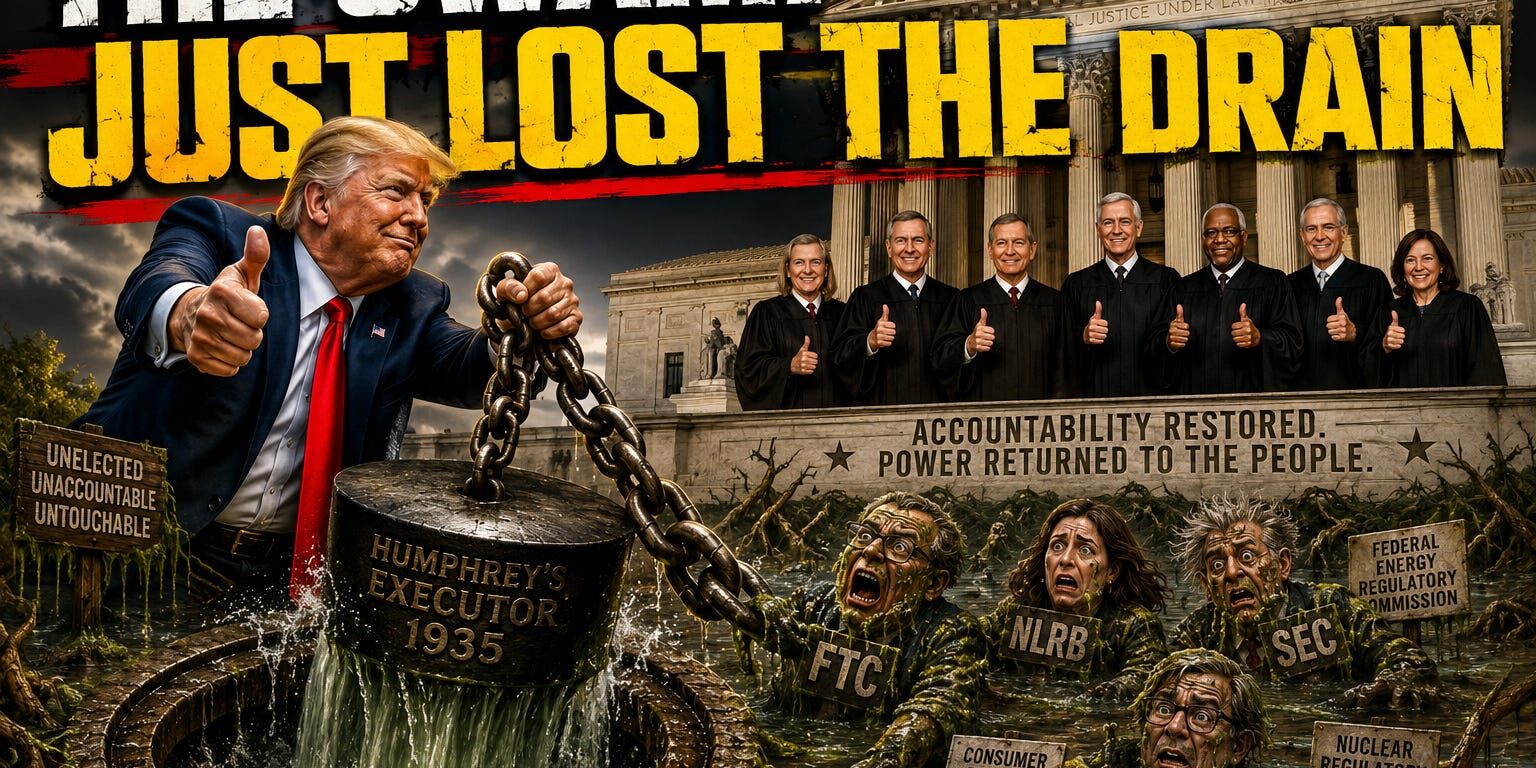
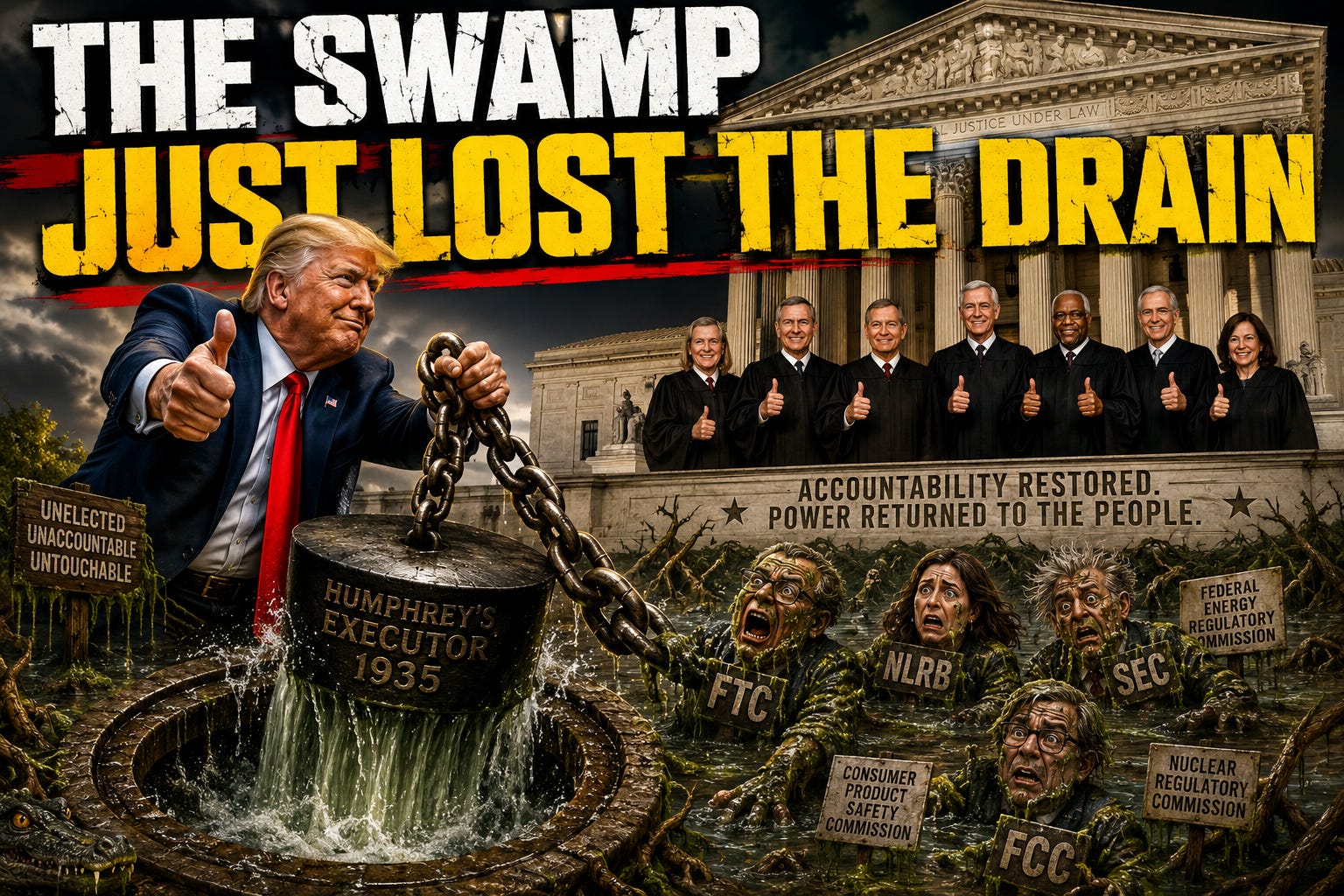
Donald Trump couldn’t drain the swamp if he wanted to — because the swamp owned the drain.
Think about what Humphrey’s Executor actually did for ninety-one years. It did not just protect a few commissioners. It welded the plug into the basin. It told every elected President: you may have won the country, you may carry the mandate of a hundred and fifty million voters, but these offices are not yours to empty. The water stays. The plug stays. And the hand on the plug belongs to people no ballot can ever reach.
You cannot drain a swamp when the people you elected don’t control the drain. That is not a slogan — that is engineering. It does not matter how strong the man at the pump is if someone else controls the valve. For nearly a century the valve was locked shut by a single 1935 case, and no amount of campaign promises could turn it.
Today the Supreme Court cut the lock.
The President didn’t seize the drain. The Court handed it back to the office the voters actually control — which means it handed it back to you. Whether the swamp gets drained now is a political question, and you can argue about it. But for the first time in ninety-one years, the man you elect actually holds the plug.
The drain has an owner again. And for once, it’s the one you voted for.
VI. Now — The Honest Counterargument
I promised you Professor Toto’s lessons would always give you the whole board, not just my side of it. So here is the strongest case the other side is making, stated fairly.
Three justices dissented — Sotomayor, Kagan, and Jackson — and Justice Sotomayor was angry enough to read her dissent aloud from the bench, which justices almost never do. Her warning deserves to be heard and weighed. She wrote that the ruling gives the President “a power unknown even to the English Crown against which the Founders revolted,” transforming the duty to take care that the laws be faithfully executed into, in her words, a “license to act in defiance of those very laws.” The fear is real and worth naming — that an independent referee at the FTC or the labor board keeps decisions grounded in expertise and law rather than the whim of whoever holds the White House, and that without that buffer, every agency becomes a political weapon that changes hands every four years.
That is a serious argument, and an honest broadcast does not pretend otherwise.
But here is Professor Toto’s answer to it.
An “independent” referee who answers to no voter is not neutral — he is simply unaccountable. The dissent calls it expertise; the Constitution calls it executive power, and executive power in a republic must trace back to the consent of the governed. The cure for a president who abuses agencies is the same cure the Framers built for every other abuse: the next election. The cure for an unelected commissioner who abuses his office was — until today — nothing at all. Between a power the people can vote out and a power they cannot touch, the republic chooses the ballot every time.
And note what this ruling does not touch. It reaches only the presidentially appointed, Senate-confirmed leaders at the top of these agencies. The Senate still confirms them. Staggered terms still slow how fast any president can remake a commission. And the civil-service protections for the thousands of career employees who actually run these agencies day to day are untouched. The fear of an overnight purge of the entire government makes for a dramatic dissent, but the structure the Founders built still stands between the President and that outcome.
VII. The Fed Footnote — Don’t Miss It
One more piece, because it matters and the headlines are blurring it.
On the very same day, in a companion case called Trump v. Cook, the Court declined — by a narrower 5 to 4, with the three liberal justices joining Roberts and Kavanaugh — to let the President remove Federal Reserve Governor Lisa Cook. The Court held that Trump had not properly given Cook the chance to answer the allegations against her before firing her, and it flagged the Federal Reserve as holding a potentially constitutionally distinct status, rooted in the long American tradition of a central bank insulated from day-to-day political control.
So no, this is not a blank check. The Court drew a line: the central bank stays walled off, for now.
But be honest with the audience about what that line is. The Cook ruling was procedural, not final. The Court did not say the President can never remove a Fed governor — it said he didn’t do it the right way this time. The deeper question is still open, and the President has already signaled he intends to come back at it. That fight is not over; it’s postponed.
And here’s the tell that this was a real court and not a rubber stamp: only Roberts and Kavanaugh sat in the majority of both cases. The other four conservatives — Thomas, Alito, Gorsuch, and Barrett — would have let Trump fire Cook too. The Federal Reserve’s independence was preserved by two votes from the center of the Court. That is not a king’s court. That is nine human beings drawing hard lines in real time, and leaving the hardest one for another day.
VIII. And Now You Know… The Rest of the Story
In 2024, Professor Toto told a faithful audience that the greatest threat to self-government in America was not a party or a politician. It was a structure — a permanent, unelected government that wrote the rules of your life while standing forever out of your reach.
Today the Supreme Court of the United States looked at that structure and ruled that in a republic, executive power must answer to the people through the one office they elect.
The headless branch has its head back. The wheel has hands on it again. And the question of who steers America is, once more, a question the voters get to answer.
That is the whole story. That is the best of the story.
And now you know it.
Research Notes & Factual Addendum
The verified record underpinning this piece, as of June 29, 2026:
Claim Verified Fact The case & vote Trump v. Slaughter, No. 25-332, decided 6–3, June 29, 2026; Roberts wrote the majority (Alito, Gorsuch, Kavanaugh, Barrett joined; Thomas joined all but Part III-B) What it did Formally overruled Humphrey’s Executor v. United States (1935) Roberts’ key line “If anything more is left of Humphrey’s, we overrule it.” 1935 ruling was unanimous All nine justices joined in 1935 The 1935 standard FTC commissioners removable only for “inefficiency, neglect of duty, or malfeasance in office” The firing at issue Trump removed FTC Commissioner Slaughter in March 2025; called her service “inconsistent with [the] Administration’s priorities” — not a statutory cause Roberts “dried husk” Said at oral argument, Dec. 8, 2025 Constitutional basis Article II vests “the executive Power” in “a President”; executive officers must be removable by him Roberts accountability quote “Subordinates who exercise the President’s power are subject to removal by him. Then, and only then, can they remain accountable to the President, and the President to the people.” Scope ~two dozen multimember agencies (NLRB, CPSC, FCC, SEC, FERC, NRC, etc.) Stairway cases Seila Law v. CFPB (2020) and Collins v. Yellen (2021) narrowed Humphrey’s before today’s full overrule The dissent Sotomayor, Kagan, Jackson; Sotomayor read hers from the bench Sotomayor’s actual words “a power unknown even to the English Crown against which the Founders revolted, elevating him above his once-coequal branches by transforming a duty to take care that the laws be faithfully executed into a license to act in defiance of those very laws”; “a President who emerges with far greater power than ever before” “Headless fourth branch” Phrase used by Solicitor General D. John Sauer at argument; traces to a 1937 presidential commission report Companion case Trump v. Cook, 5–4 — Court declined to allow removal of Fed Governor Lisa Cook; Fed treated as constitutionally distinct Cook basis Procedural — Trump had not given Cook proper opportunity to respond; deeper “for cause” question left open Both-majority justices Only Roberts and Kavanaugh were in the majority in both Slaughter and Cook
Professor Toto | TOTO FREE PRESS — Tomorrow’s News Today MAN BEHIND THE MIC | Coming to you from the heart of TOTO-TOWN, where we do not bring you the news — we bring you the truth.