



There is a hill in the Judean Shephelah that nobody wanted.
The nineteenth-century surveyors walked right past it. When Wilson, Conder and Kitchener mapped western Palestine for the Palestine Exploration Fund, they came to this ridge above the Valley of Elah, looked at it, and wrote down three words: heaps of stones.
Heaps of stones. That was the whole report. They moved on.
For over a century that hill sat under the sun with its Arabic name — Khirbet Qeiyafa — and nobody thought it was worth a shovel. Meanwhile, in the lecture halls of Europe and America, a different kind of digging was underway. They were excavating the Scriptures, and they announced they had found nothing.
No united monarchy. No King David worth the name. A tribal chieftain at best — a hill-country warlord with a few hundred men, no capital, no scribes, no administration, no fortified cities. The Bible’s account of a kingdom in the tenth century before the Messiah was, in their word, mythological.
A comfort story. A myth a beaten people told themselves in captivity, about kings they never had and a kingdom that never was — because a nation with nothing left will invent a past to survive the present.
That was the charge. David was Judah’s King Arthur.
They did not whisper it. They put it in the textbooks. They put it in the documentaries. They handed it to our sons and daughters in their first year of college, and some of those children never came home to the faith again.
Then in 2007, Yosef Garfinkel of Hebrew University and Saar Ganor of the Israel Antiquities Authority put a trowel into that heap of stones.
What Came Out of the Ground
Not a village. A city.
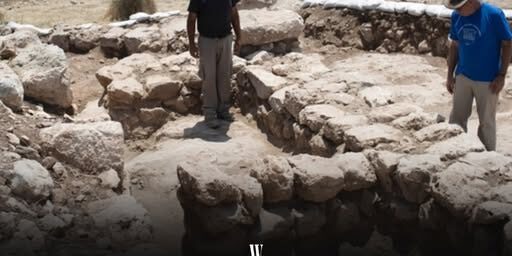
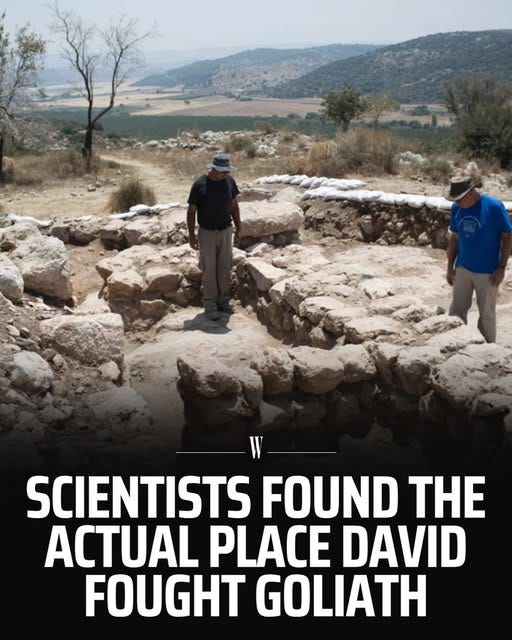
A casemate wall runs seven hundred meters around that summit, still standing two and three meters high, built from stones so massive that some of them weigh several tons. Men did not stack those by accident. That wall is engineering. That wall is a treasury, a labor force, a chain of command, and somebody with authority saying build it here.
Everything the minimalists said tenth-century Judah could not produce is sitting on that ridge in cut stone.
And here is the mercy of it: that hill has almost no history. Most ancient mounds in that land are layer cakes — Megiddo has twenty-six occupation levels stacked one on another, each one muddying the last, every dating argument a swamp. Khirbet Qeiyafa has essentially one. One city. One brief life. One destruction. Everything you lift out of that dirt comes from the same moment.
So there was no hiding behind the layers. The only question left was when.
They pulled charred olive pits from the destruction layer — short-lived samples, the gold standard, no guesswork about old wood. They sent them to Oxford. They sent them to Belfast. Seventeen samples in the second dating project alone.
1020 to 980 BC.
Not near the time of David. The time of David.
The Word That Was Waiting Three Thousand Years
The western gate came up first — monumental, four-chambered, opening toward the Philistine coast. Impressive, but every walled city had a gate.
Then they found the second one.
Understand why that stopped them cold. In fortress architecture the gate is the wound. It is the one place in the wall where the wall is not a wall. Every gate you cut is a second front you have to bleed to defend. Which is why in the entire archaeological record of Israel and Judah — every excavated city, every season, every dig — no other site has ever been found with two. Not one. Khirbet Qeiyafa stands alone in the record.
Now open your Bible.
There is a city named three times in Scripture. Joshua 15:36. First Chronicles 4:31. And in the middle of the most famous battle in the Hebrew Scriptures. The King James spells it Shaaraim. In Hebrew it is שַׁעֲרַיִם — Sha’arayim.
That is not a name. It is a description. Sha’ar is the Hebrew word for gate. And that ending is not the plural — it is the Hebrew dual, a form the language reserves for things that come in natural pairs. Eyes. Hands. Ears.
Sha’arayim does not mean gates.
It means two gates.
And when does the text drop that name? Read where it falls:
“And the men of Israel and of Judah arose, and shouted, and pursued the Philistines, until thou come to the valley, and to the gates of Ekron. And the wounded of the Philistines fell down by the way to Shaaraim, even unto Gath, and unto Ekron.” — 1 Samuel 17:52
That is the verse immediately after the giant hits the ground.
So the Book says: there was a city called Two Gates, above the Elah Valley, in the days of David, and the Philistines died running past it.
And the ground says: there is a city with two gates, above the Elah Valley, carbon-dated to the days of David, and it is the only one of its kind ever found.
The men who wrote heaps of stones in their notebook were standing on Sha’arayim and did not know it.
And They Could Write
The second leg of the argument was literacy. Even grant a David, they said — tenth-century Judah could not write. No scribes. No records. Therefore the biblical narrative had to be composed centuries later, out of nothing, by men with no source but their own imagination.
In 2008, in a room beside that western gate, they lifted out a piece of a broken storage jar the size of a man’s hand.
Five lines of ink. Roughly fifty-nine letters. At the hour of its discovery, the longest inscription of its kind ever recovered.
Somebody in that city, three thousand years ago, sat down and wrote.
Now watch the argument change. Nobody today disputes that there is writing on that sherd. What they dispute is what it says — the ink is worn, and the readings conflict. So the same scholars who told us those people were illiterate now spend their conferences arguing over how to translate them.
Read that again. They are fighting over the translation of a text written by men they said could not write.
The debate itself is the verdict.
Now Watch the Retreat
They did not concede. Men who have built a career on a proposition rarely do. Finkelstein and Fantalkin published a rebuttal in 2012 calling the excavation hasty, the reconstruction overreaching, the population uncertain. Perhaps Judahites, they allow — or late Canaanites of the lowlands, or Canaanite-Philistines from the coast. The finds, they say, do not settle it.
Do not let that pass you by. Look hard at what they are now arguing.
For thirty years the claim was not we’re unsure who lived there. The claim was that nobody did. No fortified city. No monumental construction. No writing. No administration. Nothing on that ridge but scattered farmers and a folk memory, because a kingdom in tenth-century Judah was a fiction.
That claim required the ground to stay empty.
The ground did not stay empty.
So the argument has moved — quietly, without apology, and without one word of correction to the students who were failed for saying otherwise. It went from there was no city to we’re not certain whose city it was. From they could not write to we can’t agree what they wrote.
That is not a rebuttal. That is a retreat with the flags still flying.
They are not defending the position they taught. They are defending the last strip of ground they have left, and they are calling it the same war.
We Never Needed the Shovel
Now hear me, because this is where the world misunderstands us entirely.
Not one believer reading this is saved a degree more securely tonight than he was last night. My faith was never sitting on a ridge in the Shephelah waiting for Garfinkel to validate it. I believed before the dig. I would believe if that hill had never been touched. Blessed are they that have not seen, and yet have believed.
We did not need the evidence.
He sent it anyway.
Not because YAHWEH is anxious. Not because He owes the academy a defense. He let them build their case for thirty years. He let them fill the syllabi and take the lecterns and grade the papers. He let the stones sit quietly in the sun through every year of it — while the surveyors walked past in the 1870s, while the twentieth century came and went and nobody came, while the mythological paradigm was being constructed in air-conditioned offices four thousand miles from the dirt that refuted it.
It was never lost. It was only unexcavated.
And then in His own season, in His own hour, on nobody’s schedule but His, He let one man with a trowel turn over one spade of ground — and the whole edifice came down.
The same way a boy came down into that valley with a sling and five smooth stones, while the professionals stood on the hillside in their armor explaining why it could not be done.
Three thousand years, and that valley is still teaching the same lesson to the same kind of men.
The Charge
There is a spirit in this hour that says hold your tongue. The experts have settled it. You are on the wrong side of the consensus and every year you hold on you look more foolish.
Fix this in your mind and do not let go of it.
Every accusation ever brought against the Word of YAHWEH has an expiration date. His Word does not.
You will not always live to see the vindication. Sometimes the stones stay covered a hundred and thirty years. That is not abandonment — that is timing, and the timing belongs to Him, not to them, and not to you.
So stand. Stand when the culture is certain and you are outnumbered. Stand when you cannot answer every objection and the honest answer is not yet. Stand the way David stood in that valley when the whole trained army of Israel had already run the numbers and concluded it was impossible.
Because sooner or later, in this age or the age to come, every heap of stones is going to be turned over.
And when the last one is, the Word of YAHWEH will be standing exactly where it has always stood.
Right there in the valley. Between two gates.
“The grass withereth, the flower fadeth: but the word of our God shall stand for ever.” — Isaiah 40:8
Rev. John Shane Vaughn
Founding Apostolic Overseer, First Harvest Ministries International.
Sources
-
Garfinkel, Y., Ganor, S., and Hasel, M. G., “Khirbet Qeiyafa: Sha’arayim,” Journal of Hebrew Scriptures (2009)
-
Garfinkel, Ganor and Silver, “Rejected! Qeiyafa’s Unlikely Second Gate,” Biblical Archaeology Review, Jan/Feb 2017
-
“King David’s City at Khirbet Qeiyafa: Results of the Second Radiocarbon Dating Project,” Radiocarbon
-
Finkelstein, I. and Fantalkin, A., “Khirbet Qeiyafa: An Unsensational Archaeological and Historical Interpretation,” Tel Aviv 39 (2012)
-
Misgav, H., Garfinkel, Y., and Ganor, S., “The Ostracon,” in Khirbet Qeiyafa Vol. 1 (Israel Exploration Society, 2009)