

TOTO FREE PRESS — Tomorrow’s News Today From Toto-Town, on the Gulf Coast of Mississippi
I. WHEN A MAN’S WORD WAS HIS BOND
There was a time in this Republic when a man’s word was his bond.
Our system of elections was born among men who spoke freely of honor, duty, fidelity, and sacred obligation. They understood something that our generation has nearly forgotten — that liberty can survive only so long as the character of the people is strong enough to sustain it.
To those generations, a vote was not merely a mark upon a piece of paper.
It was the voice of a citizen in the affairs of his Republic. It was a sacred trust — purchased by sacrifice, protected by law, and guarded by the honor of free men.
And so they built much of our system upon a thing we possess in far shorter supply today.
Trust.
Write that word down. TRUST. Because everything that follows in this letter hangs upon it.
I believe reasonable Americans on both sides of the political aisle can acknowledge this much — and I am asking my friends across the aisle to acknowledge it with me:
We no longer live in that world.
We live in an age of forged documents. Stolen identities. Artificial intelligence that can manufacture a face, a voice, a signature, a life. Sophisticated fraud. Institutional distrust running in every direction at once. A culture in which a deception can travel around the world before the truth has got its boots on.
Yesterday’s system was built for yesterday’s society.
And yesterday is gone.
II. THE PRINCIPLE
Therefore — and follow me closely, because this is the whole argument in a single sentence —
It is not extreme to demand verification. It is irresponsible not to.
When trust diminishes, verification must increase.
When dishonor becomes common, safeguards must become stronger.
When citizens begin doubting whether their own elections can be trusted, government has a solemn obligation to remove every reasonable cause for that doubt.
No honest citizen should fear verification.
No legitimate voter should fear proving that he or she is legally entitled to cast a ballot.
And no political party — not one, not either, not ANY — should desire a system in which uncertainty hangs over the most consequential act of citizenship we possess.
This is larger than Republican.
It is larger than Democrat.
It is larger than the next election.
This is about whether the American experiment will still command the confidence of our grandchildren.
III. NOW LET ME SHOW YOU THE BOARD
I do not ask you to take my word for anything. I am the Connoisseur of Common Sense, not the Curator of Convenient Facts. So here is the whole board — the good, the hard, and the honest.
Where the bill actually stands, as of this hour
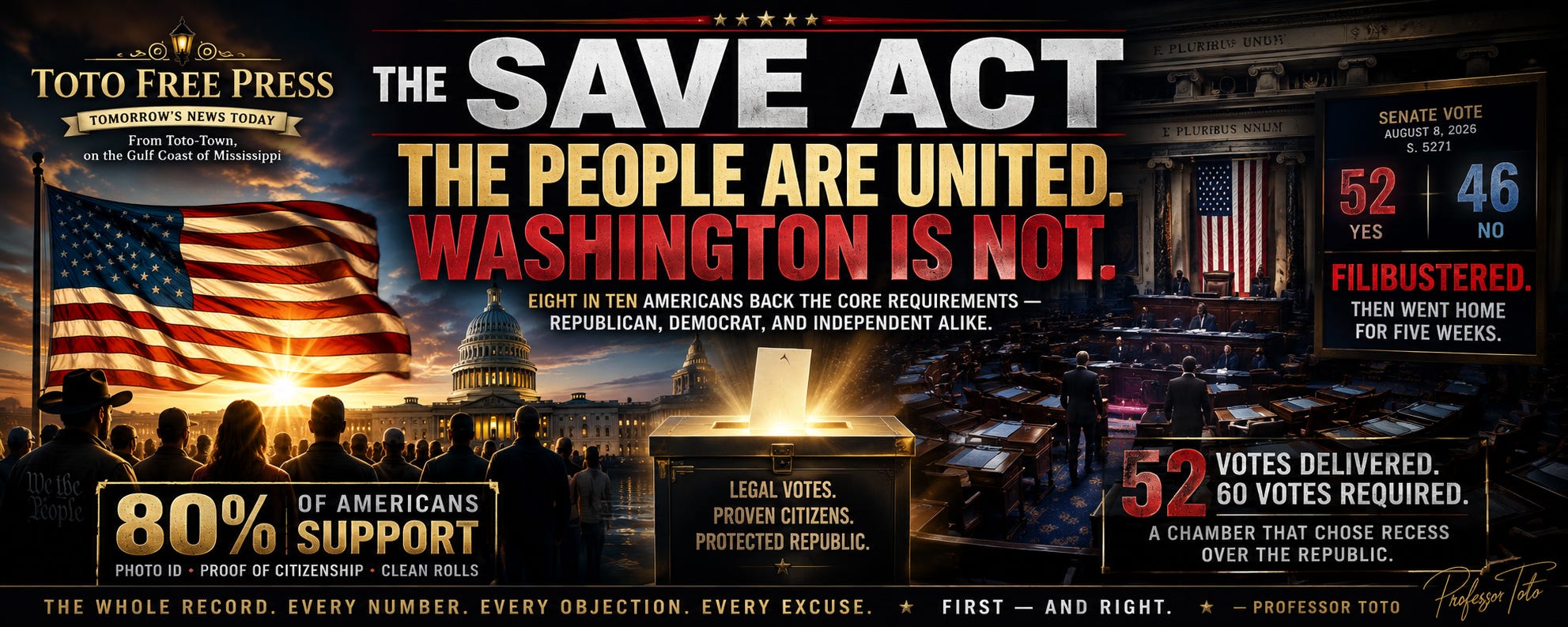
The Safeguard American Voter Eligibility Act — the SAVE Act, now carried under the name the SAVE America Act — passed the United States House of Representatives on February 11, 2026, by a vote of 218 to 213 — Roll Call 69. Every Republican voting backed it. Exactly ONE Democrat crossed over: Henry Cuellar of Texas, who represents a border district and who has broken with his party on border questions before. One. Out of two hundred and thirteen. Hold that number, because I am going to hand it back to you in a moment. It was not the first time. A prior version cleared the House in April of 2025 and then sat in the Senate for the better part of a year, gathering dust while nearly thirty members of the Republican Study Committee demanded a vote that never came.
On March 17, 2026, the Senate voted 51 to 48 merely to begin debate. Not to pass it. To TALK about it. Senator Lisa Murkowski of Alaska was the only Republican to vote against even opening the conversation.
On March 26, a narrower amendment from Senator Jon Husted of Ohio — establishing a photo identification requirement — failed to get cloture, 53 to 47. Sixty were needed.
In July, House Republicans grew impatient and began strapping the bill to must-pass vehicles — the State Department funding bill on the fifteenth, the National Defense Authorization Act on the twenty-second.
And then came the first week of August. President Trump demanded the Senate cancel its recess until the bill passed. Senate conservatives — Johnson, Lee, Scott — pushed to stay in Washington. Senator Ashley Moody of Florida put it plainly: <cite index=”45-1”>the chamber should not leave the capital without a vote on election integrity — period.</cite>
They got their vote. On the overnight of August 8, 2026, the Senate took up S. 5271 — a standalone photo identification bill.
It failed 52 to 46. Roll Call Vote Number 231.
Every senator voting yes was a Republican. Every Senate Democrat voted no.
And then the Senate went home for a five-week recess.
That is where the matter sits as of this writing. Not defeated on the merits. Filibustered. Sixty votes required, fifty-two delivered, and a chamber that adjourned rather than argue it out.
What the bill actually does — and does NOT do
I want you to be the best-informed person in any room you walk into, so let me correct some things you have heard from BOTH directions.
No — you would not have to re-register. There is no provision in this bill requiring currently registered voters to prove citizenship all over again. If you are on the rolls, you stay on the rolls. But understand the fine print honestly: if you move, or you change your name, or you otherwise conduct what election administrators call a registration transaction — then yes, documentary proof would be required at that point.
The words that carry the most freight are “IN PERSON.” And this is the provision that gets the least attention and deserves the most. Documentary proof must generally be presented in person to an election official — even if you are registering by mail. Understand what that does downstream. It would functionally end most online registration. It would gut the automatic and “motor voter” registration pathways that many states now run through their motor vehicle bureaus. County election offices would absorb a volume of in-person transactions they are not staffed for. That is not a partisan objection. That is an ADMINISTRATIVE reality, and any honest advocate of this bill has to plan for it rather than pretend it away.
The acceptable documents.
-
A United States passport standing alone.
-
Or a certified birth certificate paired with a government-issued photo ID.
-
Or a REAL ID license that indicates citizenship — available in only five states.
-
Or a military ID with a service record showing U.S. birth.
-
Or a naturalization certificate, a consular report of birth abroad, an adoption decree, a hospital birth record,
-
or an American Indian card carrying the citizenship classification.
The name-change question. The bill directs states to establish a process for applicants whose documents carry a former name — either additional documentation, or a signed affidavit.
Representative Chip Roy of Texas, the bill’s author, has called the alarm over married women “absurd armchair speculation” and points to that provision. Critics answer that the bill does not specify what that process must look like, leaving fifty states to invent fifty different answers — and they point to an estimate that as many as 69 million American women hold birth certificates that no longer match their legal name. Both of those things are true at the same time. That is not a contradiction. That is a drafting question — and drafting questions get FIXED in conference, not used as an excuse to kill a principle.
The photo ID piece is new this year. In-person voters would present a valid physical photo ID; mail voters would send a copy. A voter without ID at the polls could cast a provisional ballot and produce identification within three days — or sign an affidavit of religious objection to being photographed. Mail voters lacking a copy could submit the last four of their Social Security number with an affidavit.
The rolls provision. States would be required to run their voter lists against the Department of Homeland Security’s SAVE database and remove noncitizens — after notice, and after an opportunity to produce proof.
The enforcement teeth — and there are two sets. The bill creates criminal penalties for election officials who register someone without the required documentation. And it goes further: it establishes a private right of action, meaning any private citizen may sue an election official who registers a voter without documentary proof.
Mark both of those. I am coming back for them.
IV. THE PEOPLE HAVE ALREADY VOTED ON THIS
Now let me hand you the receipts, Class — because on this question, the American people are not divided. Washington is.
-
Gallup, October 2024 — 84% of adults supported requiring photo identification at the polling place; 83% supported requiring first-time registrants to prove citizenship. About two-thirds of Democrats backed both. More than eight in ten independents. Nearly every Republican.
-
Pew Research Center, August 2025 — 83% favored government-issued photo ID before voting, including 71% of Democrats.
-
Harvard CAPS/Harris, February 2026 — 71% of registered voters supported the SAVE America Act itself: 91% of Republicans, 69% of independents, and 50% of Democrats. Broken into its parts, support climbed higher still — 75% for proof of citizenship, 81% for voter ID, 80% for removing noncitizens from the rolls.
-
Fox News, July 17–20, 2026 — 83% favored photo ID to register, 77% to cast a ballot. Fox has measured this question since 2011 and it has never dropped below 77%.
-
Rasmussen, August 2026 — 62% of likely voters favored the SAVE America Act, with support for citizens-only voting reaching 89% of Republicans, 77% of Democrats, and 79% of independents.
Now hold on. I said I would show you the WHOLE board — and a man who only shows you the half that flatters him is not teaching you. He is recruiting you.
So here is the other half.
An Economist/YouGov survey in March of 2026 found Democrats opposed a proof-of-citizenship requirement, 35% for and 53% against — a very different picture from the Gallup and Rasmussen numbers. And in California, a poll found 71% overall supported proving citizenship at registration, but support collapsed to 54% for proving it every time you vote, with about 60% of Democrats opposed.
And David Becker of the Center for Election Innovation & Research made a point I think is fair and worth your consideration: ask people whether they support voter ID and vast majorities say yes. Ask them whether eligible voters who lack an ID should be turned away, and the numbers move considerably.
He is right. And that is not a defeat for our argument. That is the assignment.
Because it tells you exactly what a bill has to do to earn the confidence of the whole country: verify eligibility and make certain the eligible can comply. Those are not competing goals. Anybody who tells you they are is selling you something.
V. THE HARDEST OBJECTIONS — STATED HONESTLY, THEN ANSWERED
Now I am going to do something you almost never see on cable television. I am going to make my opponents’ argument better than they usually make it themselves — and then I am going to answer it.
Objection One: “Noncitizen voting is vanishingly rare.”
This is the strongest card in the deck. So let us play it all the way out.
The Bipartisan Policy Center examined a fraud database compiled by the conservative Heritage Foundation and found 77 instances of noncitizen voting between 1999 and 2023. Georgia election officials reported in October 2024 that 20 individuals out of 8.2 million on the state’s rolls were not citizens, and that 9 had voted in prior elections. Ohio’s Secretary of State identified 137 people on the rolls who had twice told the motor vehicle bureau they were not citizens. A Georgia review covering 1997 to 2022 found 1,634 registration attempts that could not be verified as citizens — and none of them had voted. Walter Olson of the Cato Institute states the conclusion directly: the numbers are extremely low, and not high enough to have changed the party outcome of any recent federal election.
Now Class, watch what I do with that.
I do not dispute it. I accept it. And I want you to understand that accepting it makes our case stronger, not weaker.
Because if the rate of noncitizen voting is genuinely that small — then verification costs the opposition almost nothing and buys the Republic almost everything.
You cannot stand up and say “this problem is so tiny it isn’t worth verifying” and then in the very next breath say “verifying it would disenfranchise millions.” Those two sentences cannot both be true. One of them has to give.
And here is the deeper point, the one I want carved into the doorpost of every argument you have this year:
The SAVE Act is not primarily a fraud bill. It is a CONFIDENCE bill.
Fraud is the symptom. Doubt is the disease. And doubt does not require fraud to be lethal. Doubt only requires the plausibility of fraud in a system nobody can independently verify. That is precisely the condition we now live in — and it is why tens of millions of Americans on the left were certain in 2016 that the thing was rigged, and tens of millions on the right were certain in 2020 that the thing was rigged, and neither side could be conclusively answered. Not because the evidence was hidden. Because the SYSTEM was never built to produce an answer that a skeptic would accept.
A system that cannot be verified cannot be defended. And a system that cannot be defended will eventually not be believed. Write it down.
Objection Two: “Twenty-one million Americans can’t easily produce the documents.”
Now this one is real, and I want you to take it seriously, because I do.
A 2023 survey conducted by NYU’s Brennan Center and partner organizations found that more than 9% of voting-age Americans — roughly 21.3 million people — could not quickly locate their citizenship documents if asked to produce them tomorrow. Among Americans who did not identify as white, the figure was 11%.
And I will tell you exactly who produced that number, because I tell you who produces every number in this letter. The Brennan Center is not a neutral scorekeeper. It is an advocacy organization that actively opposes this bill and has urged the Senate to kill it. That does not make the figure false. It means you weigh it the way you weigh any number from an interested party — and you notice that the Bipartisan Policy Center, working from MIT’s election data, lands in the same neighborhood.
The Bipartisan Policy Center, examining the 2024 Survey on the Performance of American Elections from MIT’s Election Data + Science Lab, found that 12% of registered voters lacked either a passport or the birth-certificate-plus-photo-ID combination. And here is a finding neither party will enjoy: BPC found that wealthier and better-educated voters are likelier to hold documentary proof — and that registered Democrats are more likely to hold a valid passport, while Republicans are more likely to hold a birth certificate.
Only about 53% of the U.S. population holds a passport at all.
That is not a talking point. That is a logistics problem. And a logistics problem has a solution.
The left uses it to say: therefore abandon verification.
Some on the right wave it away as if it doesn’t exist.
Both are wrong. The honest answer — the CONSERVATIVE answer, the answer of a people who actually intend to govern — is this:
If the gate is too narrow, WIDEN THE GATE. Do not leave it standing open.
Fund the documents. Waive the fees. Put mobile document units in every county in America the way we put polling places there. Give the states a runway of years, not weeks. Make the vital-records offices work like the DMV on its best day instead of its worst. If this Republic can find ten billion dollars to argue about, it can find the money to hand a birth certificate to every citizen who wants one.
Verification and access are not enemies. They are the two hinges of the same door. A gate with no lock protects nothing. A gate with no key admits no one. Build the lock AND cut the keys.
Objection Three: “The federal database is broken.”
And now the objection that troubles me the most — because it is the one with the most evidence behind it.
The bill requires states to check their rolls against the Department of Homeland Security’s SAVE system. That system has demonstrated problems.
The New York Times reported in January 2026 that roughly 49.5 million voter registrations had been checked across several states, with DHS referring about 10,000 cases — two-hundredths of one percent — to investigators. When counties began examining those referrals, only a fraction proved to be potential noncitizens.
Texas found the same. In October 2025 the Secretary of State reported that the database flagged 2,724 potential noncitizens out of a roll of more than 18 million, and referred them to the counties. Many of those counties found U.S. citizens among the flagged.
In February 2026, ProPublica and the Texas Tribune reported that DHS pushed the revamped tool into service while data was still being loaded — and that it made persistent errors regarding people born outside the United States, sometimes failing to register that a person had subsequently become a citizen.
And the Center for Election Innovation & Research, reviewing claims across all fifty states, concluded that when sweeping allegations about noncitizens on the rolls are properly investigated, the alleged numbers fall drastically.
Class, hear me. A citizen wrongly purged from the rolls is not a rounding error. That is a stolen vote — and it is stolen by the very machinery we said we were building to protect him.
So here is the ruling. A verification system is only as legitimate as its error rate and its appeal process. If we are going to demand that the government verify eligibility, then we must demand with equal force that the government be RIGHT — and that when it is wrong, the citizen has a fast, free, and certain path to correct it.
Now go back and collect the two provisions I told you to mark. Combine a flawed database with criminal penalties for the clerk who registers the wrong person — and then stack a private right of action on top of it, so that any activist with a filing fee can drag that same clerk into court. You have built a machine with a thumb on one side of the scale. A county clerk facing prosecution on one side and a lawsuit on the other will not err toward the citizen. He will err toward the file cabinet. Every single time. That is human nature, and any law that ignores human nature is not a law. It is a wish.
Fix it. Then pass it. That is not retreat. That is how you build something that lasts longer than one election cycle.
VI. AND NOW LET THE PASTOR SPEAK
Now I want to take off the professor’s spectacles for a moment — though the man wearing them never changes — and speak to you from the older Book.
Because this question is not new. It is ancient.
“A false balance is abomination to YAHWEH: but a just weight is his delight.” — Proverbs 11:1
“Thou shalt not have in thy bag divers weights, a great and a small… But thou shalt have a perfect and just weight.” — Deuteronomy 25:13, 15
Now understand what a weight was. In the ancient marketplace there was no register, no receipt, no camera. There was a scale, and a stone in the merchant’s bag. And the whole economy of a village — the widow’s grain, the laborer’s wage, the farmer’s harvest — rested on whether that stone was honest.
The merchant with two stones in his bag, a heavy one for buying and a light one for selling, was not merely cheating. He was destroying the possibility of commerce itself. Because once the people could not trust the scale, they could not trade at all. And a society that cannot trade cannot hold together.
The ballot box is the scale of a free Republic.
And YAHWEH did not tell Israel to simply hope the merchants were honorable men. He did not say trust your neighbor’s character. He commanded a standard — a perfect and just weight, verifiable by anyone, identical in every bag, in every city, in every tribe.
The God of Scripture is a God of verification. He established two or three witnesses. He required just balances, just weights, just measures. He told the Corinthians to let all things be done decently and in order. This is not the theology of suspicion. It is the theology of ORDER — and order is what love looks like when it is applied to a public square.
And I will tell you why the pastor is not silent on this while the professor speaks.
Ezekiel 33 gave the watchman one job. Not to fight the battle. Not to win the argument. To see the sword coming and to blow the trumpet. And if he sees it and stays quiet, the blood is on his hands.
Class, I see the sword. It is not an invading army. It is something quieter and far more dangerous: a nation that stops believing its own count.
That is how republics die. Not in a coup. In a shrug. In the slow settling conviction, on both sides of the aisle, that the whole thing is theater and the outcome was arranged. When a people stop believing the count, they stop accepting the loss. And when a people stop accepting the loss, the peaceful transfer of power — the single most extraordinary miracle in the history of self-government — stops being a tradition and starts being a negotiation.
I am blowing the trumpet and you can help me blow it – SHARE THIS TODAY! Encourage all to subscribe FREE OF CHARGE to this voice of truth known as PROFESSOR TOTO and THE CONSERVATIVE COLLEGE.
VII. THE CHARGE
So let me come home.
The Founders pledged their lives, their fortunes, and their sacred honor to establish this Republic.
Our generation is being asked for something far less.
Protect it.
Build an election system worthy of public confidence.
Verify citizenship.
Verify eligibility.
Protect the lawful voter — and hear me, that means BOTH halves of that sentence. Protect him from the illegitimate ballot that cancels his own. And protect him from the clerk, the database, and the bureaucrat who would wrongly strike his name.
Protect the ballot.
Protect the peaceful transfer of power by making the process so secure, so transparent, and so verifiable that honest men and women can trust the result even when their candidate loses.
That last clause is the whole ballgame. Anybody can trust an election they won.
In a nation drowning in suspicion, verification is not the enemy of liberty.
It is one of liberty’s necessary guards.
If we wish to preserve government of the people, by the people, and for the people, then we must be able to establish one foundational truth:
The people choosing that government are legally entitled to do so.
The hour for half-measures has passed.
The hour for confidence without verification has passed.
The hour has come to strengthen the gates of the Republic.
PASS THE SAVE ACT.
Two hundred eighteen to two hundred thirteen. Fifty-two to forty-six. Eight in ten Americans. Those are the three numbers of this fight, and only one of them belongs to the public.
And to the Senate that goes home in August and comes back in September with fifty-two votes and a shrug — I say this. You do not get to tell the American people that a proposal supported by eight in ten of them, across every party and every color, is too controversial to receive an up-or-down vote. Fix what is broken in the bill. Fund the documents. Guarantee the appeal. And then put your name on the board where your grandchildren can read it.
Not merely to save an election.
To help save the American experiment itself.
A NOTE ON WHAT THIS PIECE DOES NOT CLAIM
One more word, and it matters.
This article does not rest on a claim that fraud is rampant among the general population. It does not need to. The available evidence indicates that documented noncitizen voting in federal elections is rare — and I have printed that evidence above rather than hiding it.
The argument here is different, older, and I believe stronger: that a self-governing people must be able to VERIFY, not merely believe. That is the argument the Founders made about power itself, and it is the argument I make about the ballot.
FIRST — and RIGHT. That’s how we do it in Toto-Town.
And now you know THE BEST of the story — Professor Toto