

By Professor Toto | TOTO FREE PRESS — Tomorrow’s News Today
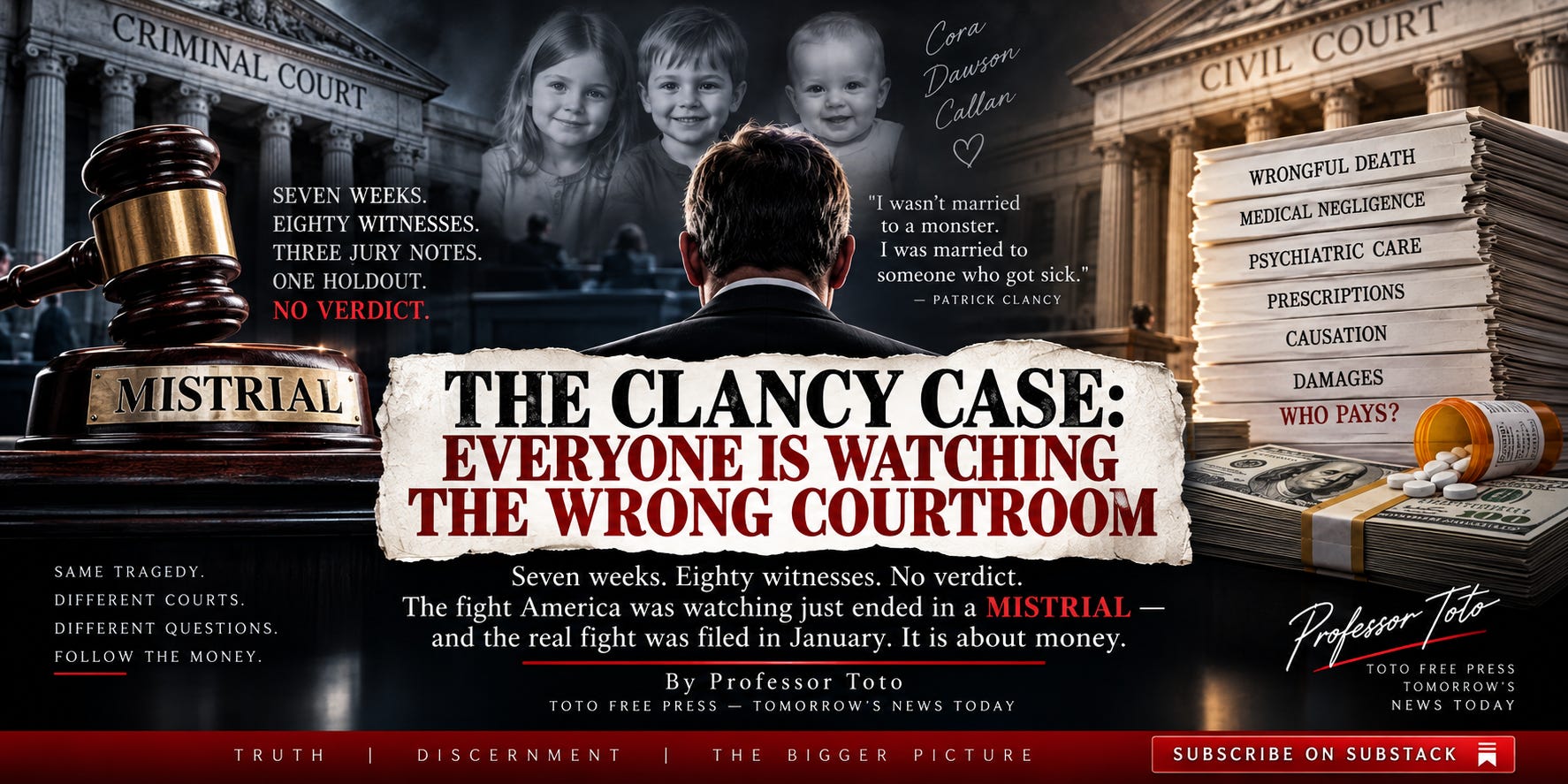
MISTRIAL.
At 11:25 this morning — Friday, September 4, 2026 — Judge William Sullivan declared it. Seven days of deliberation. Thirty-six hours in the room. Three notes from the jury saying they could not agree. One holdout juror the defense accused of lying under oath. And after nearly six weeks of trial, eighty-plus witnesses, and three hundred exhibits, Courtroom Number One produced exactly what I told you it might.
NOTHING.
Lindsay Clancy is not convicted. She is not acquitted. She goes back to the psychiatric hospital exactly as she came, and the Plymouth County District Attorney now has to decide whether to do the whole thing over again. Kevin Reddington got a one-hour stay to run to the Supreme Judicial Court and beg a single justice to undo it. As of this writing, that door is still swinging.
So the courtroom the entire country stared at for seven weeks just went dark without an answer.
Good. Because it was the wrong courtroom.
Something about the Lindsay Clancy trial has bothered me from the beginning.
Not the insanity defense. We have seen insanity defenses before.
Not the psychiatric testimony. That was entirely predictable.
It was Patrick Clancy.
The father.
Three children are dead.
Cora, five. Dawson, three. Callan, eight months.
And the woman who killed them is their mother. His wife at the time. Lindsay Clancy.
But before we talk about the father, you need to know the one thing almost none of the coverage has told you: the lawsuits are already filed. Both of them. Months ago. We will get there. First — the father.
Understand what is on trial in Plymouth, because it is not what you think. Lindsay Clancy does not deny that she strangled her children. Nobody in that courtroom denies it. The ONLY question before that jury is whether the law is allowed to hold her responsible for it. Massachusetts calls it “lack of criminal responsibility.” You and I call it the insanity defense. Same thing.
Now Class, put yourself in that man’s shoes. Any father in America knows what he would do with the woman who strangled his children. He would become the single most devastating witness the prosecution ever put on a stand.
Patrick Clancy did take the stand for the Commonwealth. Two days of it. And what did the jury hear from the father of three dead children?
They heard a story about illness.
They heard about a “big spiral.” Intrusive thoughts. Insomnia. A carousel of providers and a pharmacy shelf of medications.
This is the same man who — four days after the killings, before his children were even buried — wrote the words the whole country now knows by heart: “I want to ask all of you that you find it deep within yourselves to forgive Lindsay, as I have.” The same man who told The New Yorker in October 2024, in his own words: “I wasn’t married to a monster. I was married to someone who got sick.”
And here is the detail the coverage skips right past. Patrick Clancy is not her husband anymore. He divorced her. He moved to Manhattan. He remarried a physician.
So do not tell me this is marital loyalty. That bridge is burned and the river is dry.
Which makes the question louder, not quieter:
WHY?
How does a father look at the deaths of all three of his children — divorce the woman who did it — and STILL insist, under oath, that the story is about medicine and not about murder?
I kept asking. And then I found the answer sitting in a court clerk’s office.
THE LAWSUITS HAVE ALREADY BEEN FILED
This is not a guess about what the Clancys might do once the criminal case is over.
They are already doing it.
On January 20th, 2026 — six months before a single juror was seated — Patrick Clancy filed a twenty-page wrongful-death and medical-negligence lawsuit. Individually, and on behalf of the estates of Cora, Dawson, and Callan.
Two days later, on January 22nd, Lindsay Clancy filed her own — nearly eight hundred pages of it, in Norfolk Superior Court.
Hers was expected. A paralyzed plaintiff suing the people who treated her is the most predictable filing in civil law.
His is the tell.
Read that again.
While America has been watching a criminal jury decide whether Lindsay Clancy is responsible for killing her children, a second battle was already built and waiting in civil court.
And that battle asks an entirely different question:
WHO ELSE IS RESPONSIBLE?
FOLLOW THE ARGUMENT
Patrick’s complaint names Lindsay’s psychiatrist, Dr. Jennifer Tufts; nurse practitioner Rebecca Jollotta; and their employers, Aster Mental Health and South Shore Health System.
Lindsay’s suit goes wider — her complaint names eleven defendants, adding more providers, McLean Hospital, and Women & Infants Hospital in Rhode Island.
The core allegation in both is the same, and it is devastating in its simplicity:
She was overmedicated and under-watched. Patrick’s complaint counts at least NINE psychiatric medications in the months before the killings — EIGHT of them in nineteen days, from November 16th to December 5th, 2022. The providers, he says, never coordinated her care and never saw how fast she was falling apart. Lindsay’s complaint counts even more pills, and goes further still: her doctors missed a bipolar disorder with postpartum onset, and the drugs they stacked on her did not treat a psychosis — they TRIGGERED one.
And Patrick’s complaint says the quiet part out loud. With proper care, Cora, Dawson, and Callan “more likely than not” would still be alive.
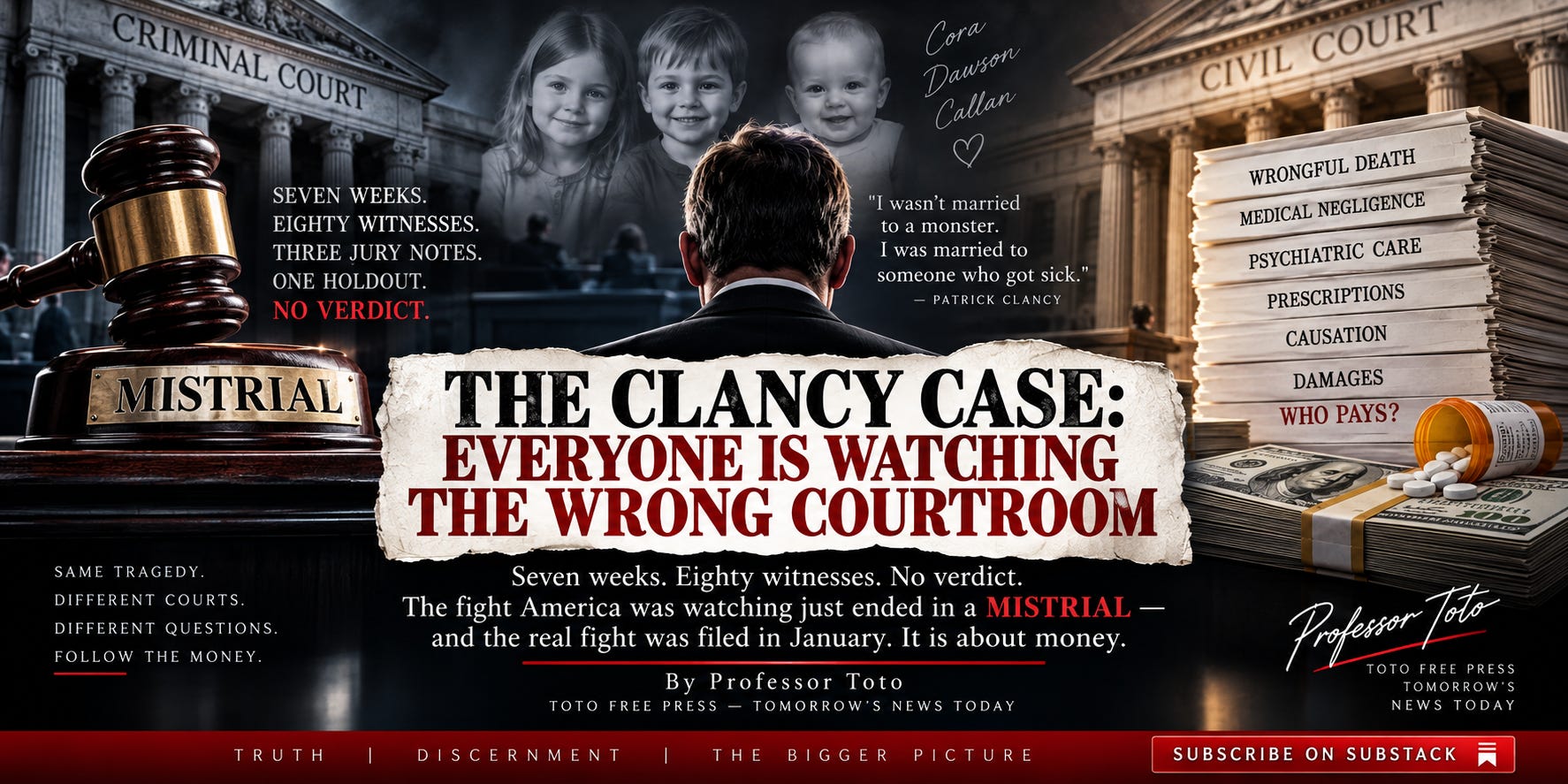
Now set the two courtrooms side by side.
THE CRIMINAL CASE:
The defense says Lindsay was so profoundly mentally ill that the law cannot hold her criminally responsible.
THE CIVIL CASES:
The lawsuits say the medical professionals failed her — and that her treatment itself produced the catastrophe.
Do you see it?
Separate cases. Separate courts. Separate legal standards.
One story.
Lindsay was sick.
Lindsay was being treated.
The treatment went catastrophically wrong.
Three children died.
And now the civil courts will be asked whether a psychiatrist, a nurse practitioner, and two hospital systems owe money for it.
WHICH VERDICT FITS THE LAWSUIT?
The lawyers will tell you an insanity verdict proves nothing in civil court. They are right, as far as it goes. It does not prove malpractice. It does not prove a drug caused the killings. Legal analysts say an insanity acquittal most likely would not even be ADMISSIBLE in the civil cases — the criminal jury judges her mind on one night; the civil jury judges a psychiatrist’s standard of care over four months. And to win that civil case, the plaintiffs have to prove breach, causation, and damages — and prove that if the doctors had done their jobs, Lindsay Clancy would not have done what she did.
Fine. I am not talking about the law books.
I am talking about the real world — where cases are settled in conference rooms, not decided by juries.
Ask yourself one question.
Outcome A — GUILTY:
A jury finds that Lindsay Clancy deliberately murdered her three children while fully responsible for her actions.
Outcome B — INSANE:
A jury finds that Lindsay Clancy was so diseased in mind that the criminal law cannot hold her responsible.
You do not need a law degree to see which one the malpractice lawyers are praying for. Outcome B is the headline every insurer, every defense counsel, and every future civil juror in the Commonwealth of Massachusetts will have read before they ever walk into Courtroom Number Two.
A criminal jury declaring, in writing, that this woman was too sick to be held responsible — that is not evidence in the civil case.
It is something better. It is the STORY. And the story is what settles cases.
And a story like that comes with a price tag.
THEN THERE IS THE MONEY
Three children are dead. Their father is pursuing wrongful-death claims for all three estates.
Their mother is paralyzed from the waist down — she jumped from a second-story window of that Duxbury home after the killings. Permanently. Her suit seeks damages for the physical and psychiatric injuries she says her treatment caused.
Neither complaint names a dollar figure. Both ask the court to set damages at trial.
But Massachusetts law tells you the SHAPE of the number.
Wrongful-death claims in this state are brought by the estate — and there are THREE estates. The statute allows punitive damages on top of everything else where the conduct was grossly negligent. And the state’s cap on pain-and-suffering damages in a malpractice case — five hundred thousand dollars — comes OFF when the jury finds a permanent loss of bodily function. A woman paralyzed from the waist down clears that bar before the first witness is sworn.
So nobody can tell you today what these cases are worth.
But I can tell you what they are not.
They are not small.
Three wrongful deaths. One permanent paralysis. Two hospital systems. A psychiatrist. And a hearing in Patrick’s case already on the docket for October 28th.
Whatever the number turns out to be, it will have commas in it.
THE QUESTION NOBODY WILL ASK
Here is the question that started bothering me — the one the trial coverage will not touch:
Did Patrick Clancy come to believe that Lindsay did not really kill their children — that her mistreated illness did?
Because if that is what he believes, everything he has done makes perfect sense.
He is not standing beside the person who murdered his children.
In his mind, he is standing beside another victim of the same catastrophe.
And if that is his worldview, then the villains in Patrick Clancy’s story are not sitting at the defense table.
They are the names on his complaint.
He and his sisters even founded a foundation in the children’s names to improve perinatal mental-health care — the very system his lawsuit now targets.
Forgiveness in 2023. Lawsuit in 2026. Same belief, start to finish. A father who is convinced that negligent doctors helped kill his children would do exactly what Patrick Clancy has done — forgive the patient and sue the physicians.
And the criminal jury has been listening to that belief, from that witness, for two days.
THE HARDER QUESTION
Now the one nobody wants asked.
What happens to those malpractice cases if Lindsay Clancy walks out of Courtroom One not guilty by reason of insanity?
Does that verdict become the public centerpiece of the argument that this was a psychiatric catastrophe and not a murder?
Do the insurers for two hospital systems suddenly look very differently at the risk of putting this case in front of a civil jury that spent a summer watching this trial on television?
And eventually:
Who pays?
Those questions are on the table because the lawsuits were not dreamed up after a verdict.
They were filed BEFORE the trial ever began — which means none of this was an afterthought. The civil strategy was built on the same foundation as the criminal defense. By design. From the start.
TWO COURTROOMS. ONE TRAGEDY.
Now you know how Courtroom One ended. Twice this week Judge Sullivan refused to throw out the lone holdout juror Reddington accused of lying under oath. Reddington told the court the jury stood eleven-to-one for acquittal by reason of insanity. That count is Reddington’s. The judge would not confirm it and said he would not take sides with “one juror or eleven.” And then, this morning, a hung jury and a mistrial.
So America spent seven weeks staring at one courtroom door — and it never opened.
Murder — or insanity? The answer was: ask again next year.
But there has been another courtroom waiting in the wings the entire time.
That courtroom will deal with money.
Negligence.
Medical decisions.
Prescriptions.
Diagnosis.
Causation.
And responsibility.
The criminal jury was asked whether Lindsay Clancy bears criminal responsibility — and could not answer.
The civil litigation will decide whether her doctors bear financial responsibility — and it does not need a verdict from Courtroom One to proceed.
Different legal questions.
Same terrible night.
And whatever you think about Lindsay Clancy, Patrick Clancy, postpartum illness, psychiatric medication, or the insanity defense, there is one fact that changes how you should read this entire story:
THE CLANCYS ARE NOT WAITING TO BLAME THE MEDICAL SYSTEM.
THEY ALREADY HAVE.
So here is the ruling.
Mistrial, retrial, plea deal, or a DA who quietly walks away — it does not matter. The Clancy story is nowhere close to over.
It is simply moving into Courtroom Number Two.
And I will be watching that door every bit as closely as I have watched the first one.
Every fact in this column — and where it came from — is in the Receipts table below the sign-off. Check my homework.
CLASS DISMISSED!!!!
Office hours continue in Courtroom Number Two. Subscribe — free — so you don’t miss the first hearing.
And Now You Know… THE BEST of the Story.
PROFESSOR TOTO
TOTO FREE PRESS — Tomorrow’s News Today
professortoto.substack.com