

Now Class — come to order.
Because yesterday afternoon the Supreme Court of the United States did something the political press has spent all night trying to describe without using the only word that fits.
They won.
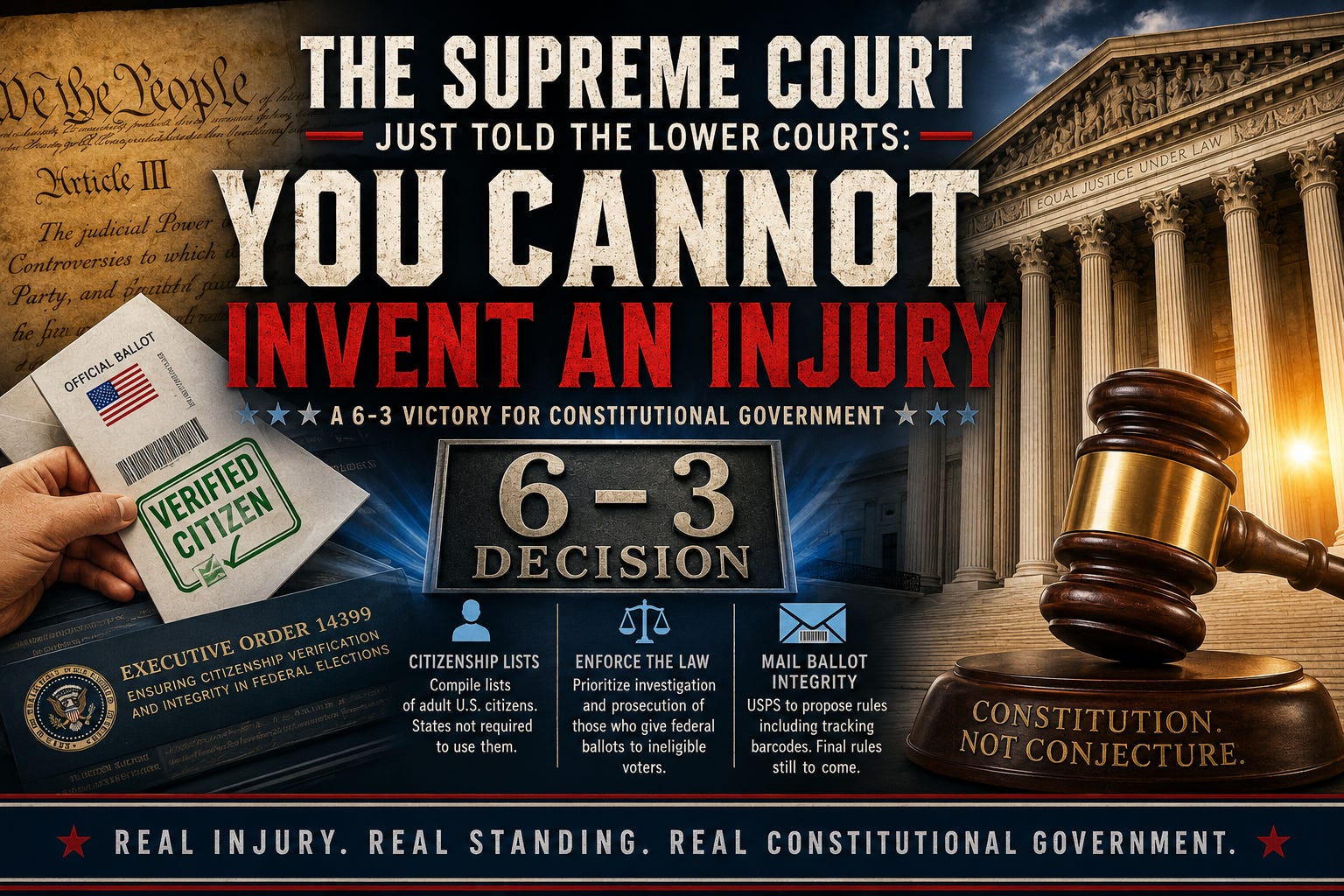
The injunction that had frozen President Trump’s election-integrity order since June is stayed. Gone. Lifted. Inoperative.
Not narrowed. Not modified. Not sent back for further proceedings.
Stayed.
And it stays stayed through the entire First Circuit appeal, and through any petition to the Supreme Court that follows it.
Which means that as of yesterday, the Department of Homeland Security may begin compiling State Citizenship Lists. The Attorney General may prioritize the prosecution of officials who hand federal ballots to people who cannot legally vote. And the United States Postal Service may proceed with its rulemaking on mail ballots.
For the November 2026 midterms.
Twenty-three states and the District of Columbia went to war to stop that from happening.
They lost 6–3.
LET US BE PRECISE — BECAUSE PRECISION IS WHY WE WIN
Class, you know my rule. We read the decision before we believe the headline. And that rule does not get suspended just because the decision went our way.
So here is exactly what happened, stated with the accuracy our opponents never bother with:
This was an emergency application for a stay. Docket No. 26A124. A ten-page per curiam order issued August 24, 2026. No oral argument. No signed majority opinion.
The Court did not rule that Executive Order 14399 is constitutional.
The Court ruled that the government is likely to succeed on its argument that the District Court never had jurisdiction to hear the case at all — and that the injunction is irreparably harming the Executive Branch while the appeal grinds on.
Now — some of you are already deflating. Don’t.
Because I want you to understand what that actually means in the real world, in the next seventy days, in an actual election.
It means the order is operative.
It means the machinery is running.
It means every practical objective the plaintiff states filed suit to prevent, they have now failed to prevent — for this election cycle, which is the only cycle they cared about.
A win on jurisdiction that puts the policy into the field is not a consolation prize.
It is the whole prize.
HOW WE GOT HERE
On March 31, 2026, the President signed Executive Order 14399, “Ensuring Citizenship Verification and Integrity in Federal Elections.”
Four days later — four — a coalition of twenty-three states and the District of Columbia was in federal court in Massachusetts.
Four days. Before a single list had been compiled. Before a single prosecution had been contemplated. Before the Postal Service had proposed anything at all.
On June 25, the District Court granted them summary judgment and entered a permanent injunction barring implementation of Sections 2 and 3 as to those states for the 2026 cycle.
The First Circuit refused to stay it, 2–1.
And then the case reached nine people who actually read Article III.
Six of them said: you had no business being in court in the first place.
WHAT THE ORDER ACTUALLY DOES — ALL OF IT
I am now going to do something the other side will not do for you. I am going to tell you what is in all three provisions, including the aggressive one, because our argument does not require hiding anything.
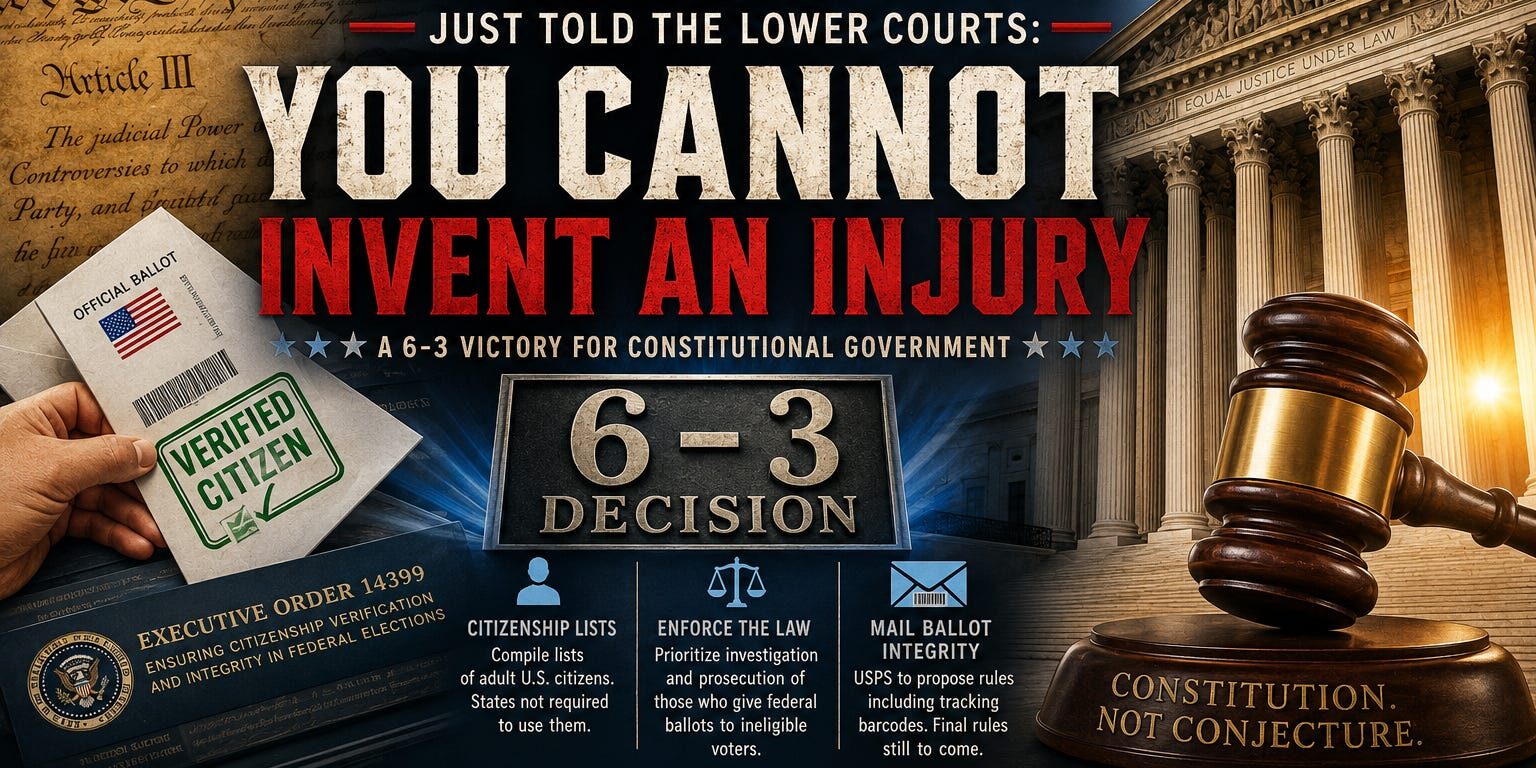
Section 2(a) directs the Secretary of Homeland Security to create State Citizenship Lists — rosters of confirmed United States citizens in each state who will be eighteen or older at the next federal election — and to send them to the states.
The states are not required to use them. The Secretary compiles them only to the extent it is feasible and consistent with applicable law.
The Court’s words: the provision “imposes no obligations on the States.”
Section 2(b) directs the Attorney General to prioritize investigation and, where appropriate, prosecution of state and local officials — or anyone else — who issues federal ballots to ineligible voters.
It creates no new crime. It points to statutes Congress already passed.
The Court’s words: “It does nothing to them.”
Section 3 — and here is the provision the other side thinks we’re afraid of — directs the Postal Service to initiate a proposed rulemaking. Among the provisions that rulemaking must at minimum propose: a unique Intelligent Mail barcode on every outbound ballot envelope, and a requirement that the Postal Service not transmit mail-in or absentee ballots to individuals who have not been enrolled on a state-specific list.
Yes. I said it out loud.
That is the provision our opponents call ballot suppression, and I will not pretend it says something milder than it says.
But notice what it is.
It is an instruction to begin a rulemaking.
Not a rule. Not a final rule. An instruction to an agency to propose one, subject to notice, subject to comment, subject to revision, subject to abandonment — and expressly subject, like every provision of the order, to implementation consistent with applicable law.
The Supreme Court’s answer to that was seven words long and it ought to be carved into marble:
“Federal courts review final rules, not proposed rules.”
Finish the process. See what the government actually does. Find out whether anyone is actually injured.
Then sue.
THE CHAIN OF MAYBES
The heart of this decision is the majority’s demolition of what the District Court had to do in order to find an injury.
Watch the sequence the lower court had to assume:
Maybe it would be feasible for the Secretary to build the lists before November.
Maybe he would build them in a particular way.
Maybe he would deem particular actions appropriate.
Maybe those actions would harm the states.
Maybe. Maybe. Maybe.
And on Section 3, an even longer ladder: maybe the Postal Service proposes a rule, maybe it weighs the comments a certain way, maybe it issues a final rule, maybe the final rule says a particular thing, maybe that thing hurts somebody.
The Court’s verdict on this method of reasoning:
Article III forbids “stacking hypothetical on hypothetical.”
Class, write that down.
Because that single phrase is worth more to the future of this Republic than every headline written about this case combined.
AND THE SPENDING TRICK DIDN’T WORK EITHER
The states had a clever fallback. We’re already spending money preparing for this. That’s a real injury. Money is concrete.
The Court, quoting Clapper, was unimpressed. States cannot manufacture standing by inflicting harm on themselves out of fear of a hypothetical future harm that is not certainly impending.
Understand why this matters far beyond elections.
If voluntary preparation spending created standing, then any government could sue any other government over any announced policy simply by writing a check first and calling it damages. Standing would become a purchase order.
Six Justices closed that door.
THE DISSENTS — AND WHY THEY FAIL
I don’t caricature opponents. I answer them. So here is their best case, at full strength.
Justice Sotomayor, joined by Justice Kagan, argues that Sections 2(a) and 2(b) must be read together — the lists exist to feed the prosecutions. And her sharpest point is not rhetoric, it is a quotation from the government’s own reply brief, conceding that a state’s refusal to consider its Citizenship List could conceivably, depending on circumstances, be relevant evidence of intent to violate the very statutes the Attorney General is told to prioritize.
That is a real argument. Here is why it loses.
“Could conceivably, depending on the circumstances” is not a threat. It is a lawyer declining to promise the impossible. Section 2(b) lists the statutes the Attorney General is to enforce, and the Citizenship Lists appear nowhere among them. The states conceded they are not required to use the lists at all. As the majority put it, it is therefore logically impossible for a state to violate Section 2(a).
You cannot be prosecuted for breaking a rule that was never a rule.
And when the states raised the one specific fear that had teeth — that officials might be prosecuted for giving primary ballots to seventeen-year-olds who may lawfully vote in primaries under state law — the government disavowed any such intention on the record, before the Supreme Court.
That is not a speculative comfort. That is a concession the states can hold the Justice Department to.
Justice Jackson goes considerably further, in a dissent nearly two and a half times the length of the majority’s entire order. Her strongest factual point is this: the Postal Service did propose a rule, on June 2, 2026. So where, she asks, is the speculation?
The answer is one line of black-letter law, and the majority didn’t even have to raise its voice to give it.
Standing is measured when the complaint is filed.
The complaint was filed on April 4. On April 4 there was no proposed rule, no list, no investigation, no prosecution, no injury — nothing but an internal memorandum from a President to his own subordinates and twenty-three attorneys general with a press conference scheduled.
You do not get to file suit on an imaginary injury and then wait for reality to catch up with your pleadings.
THE HONEST PART — AND WHY IT’S STILL A ROUT
Two facts our opponents will lean on. I’ll state them plainly, because a victory you have to lie about isn’t one.
First: the government did not argue the merits. It did not stand before the Court and defend the constitutionality of Executive Order 14399. It argued jurisdiction.
Second: the majority expressly declined to bless the outcome. Whether any particular measure taken to implement the order turns out to be lawful, the Court said, “time will tell.”
Now watch what happens when you look at those two facts squarely instead of flinching from them.
The government argued jurisdiction because jurisdiction comes first. That is not a dodge; that is the sequence the Constitution requires. A court that lacks power to hear a case does not get to reach the merits of the case, and a litigant is not obligated to argue the merits to a court that has no business asking.
And “time will tell” is not a warning to us. It is the restoration of the correct order of operations.
Take an action. Cause an injury. Get sued.
In that order.
For five months the other side had it precisely backwards — and yesterday six Justices turned it right side up.
THIS IS THE VICTORY, STATED PLAINLY
Strip out the doctrine. Here is the scoreboard.
The states wanted these provisions dead before November. They are alive.
The states wanted DHS blocked from compiling citizenship lists. DHS may compile them.
The states wanted the Attorney General barred from prioritizing enforcement against officials who hand ballots to ineligible voters. He may prioritize it.
The states wanted the Postal Service frozen. It may proceed.
The states wanted a federal district judge in Massachusetts supervising the Executive Branch of the United States through November 3rd. She is not supervising anything.
And the companion application filed by Alabama and eleven other states in support? Denied as moot — because the relief they sought had already been granted.
That is not a technicality, Class.
That is a rout.
THE LARGER WAR
This case is bigger than barcodes.
For years now the pattern has been identical, and every one of you can recite it:
A President announces a policy.
A lawsuit appears within days.
A district judge enjoins it.
The appeal takes eighteen months.
The policy dies of old age without ever being implemented — and no one ever discovers whether the catastrophe predicted in the complaint would have happened at all.
The injunction becomes the policy.
That is how a nation quietly stops asking who governs? and starts asking which judge caught the case?
Yesterday the Supreme Court said the quiet part into the record: federal courts exist to resolve actual disputes between actually injured parties over actually completed government action.
Not predictions. Not fears. Not preparations. Not press releases with docket numbers attached.
Actual injuries.
And this rule cuts both ways, permanently, which is exactly why it is a principle and not a favor. Today the President is Donald Trump. One day he will be somebody you did not vote for. The rule will be the same, and you will be grateful for it.
WHAT COMES NEXT — STAY AWAKE
Victory does not mean the fight is over, and I will not let you leave this classroom thinking otherwise.
The stay holds through the First Circuit appeal and through any timely petition for certiorari. If the Court denies review, the stay ends automatically. If it grants review, the stay holds until judgment.
The Postal Service has still not issued a final rule. When it does, the states will sue again — and that suit will be ripe, and it will be fought on the merits, and it will be fought hard.
So the correct posture this morning is not celebration alone. It is execution.
Build the lists. Do it carefully, do it lawfully, do it accurately — because every error in a citizenship list will be on a front page within the hour, and accuracy is not merely a legal requirement, it is our entire argument made visible.
Enforce existing law against those who hand federal ballots to people who cannot lawfully cast them.
Finish the rulemaking. Take the comments seriously. Produce a final rule that survives contact with a courtroom.
Do all of that, and the next lawsuit meets a record instead of a rumor.
THE FINAL LESSON
Class dismissed — but not until you write this down:
YOU CANNOT ENJOIN A GOVERNMENT FOR WHAT YOU IMAGINE IT MIGHT DO.
Twenty-three states tried. A district court agreed. A circuit court let it stand.
And six Justices of the Supreme Court of the United States looked at the whole apparatus and said: there is no injury here, there is no jurisdiction here, and there is no case here.
The injunction is stayed.
The Executive Branch may proceed.
The courthouse doors remain open for anyone who is genuinely harmed by something that genuinely happens.
That is not the end of judicial review.
That is judicial review, restored to its proper place — seventy days before an election.
And after years of government-by-injunction from America’s lower federal courts, that may prove to be the most important election protection of them all.
And now you know the BEST of the story …..
TOTO FREE PRESS Tomorrow’s News Today Professor Toto
From Toto-Town — where we read the decision before believing the headline.