

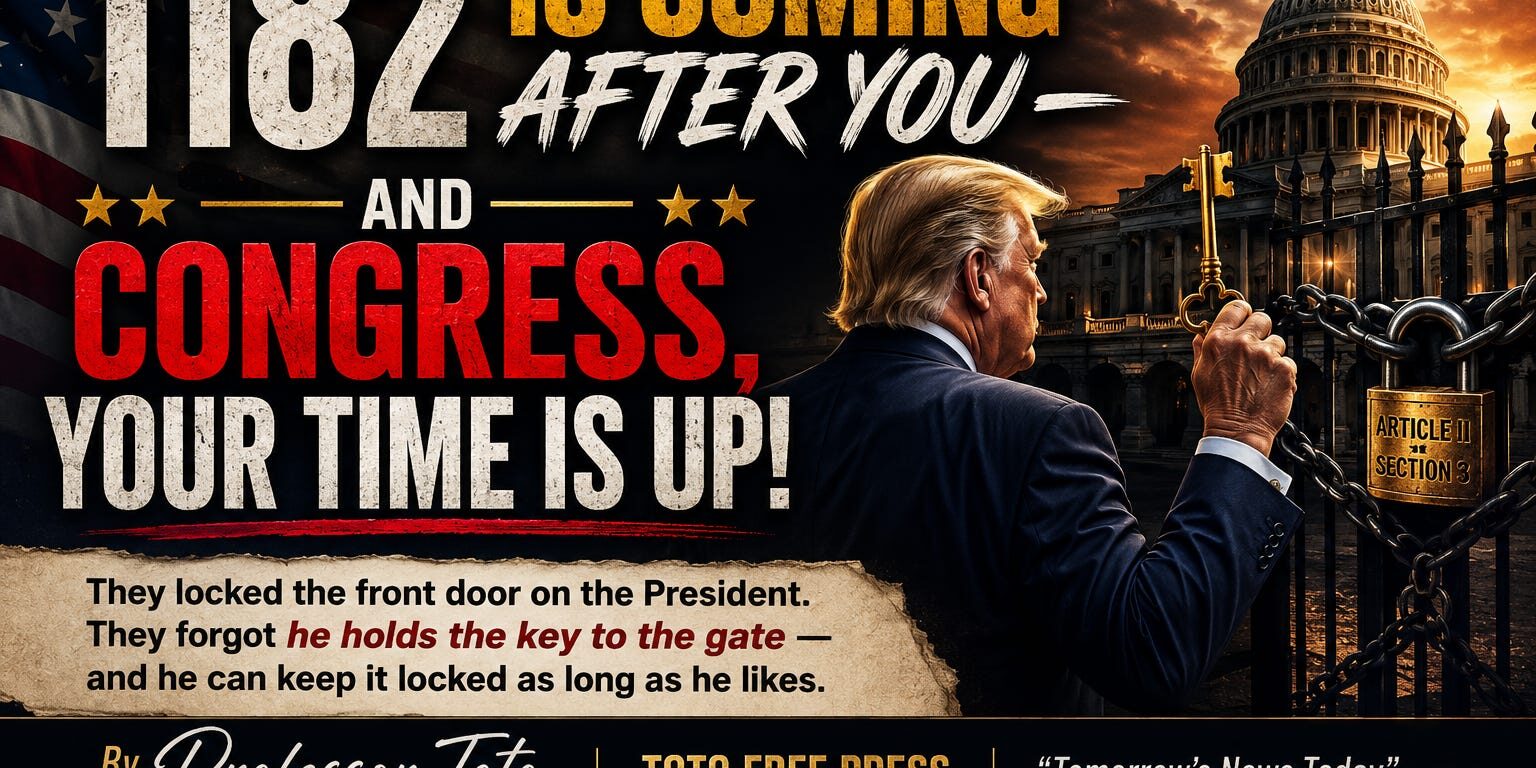
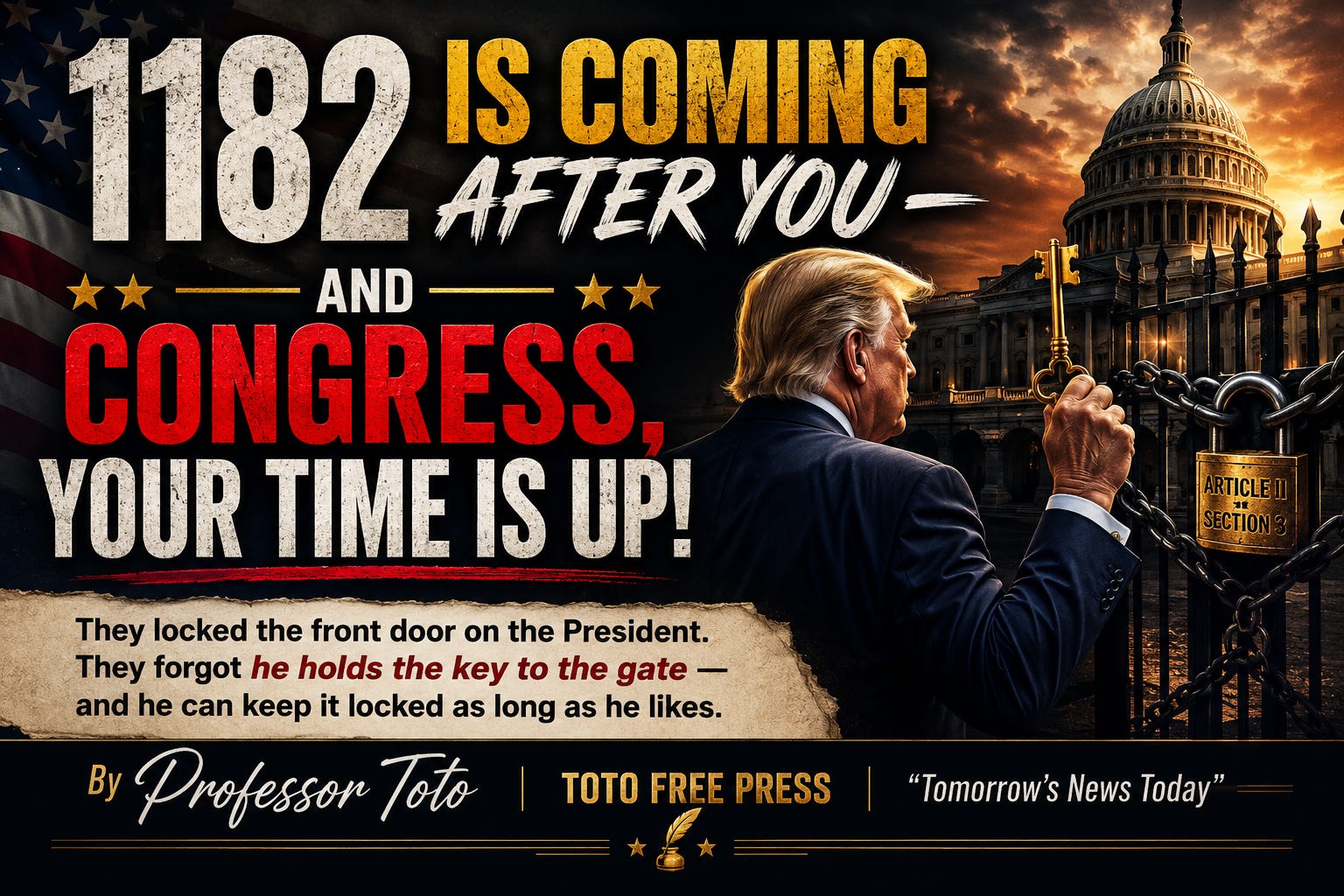
By Professor Toto | TOTO FREE PRESS — “Tomorrow’s News Today”
1182(f) Is Loaded — Congress, Your Time Is Up
They locked the front door on the President. They forgot he still holds the gate key — and under 1182(f), that gate can stay closed until the danger Congress refuses to fix is finally fixed.
By Professor Toto | TOTO FREE PRESS — “Tomorrow’s News Today”
“They told the President he could not rewrite citizenship from the Oval Office. They were right. What they forgot is that the same law still hands him the key to the gate — a loaded weapon left right there in his desk drawer, and the Supreme Court already said he’s allowed to use it.”
I. The Day Everyone Called a Defeat
Let me tell you what happened this week, and then let me tell you what almost nobody in America noticed underneath it.
On June 30, 2026, the Supreme Court of the United States refused to end birthright citizenship. Six justices to three, in a case called Trump v. Barbara, the Court held that the Fourteenth Amendment means what it has been read to mean since 1898: nearly everyone born on this soil is a citizen, full stop. But read the box score carefully, because the number that matters isn’t six — it’s five. Chief Justice Roberts wrote a five-justice majority opinion, joined by Justice Barrett and the three liberals. Justice Kavanaugh made it six for the outcome — but he did not sign Roberts’ constitutional reasoning. He filed an opinion concurring in the judgment and dissenting in part, resting on federal statutory law rather than the Fourteenth Amendment — and pointedly declining to hold that the order violated the Constitution itself. So while the outcome was 6–3, the constitutional rationale was narrower than the headlines suggest. Justices Thomas, Alito, and Gorsuch dissented, warning that the majority’s reading is not historically accurate — that neither the Fourteenth Amendment nor the Civil Rights Act guaranteed citizenship to persons not domiciled in the United States.
Hold onto that distinction — five and one, not six — because the “one” left a door standing wide open, and I’ll show it to you before we’re done.
The conservative internet went into mourning. The cable panels declared the fight over. And the Left threw a party.
They were all looking at the wrong door.
II. The Question Every Honest American Asked
When that ruling came down, a sharp question landed in my inbox — and I’ll bet it landed in your heart too. It went like this:
“Professor, what a mess. How does ICE even do its job now? They can deport the illegal parent, but the child born here is a citizen. Do we just stop ALL immigration until somebody fixes this?”
That is exactly the right question. And here is the answer the cable panels will never give you straight — because most of them don’t know the statute exists.
The Court closed one door. It left another one wide open.
-
What the Court closed: the President cannot rewrite the Fourteenth Amendment by executive order. That door is shut. The baby born on our soil is a citizen. Settled.
-
What the Court left wide open: the President’s power over who enters this country in the first place. That power was never on trial this week. It is sitting right there, fully loaded, untouched.
-
The key nobody’s holding up: the citizen child keeps citizenship — but the unlawfully present parent is still removable, and the border is still the President’s to control. The ruling shielded the child. It did not shield the parents, and it did not touch the gate.
III. The Weapon Has a Name and a Number: 8 U.S.C. § 1182(f)
Write this down, because this is the part they’re not telling you.
There is a federal statute — Title 8, Section 1182(f) of the United States Code — that reads, in plain black letter:
“Whenever the President finds that the entry of any aliens or of any class of aliens into the United States would be detrimental to the interests of the United States, he may by proclamation, and for such period as he shall deem necessary, suspend the entry of all aliens or any class of aliens.”
Read those words slowly. Any class of aliens. All aliens. For such period as he shall deem necessary.
That is not Professor Toto’s theory. That is the statute. And before any fact-checker comes for me — the Supreme Court already ruled on this exact power, and upheld it, in 2018. You knew the case as the “travel ban.” Its name is Trump v. Hawaii. And the man who wrote the majority opinion upholding this power was none other than Chief Justice John Roberts — the same Chief Justice who wrote against us on birthright this week.
You remember the travel ban. The protests at the airports. The cable panels calling it a Muslim ban and swearing the Court would strike it down. And then John Roberts — this same John Roberts — wrote the opinion that said the President has this power, plain and simple, and the courts don’t get to second-guess his national-security judgment. Sit with that. The same Chief Justice who closed one door on us this week is the very man who threw another one wide open seven years ago.
Here is what Roberts wrote — and I’m going to translate it for you, because judges don’t speak English the way the rest of us do.
Roberts said the statute “exudes deference to the President in every clause.” What that means in plain language is this: the President decides. That’s it. He decides when. He decides who. He decides how long, and he decides what conditions come attached. The Chief Justice called it a “comprehensive delegation” — which is lawyer-talk for Congress gave away the store.
That is the weapon. It is already sharpened. It is already court-tested. And it is already his.
And here is the part that ends the argument before it starts: this is not some exotic power nobody’s touched. Every single President since Ronald Reagan has used Section 1182(f) at least once. This is a bipartisan, well-worn tool — not a Trump invention the media can call a “power grab”:
-
Ronald Reagan, 1981 — Proclamation 4865 suspended the entry of undocumented aliens arriving by sea, and sent the Coast Guard to interdict the Haitian boats before they reached shore.
-
Jimmy Carter, 1979 — during the Iran hostage crisis, moved to deny visas to Iranian nationals. A Democrat. Nobody called him a king.
-
Barack Obama, 2011 — signed a §1182(f) proclamation suspending the entry of foreign human-rights violators. The Left cheered.
-
Donald Trump, 2017 — Proclamation 9645 barred entry of nationals from a set of terror-compromised countries — the order the Supreme Court UPHELD in Hawaii.
Read that list again. Reagan the conservative. Carter the liberal. Obama the progressive. The power to suspend entry of whole classes of aliens has been used by Republicans and Democrats alike for over forty years. So when they tell you it would be “authoritarian” for this President to use it — ask them why it wasn’t authoritarian for the other four.
What can he actually suspend? By the statute’s plain words: any class of aliens — an entire visa category, nationals connected to a particular abuse, or, in the broadest reading the Hawaii Court blessed, all aliens whose entry he finds detrimental. He can shut a category. He can shut a pipeline. He can condition the reopening on whatever he names.
IV. The Detail That Changes Everything: There Is No Clock
I had one question when I read that statute, and I want you to have the answer, because it is the hinge on which this entire fight turns.
How long can he keep it in place?
Is there a clock? Does it expire in thirty days? Ninety? A year?
There is no time limit. None. The statute says he may suspend entry “for such period as he shall deem necessary.” He sets the clock. Not Congress. Not the courts. Him.
And the Supreme Court confirmed it. In Trump v. Hawaii, the Court specifically rejected the argument that the President must set a fixed calendar end date. The suspension lasts as long as the President reasonably finds the underlying problem lasts — tie it to a real danger, and the clock runs on the danger, not on a date.
Here is what that means, and I want you to hold it, because it is the hinge on which this whole fight turns. It means the President can tie the duration to a condition — not to his mood, but to a real and stated problem. He can issue a proclamation that says, in plain English: this gate stays locked until the national-security and public-safety danger at the heart of this is resolved. And who is the only body that can resolve it for good? Congress. So the President never has to say “until you pass my bill” — he ties the suspension to the danger itself, and Congress feels the identical pressure, because they are the only ones who can lift it. The law rests on the danger. The politics rest on Congress. And both point to the same door.
Not thirty days. Not ninety. Not even a year. The suspension stays in force until the condition is met.
Think about what that does. Every morning that Congress refuses to act, the pressure builds — not on the President, but on the people who wouldn’t do their jobs. The lobbyists start calling. The governors start calling. The home-state editorial boards start writing. And the President? He just waits.
He does not have to blink.
Congress does.
V. The Kavanaugh Signal — The Door the Deciding Vote Left Open
Now come back to that box score, because here is the single most underreported fact in the entire decision.
Justice Kavanaugh was the sixth vote for the outcome — but he refused to join Roberts’ constitutional reasoning. He filed an opinion concurring in the judgment and dissenting in part, resting on federal statute and declining to hold the order unconstitutional. And in that separate writing, the man who cast the deciding vote did something extraordinary: he pointed straight at Congress.
Here is what Kavanaugh actually did. He looked at Roberts’ broad constitutional reasoning and said: I won’t sign that. He looked at the liberals’ position and said: I won’t go that far either. He rested instead on federal statute — and then, in his own words, he handed Congress the map:
“Congress could — consistent with the Fourteenth Amendment — amend [the immigration law] or otherwise enact new legislation establishing exceptions to birthright citizenship for children born to foreign citizens unlawfully or temporarily in the country. But Congress has not yet done so.”
Read that again — those are the deciding justice’s own words. Congress could. The man who made it six-to-three refused to make it a constitutional wall. He left the legislative door swinging on its hinges — and then, remarkably, told Congress exactly how to walk through it.
Understand what that means for the panic merchants who called this a permanent, unbreakable defeat. The outcome was 6–3, yes — but the constitutional rationale was narrower than the headlines screamed. Five justices closed the door on the Constitution. The sixth said the door was never locked to Congress at all. The Court did not say “never.” It said “not like this — now do it the right way, through the elected branch.”
That is not a defeat. That is a road map. And it was handed to us by the very justice everyone assumed had buried the issue.
VI. This Is How You Force a Congress That Won’t Move
Now let me connect it to the fight we’ve been having for a year and a half.
The SAVE America Act — the Safeguard American Voter Eligibility Act — has passed the House. More than once. In early June, Mike Lee’s clean, House-passed version drew 49 votes on the Senate floor — closer than it had ever come — and Lee argued that with the filibuster out of the way, it could reach 51 with Vice President Vance breaking the tie. And it still is not law.
Why? Two locks on the door. The sixty-vote filibuster — a number that appears nowhere in the Constitution. And a budget-rule technicality enforced by an unelected parliamentarian. Majority Leader Thune has admitted his conference doesn’t have the votes to break the filibuster. As of this week, House conservatives — Chip Roy among them — have ground the floor to a halt rather than let must-pass bills move without the SAVE Act attached.
So picture the board the way the President sees it. The Court just told him he cannot fix birthright by decree. The Senate won’t pass his bill. Everywhere he turns, an institution says no.
And then he looks down and sees the one weapon the Supreme Court already blessed — a weapon with no clock on it.
Here is what I believe you are about to watch. He cannot strip a baby’s citizenship. So instead he turns off the faucet that brings the birth-tourist and the illegal crosser to our soil in the first place. He suspends the entry classes. He chokes the inflow. And he holds it — not for thirty days, not for ninety, but until the men and women who won’t do their jobs finally do them.
That is the forcing function. When the President is the only branch acting — governing immigration alone, by proclamation, with a power no court can easily touch — the heat doesn’t build on him. It builds on Congress. Every single day that gate stays shut.
Picture how that pressure actually works. A senator from a border state — let’s call him Johnson — starts getting calls. The agricultural lobby needs its seasonal workers. The hospitality industry needs its staff. The university needs its researchers. And every one of them hears the same answer: the President tied the gate to the SAVE Act. Go ask Senator Johnson why his filibuster matters more than your harvest. That is how quiet majorities become loud majorities. That is how sixty votes get built — not by begging the obstructionists, but by making obstruction expensive.
And if some professor tells you a president has never leveraged one branch to move another, hand him a history book. In 1937, Franklin Roosevelt — a Democrat, the Left’s own patron saint — was so furious that the Supreme Court kept striking down his New Deal that he threatened to pack it: add up to six new justices until he got the rulings he wanted. Congress recoiled. The bill never passed. And here is the lesson they don’t want you to learn: it didn’t have to. Within weeks, the Court blinked and started upholding his programs — the famous “switch in time that saved nine.” Historians still argue over how much the threat itself caused the switch, and I’ll be honest with you that the debate is real. But no one disputes the larger truth: FDR lost the vote and won the war, precisely because the threat of using his power reshaped what the other branches were willing to do. As one historian put it, using leverage against the Court “is a hallowed American political tradition participated in by Republicans and Democrats alike.” When the Left did it, the history books called it bold leadership. Let’s not pretend it’s tyranny now.
VII. And It’s Already Starting — Listen to Capitol Hill
Don’t take my word that this is where it’s heading. Listen to Chip Roy — hours after the ruling, before the ink was dry:
“The 14th Amendment in no way stands for the proposition of creating a dangerous cottage industry of traveling to our soil to manufacture United States citizenship. That’s insane.”
Roy knew exactly what had happened. The Court protected the baby, but it left the border exposed — and within hours he was demanding legislation to close the entry angle, the § 1182(f) angle, that this column just showed you. He is not alone; others are already drafting bills to bar pregnant travelers who come only to plant a citizen and leave.
And then came the tell — the move that proves the administration already sees the whole board. The Department of Justice did not accept the ruling and walk away. The same day, it fired back with enforcement:
“The Department of Justice will prioritize the prosecutions of birth tourism schemes across the country.”
Read what just happened. The Court preserved citizenship at birth — but it did not bar the prosecution of the fraud rings that manufacture it, and it did not touch the border. So the government pivoted to the two doors left standing open: enforce against the scheme, and choke the entry that feeds it. That is not me predicting a strategy anymore. That is the strategy, in motion, on day one.
And the President himself, that very same day, aimed the entire country at one branch of government:
“We can easily make it up in Congress through Legislation, with the support of the President. Congress should start TODAY. They will have my complete and total support.”
Read that like a strategist. The President is not despairing. He is pointing — deliberately, publicly — at the exact branch that has to move. The lawmakers are naming the destination. The DOJ is already walking through the open doors. And the President holds the vehicle that gets everyone there.
VIII. The Hard Questions — Because Toto Always Gives You the Whole Board
I promised you long ago that my lessons would give you the whole board, not just my side of it. So let me do what no cheerleader ever does: let me stand up the other side’s best punches and answer them one by one. If this strategy can’t survive its hardest questions, you deserve to know it now.
“Isn’t the President just banning all immigrants forever?” No — and anyone who says so hasn’t read the statute. This power governs entry, and it has two real walls. A separate law, § 1152(a)(1), bars discriminating in immigrant visas by nationality — so he cannot re-write the visa system country-by-country. And the courts give the most deference when a proclamation rests on national security, less when it rests on pure economics. The wise move — the bulletproof move — is a suspension of the classes tied to birth tourism and border integrity, grounded expressly in security and public safety. Broad classes, held for as long as that danger persists, on the strongest legal footing there is. Not “every human on earth, forever.”
And here is the part most commentators get exactly backwards: targeted is not weak — targeted is what makes it strong. A president who declares “everyone, everywhere, forever” hands the courts an easy strike-down. A president who names specific classes, for specific security reasons, held until Congress acts, is standing on ground the Court already surveyed. The precision is not a limitation on the power. The precision is what gives the sword its edge. They think restraint is weakness. In law, restraint is what makes the blade hold.
“But the courts have said 1182(f) can’t override the whole immigration code or shut the system down indefinitely.” True — and I concede it freely, because it’s the honest law. The Supreme Court itself said in Hawaii that the statute likely cannot be used to “expressly override” particular provisions of the immigration code. Lower courts have said the power “is not unbounded,” can’t suspend visa adjudications, and can’t seal the whole system open-endedly for no reason. Read those limits carefully, though, and notice what they bite against: the maximalist fantasy — erase the code, ban everyone, forever. They do not bite against a targeted, security-grounded suspension of named classes, tied to a condition Congress can cure. That is the exact proclamation the Court upheld in Hawaii. Same statute. Different discipline. The limits are the guardrails on the road — not a wall across it.
“No president has done this in seventy years.” Wrong on the facts. Every president since Reagan has invoked § 1182(f) at least once, and the tool traces back to 1952. Reagan used it on the Haitian boats. Carter moved against Iranian nationals. Obama used it against human-rights abusers. Trump’s travel ban was upheld by the Supreme Court itself. This is a well-worn, bipartisan instrument — not a novelty.
“Isn’t using executive power to force Congress’s hand a dangerous, made-up trick?” Then the Left’s own hero was the trickster-in-chief. In 1937 Franklin Roosevelt threatened to pack the Supreme Court to force a result — and the history books call it bold leadership, not tyranny. Using the lawful powers of one branch as leverage on another is, in one historian’s words, “a hallowed American political tradition participated in by Republicans and Democrats alike.” The President here isn’t inventing a power. He’s using one Congress handed him and the Court blessed.
“Won’t the courts call this a pretext and strike it down?” They’ll try — and this is the one hard question that demands real discipline. The courts apply a “facially legitimate and bona fide” test. That is exactly why the proclamation must rest on genuine national-security and public-safety findings, documented and specific — the way the Hawaii ban was, which is why it survived. Sloppy, purely-political drafting invites a loss. Careful, security-grounded drafting is what makes it hold. I won’t pretend the courts are a rubber stamp. I’m telling you the standard, and how you meet it.
And let me be plain about what this is NOT. It is not the deportation of a single citizen child — their citizenship is settled and untouchable. It is not a nationality ban. It is not a permanent rewrite of immigration law by decree. It is a temporary suspension of entry classes, held until Congress does its job. Anyone who tells you otherwise is arguing with a strawman, not with me.
One more thing the panels won’t tell you — the SAVE Act isn’t radical, it’s mainstream. Unrestricted, soil-only birthright citizenship is the global exception, not the rule. The United Kingdom ended it in 1981. Australia, France, and Germany all place conditions on it. Most of the developed world ties citizenship to something more than the coordinates where a mother happened to deliver. So when they call securing American citizenship “extreme,” ask them why it’s the settled, moderate law across the free nations of the West.
So hear me clearly: this is a forecast, not a guarantee, and it is not a claim that the President can ban every human being on earth forever by decree. It is this — he can shut off broad classes of entry, and hold them for as long as the danger persists, until Congress moves to resolve it, and he can do it on ground the courts have already surveyed. That alone is the most powerful lever on the board. And almost no one in America is talking about it.
IX. What the Move Actually Looks Like — The Next Ninety Days
I don’t deal in vague threats, class. So let me show you exactly what this looks like if the President plays the board the way I believe he will. Not a slogan — a sequence.
-
Days 1–15 — The Proclamation. Issue a § 1182(f) proclamation grounded expressly in national security and public safety — the strongest legal footing there is. Suspend the entry classes most abused by birth tourism and by the birthright loophole the Court just widened, and pair it with the DOJ’s already-announced prosecutions of the birth-tourism schemes. The Court closed the citizenship door; the President answers on the two doors left open — entry and enforcement.
-
Days 15–45 — The Condition. Here is the hinge, and here is where the lawyering matters. Write the proclamation so its duration is tied to the underlying danger — the national-security and public-safety problem — not, on its face, to “pass my bill.” The suspension stays in force until that danger is resolved. Since Congress is the only body that can resolve it permanently, the pressure lands squarely on them — but the proclamation rests on security grounds, where the courts give the most deference, instead of looking like raw coercion of another branch. Same squeeze. Bulletproof footing.
-
Days 45–90 — The Squeeze. Now the heat lands where it belongs. Every day the gate stays shut, the pressure builds on the Senate that won’t move and the parliamentarian hiding behind a budget rule. Pair it with the convening power under Article II, Section 3 — call them back, name the date, make every senator vote on the record. The President governs from strength; Congress explains itself from weakness.
That is the whole play. Entry power in one hand, the SAVE Act in the other, the amendment road held in reserve, and the DOJ already prosecuting the fraud. Not a tantrum. A vise.
X. We Do Not Burn It Down. We Go Back to Work.
Before I tell you how this ends, let me tell you how it does not end.
We are conservatives. We took a wound this week — a real one. And we do not repay it by burning down the house that shelters us. We do not riot in the streets. We do not firebomb marble halls. We do not tear at the pillars because one beam cracked — which is precisely what the other side does every time a ruling goes against them. That is not who we are. That is not what the Constitution asks of us.
We are asked something harder: to respect the Court even when it disappoints us — and then to reach into the drawer the Founders left us, and pick up the tools that are lawfully ours.
And if Congress still will not move? Then we walk the hardest road on the map — the one that begins with two-thirds of both houses and ends with three-fourths of the states. Thirty-eight state legislatures. It has been done twenty-seven times before. It was done to free the slaves. It was done to give women the vote. It was done to limit the presidency itself. It is not impossible. It is only hard — and this country was never built by people who balked at hard.
So this is not a funeral. It is a starting gun.
Congress — your time is up.
And now you know… the best of the story.
TOTO FREE PRESS | Professor Toto | Tomorrow’s News Today