



Today at lunch, I found myself thinking about something much larger than lunch.
I was at a very exclusive resort, surrounded by families from different walks of life. Among them were several same-sex couples with children.
Nobody seemed surprised.
Nobody seemed uncomfortable.
Nobody appeared to regard what I was seeing as anything other than completely normal.
And suddenly that word arrested my attention.
NORMAL.
It was a Twilight Zone moment.
Everyone in that room had already agreed on what the word meant. Nobody voted on it. Nobody argued it. It had been settled somewhere, by somebody, and the rest of us were expected to nod.
And I understood something in that instant.
The noticing was the offense.
I was supposed to go along. To be blind with everybody else.
I sat there thinking:
What exactly does that word mean anymore?
More importantly:
Who gets to define it?
And then a second question came to me — one I believe millions of parents have been almost frightened out of asking aloud:
WHEN DID TEACHING OUR CHILDREN THE NORM BECOME HATRED OF THOSE WHO DEPART FROM IT?
Because somewhere during America’s long and necessary conversation about tolerance, we quietly changed the terms.
The original question was:
Can you tolerate people who live differently from you?
Increasingly, the question has become:
Will you affirm that every alternative is equally normal?
Those are not the same proposition.
And I refuse to pretend that they are.
So consider this an open letter.
We were told for decades: “You don’t have to agree with us. Just tolerate us.”
Very well. We did. And I would do it again.
Now I am asking you to return the favor.
Tolerate the parents who believe male and female constitute the created pattern.
Tolerate the Christians who believe marriage means husband and wife.
Tolerate the mothers and fathers who teach their children that motherhood and fatherhood are not obsolete social inventions.
Tolerate the churches that will not redefine marriage.
Tolerate the families who will not surrender the word NORMAL simply because exceptions to the norm exist.
Because tolerance that only functions when I agree with you —
IS NOT TOLERANCE AT ALL.
I. WHAT DOES NORMAL MEAN?
Before anybody gets angry, let us define our terms.
The word normal derives its meaning from a norm — a standard, a pattern, a rule against which something can be compared.
So when I speak of something being outside the norm, I am not saying the human being involved has less value.
I am talking about a pattern.
And if we want to understand a pattern, there is a simple place to begin.
Go back to the original design.
For the believer, that takes us directly to Genesis.
“Male and female created he them.” — Genesis 1:27
Then Yahweh says:
“Be fruitful, and multiply.” — Genesis 1:28
And shortly afterward:
“Therefore shall a man leave his father and his mother, and shall cleave unto his wife.” — Genesis 2:24
Look carefully at the pattern:
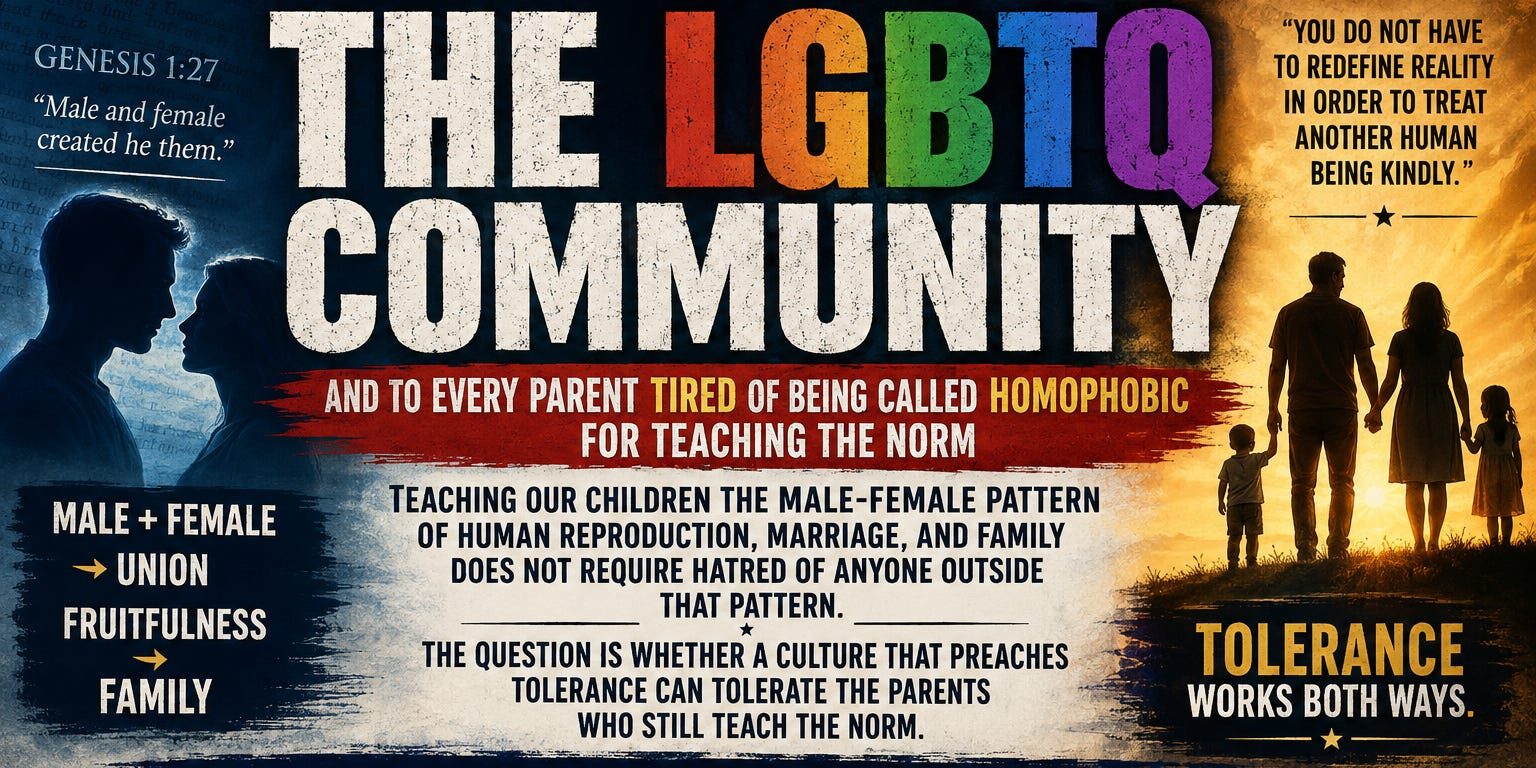
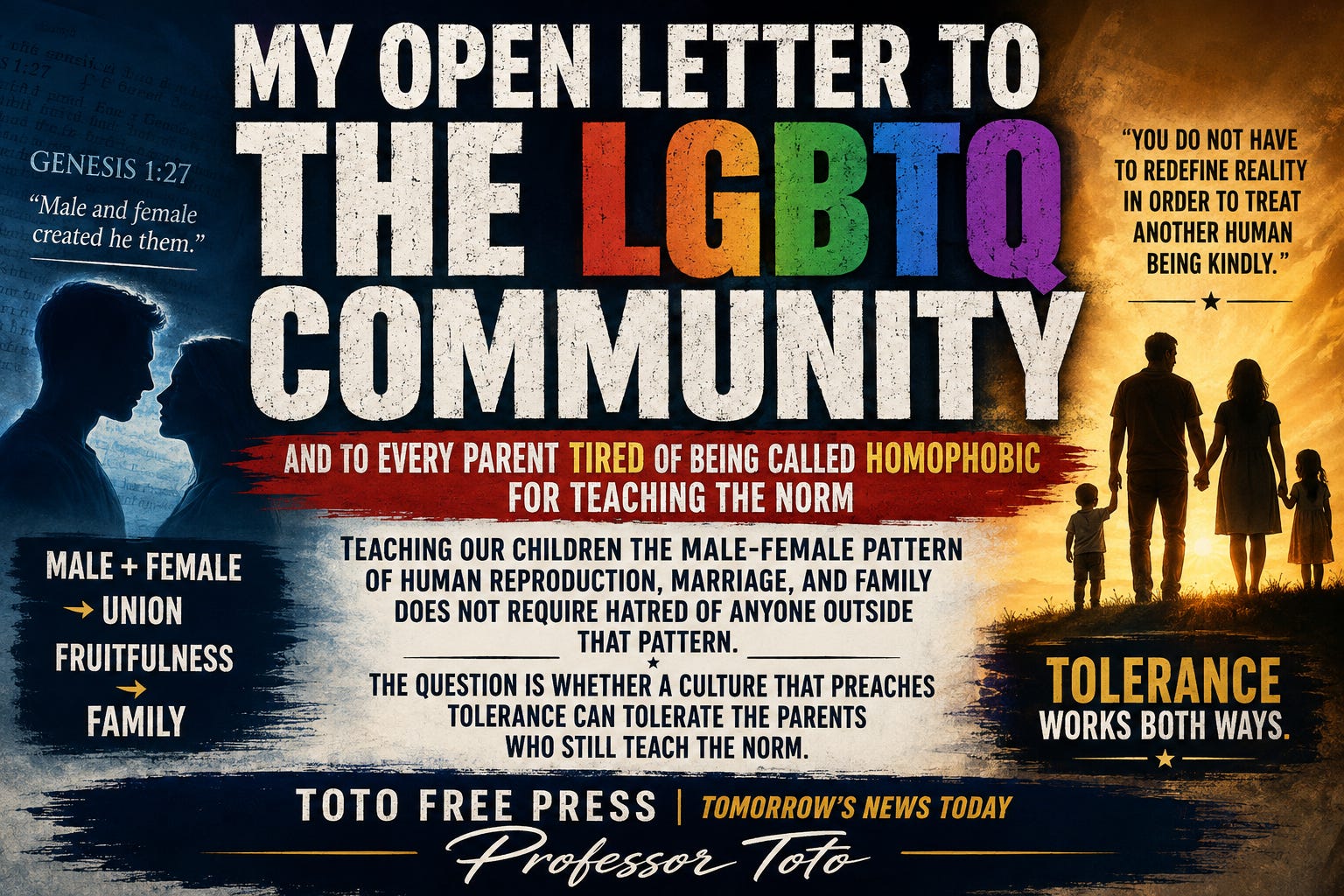
MALE + FEMALE → UNION → FRUITFULNESS → FAMILY
That is not something Christianity invented two thousand years later.
For those of us who receive Genesis as authoritative, it is embedded in the creation account itself.
And biology gives us something concrete standing alongside that theological claim.
How does human reproduction occur?
At its foundation:
SPERM + EGG.
Male gamete.
Female gamete.
Modern medicine can facilitate fertilization. It can use IVF. It can involve donors. It can involve surrogacy. Technology can dramatically alter the circumstances surrounding conception.
But it has not produced a third human reproductive gamete.
The reproductive pattern remains sexually differentiated.
Now let me be intellectually precise, because I will not win this argument by overstating it.
Biology alone does not prove my entire theology of marriage. My theology comes from Scripture.
But biology does demonstrate that male and female reproductive differentiation is not some arbitrary invention of Christian conservatives.
It is rooted in human reproduction itself.
AND NOW LET ME SAY THE PART I AM NOT SUPPOSED TO SAY
I want to be candid here, because a careful reader will catch me if I am not.
I am making two claims in this article, not one. And they are different in kind.
The first is descriptive. Male and female reproduction is the pattern by which human beings actually come into existence. That is not a matter of opinion.
The second is normative. I believe the union of a man and a woman, ordered toward children, is not merely the statistically common arrangement. I believe it is the better one. I believe it is what a healthy society ought to encourage, hold up, and teach first.
Now, I could hide that second claim inside the first. Plenty of people do it. They define normal as nothing more than “whatever happens to be typical,” insist that no judgment whatsoever is implied, and then proceed very quietly to argue that society should privilege the typical.
I will not do that, for one simple reason:
It is dishonest. And I have spent this entire article asking the other side to stop pretending.
So let me be plain.
I am not merely describing a pattern. I am defending it.
When I use the word norm, I mean it in both senses — the pattern that is, and the standard I believe ought to be taught.
That is a far more demanding claim. It obligates me to actually argue for it rather than smuggle it in through a dictionary definition.
Fair enough. I accept that burden.
But notice carefully what that claim does not contain.
Saying that an arrangement is better is not saying that the people in other arrangements are worth less. We make that distinction constantly, and without the slightest difficulty, everywhere else in life.
I believe a child is generally best served by having both a mother and a father in the home. That is a claim about an arrangement.
It is not a verdict on the dignity, the worth, or the citizenship of a single mother — who may well be the most heroic person I know.
Those are two entirely different sentences.
And the confusion of them is the whole reason this conversation has become impossible.
A judgment about a pattern is not a judgment about a person.
I am making the first.
I refuse to make the second.
II. IF THERE IS A NORM, SOMETHING MUST FALL OUTSIDE IT
And here is where the modern conversation becomes strangely uncomfortable.
If we acknowledge a norm, then logically we must acknowledge that some things fall outside that norm.
That is what abnormal, in its most literal sense, actually means: outside or departing from the norm.
But our culture hears that word and immediately translates it into:
worthless.
That does not follow. It has never followed.
If something falls outside a particular norm, that tells us nothing whatsoever, by itself, about the worth of the human being involved.
Those are two entirely separate propositions.
A single-parent household is not the same family structure as a two-parent household.
A grandparent raising a grandchild is not the ordinary biological parent-child arrangement.
An adoptive family necessarily has a different biological history than a birth family.
Yet none of that means the people in those families possess one ounce less human dignity.
Departure from a norm does not equal absence of worth.
And therefore Christians should not have to destroy the category of normal in order to demonstrate compassion toward people whose lives fall outside what we believe to be Yahweh’s created pattern.
III. “WHAT THEY DO IN THEIR BEDROOM IS NONE OF YOUR BUSINESS”
For years, this was the argument.
And frankly, there is considerable wisdom in part of it.
Government should not be peering through bedroom windows.
Christians should not spend their lives obsessing over the private behavior of strangers.
People should not be harassed in restaurants, screamed at on sidewalks, assaulted, threatened, or treated as less than human because of their sexuality.
I will say that as plainly as I know how, and I will defend it as long as I have breath.
But something changed.
The argument left the bedroom.
Once we begin discussing:
-
the definition of marriage,
-
what constitutes a family,
-
motherhood and fatherhood,
-
adoption,
-
children’s education,
-
school curricula,
-
institutional religious liberty,
-
and what society is expected to recognize as equally normative —
we are no longer talking exclusively about private sexual conduct.
We are talking about SOCIAL INSTITUTIONS.
Marriage is a social institution.
Family is a social institution.
Education is a social institution.
Parenthood carries enormous social consequences.
Therefore society has every right to discuss them.
The question is not:
“Should homosexual people be allowed to live peacefully?”
Of course they should.
The harder question is:
“Does allowing people to live differently require society to surrender the right to identify an ideal or a norm?”
My answer is NO.
IV. TEACH THE RULE BEFORE THE EXCEPTION
This may be the most important question in the entire piece:
DOES SOCIETY STILL HAVE THE RIGHT TO TEACH ITS CHILDREN THE NORM?
Here is where I believe society has lost its nerve.
Every civilization teaches children patterns before it teaches them exceptions. It cannot avoid doing so.
We teach grammar by beginning with the rule, even though irregular words exist.
We teach mathematical principles before introducing the complexities and edge cases that come later.
We teach children what healthy behavior looks like even though human beings routinely depart from it.
So why should family suddenly become the one subject where society grows afraid to identify a norm?
Suppose a five-year-old asks:
“Where do babies come from?”
The foundational biological answer remains remarkably simple:
A baby begins through the joining of a sperm and an egg.
Male reproductive contribution.
Female reproductive contribution.
That is not hate speech.
That is human reproduction.
And why should we be embarrassed to teach children the historical family pattern that naturally corresponds to that reproductive reality?
MAN + WOMAN → CHILDREN → FAMILY
Now somebody will immediately object.
“But not every married couple has children.”
Of course not.
“But some children are adopted.”
Certainly.
“Some children have only one parent.”
Absolutely.
“Some children are being raised by grandparents.”
Yes.
“Some children have two mothers or two fathers.”
They do.
Those realities exist. I am not asking anyone to pretend otherwise.
But here is the distinction I want restored:
The existence of exceptions does not prevent us from teaching a foundational pattern.
V. ACKNOWLEDGING AN EXCEPTION DOES NOT REQUIRE MAKING IT THE RULE
Teaching children that motherhood and fatherhood constitute a longstanding family norm does not require teaching them to despise a classmate whose family looks different.
That would be cruel, and I reject it outright.
A child is fully capable of being taught both:
“This is the family pattern our faith regards as normative.”
and
“You will meet people whose families are different, and you will treat them with dignity and kindness.”
Why have we convinced ourselves that children cannot hold those two thoughts at the same time?
We teach precisely that structure everywhere else in life.
Here is the standard.
Here are the departures from the standard.
And here is how decent people treat those whose circumstances differ from their own.
That isn’t hatred.
That is civilization.
VI. CHILDREN SHOULD NOT HAVE TO DESTROY A CATEGORY TO UNDERSTAND AN EXCEPTION
This is where I believe modern society has made a serious philosophical mistake.
In our determination that no child should ever feel excluded, we began behaving as though the very existence of a norm constitutes an attack upon everyone outside it.
But follow that principle all the way to its conclusion.
If every exception requires us to abolish the category from which it differs, eventually language itself becomes impossible.
There can be no NORMAL.
There can be no IDEAL.
There can be no STANDARD.
There can be no RULE.
And — pay attention to this one — there can be no EXCEPTION either.
Because an exception can only be identified in relationship to a rule. Remove the rule and you have not liberated the exception. You have erased it.
That leaves society one possible conclusion:
Everything must be described as equally normative.
I reject that.
Not because I want children mistreated.
Precisely because children deserve clarity.
I want a child to be entirely capable of understanding:
“My family is different from the traditional pattern, and that does not make me less valuable.”
That is a far healthier lesson than pretending differences do not exist.
Teach them the pattern.
Teach them the exceptions.
Teach them that the exceptions are occupied by human beings possessing full dignity.
And teach them the thing our generation most desperately needs to relearn:
YOU DO NOT HAVE TO REDEFINE REALITY IN ORDER TO TREAT ANOTHER HUMAN BEING KINDLY.
VII. NOW LET’S TALK ABOUT TOLERANCE
Here is where this discussion gets uncomfortable.
For decades Christians were told:
“You don’t have to agree with homosexuality. Just tolerate us.”
Very well.
Then I have a question.
CAN YOU TOLERATE ME?
Not merely tolerate my existence.
Can you tolerate my actual beliefs?
Can you tolerate me teaching that Yahweh created humanity male and female?
Can you tolerate me believing marriage is properly defined as the union of a man and a woman?
Can you tolerate Christian parents teaching their children that motherhood and fatherhood represent the created family pattern?
Can you tolerate churches that refuse to redefine marriage?
Can you tolerate religious schools maintaining sexual standards drawn from Scripture?
And here comes the hardest one:
Can you tolerate knowing that, according to my understanding of the created norm, I regard same-sex sexual relationships as outside that norm?
Because if you cannot —
what exactly does the word tolerance mean?
VIII. EVERYBODY CAN TOLERATE APPLAUSE
Think about this carefully.
It requires absolutely no tolerance to coexist with someone who already agrees with you.
Everybody can tolerate applause.
Tolerance becomes meaningful at precisely the moment somebody says something you profoundly dislike.
An LGBTQ reader may well believe:
“Professor Toto’s theology is antiquated, offensive, and wrong.”
Fine.
I can tolerate that.
You are free to believe it. You can tell me my interpretation of Scripture is mistaken. You can reject my understanding of creation. You can disagree with every word in this article.
I will not ask government to force you to believe otherwise.
Now —
CAN YOU RETURN THE FAVOR?
Can you say:
“Professor Toto believes my relationship falls outside Yahweh’s created pattern. I strongly disagree with him, but he possesses the same freedom of conscience I demand for myself.”
If so —
THAT is tolerance.
But if tolerance means:
“You must respect my right to define my relationship however I choose, AND you must adopt my definition yourself” —
then we have left tolerance behind entirely.
That is compelled affirmation.
And compelled affirmation is not a virtue. It is a demand.
IX. I CAN RESPECT YOUR HUMANITY WITHOUT ADOPTING YOUR WORLDVIEW
This should not be difficult.
I can sit at lunch beside a homosexual couple.
I can speak kindly to them.
I can recognize their human dignity.
I can defend them if somebody threatens them.
I can oppose genuine discrimination or violence against them.
I can wish them no harm whatsoever.
And I can simultaneously say:
“I do not believe your relationship conforms to Yahweh’s created pattern for marriage.”
Those propositions can coexist. They have coexisted for most of human history.
In fact, if my Christianity cannot distinguish between disagreement and dehumanization, then my Christianity needs serious examination.
But the reverse is equally true.
If modern tolerance cannot distinguish between disagreement and hatred, then modern tolerance needs serious examination.
I refuse both extremes.
Conviction without human dignity becomes cruelty.
But —
human dignity does not require the surrender of conviction.
X. THERE IS NO NEUTRAL SOCIETY
Does society have the right to have standards?
Of course it does. It cannot function without them.
Every civilization distinguishes among the things it encourages, accepts, discourages, and prohibits.
Every civilization teaches its children some understanding of citizenship, responsibility, family, sexuality, honesty, justice, and human relationships.
So let us stop pretending that one side wants to impose values while the other side merely wants society to remain neutral.
There is no neutral society.
The moment a school teaches that heterosexual and homosexual relationships are to be regarded as equally normative, it has taught a value.
The moment a school teaches that marriage is fundamentally male and female, it has taught a value.
Those are competing understandings of the human person and the family. We should stop pretending otherwise.
One parent says: “Marriage is fundamentally the union of man and woman.”
Another says: “Marriage includes opposite-sex and same-sex couples equally.”
Those are competing propositions. Both cannot be the norm.
So the real argument was never:
VALUES versus NO VALUES.
It is, and always has been:
WHICH VALUES?
And:
WHO DECIDES?
XI. AMERICA IS NOT A CHURCH
Now let me draw an important boundary, because I do not want to be misunderstood.
America is not the Church.
My belief that Yahweh established a created order does not mean every biblical command should automatically become American criminal law. That would confuse theology with civil government, and it would be a disaster for both.
In a constitutional republic containing millions of people holding radically different beliefs, we must protect two things at once:
EQUAL CITIZENSHIP
and
FREEDOM OF CONSCIENCE.
The homosexual person is my fellow citizen.
So is the Christian who believes homosexuality falls outside the created order.
Neither should have to surrender his humanity to the other.
Neither should be subjected to violence.
Neither should be silenced merely for existing.
And neither should possess the power to compel the other’s conscience.
I want the freedom to teach my children that male and female are the created pattern.
I must simultaneously recognize that another parent possesses the civil freedom to teach something different.
Then, at last, we can have the argument America actually needs to have:
What should our common institutions teach as the norm — and what should properly be left to families, churches, and individual conscience?
That is a legitimate debate. That is a debate worth having in public.
And refusing to have it because somebody might be offended does not resolve the question.
It merely allows somebody else to answer it for us.
XII. THE RECIPROCITY TEST
So I propose a very simple test for modern tolerance. Five questions. Answer them honestly.
I will respect your humanity. Will you respect mine?
I will recognize your civil liberties. Will you defend my religious liberty?
I will not ask government to force you to believe my theology. Will you refrain from asking institutions to force me to affirm yours?
I will teach my children not to mistreat yours. Will you permit me to teach mine what I believe about marriage?
I will peacefully coexist with you while believing your relationship falls outside the created norm. Can you peacefully coexist with me while believing my theology is wrong?
If both sides answer YES —
we can have a society.
But if one side answers:
“No. You must affirm me before I will consider you tolerant” —
then we have discovered something important.
That person is no longer asking for tolerance.
They are asking to establish their worldview as the new social standard.
XIII. PERHAPS THIS WAS NEVER REALLY ABOUT THE BEDROOM
And that brings me back to that lunch.
I wasn’t angry at the people around me.
They were eating lunch. So was I.
They didn’t bother me. I didn’t bother them.
In one sense, that scene demonstrated exactly how a free society is supposed to work. We peacefully shared the same space while almost certainly holding radically different understandings of life.
But watching it caused me to recognize something deeper.
The great cultural argument was never ultimately about what somebody does behind a closed bedroom door.
It is about something far larger:
WHO GETS TO DEFINE NORMAL?
Is normal determined by whatever society currently celebrates?
By legislation?
By courts?
By corporations?
By entertainment?
By schools?
By majority opinion?
Or is there a pattern that precedes all of us?
For me, there is.
I go back to the beginning.
I go back to Genesis.
I go back to the pattern.
MALE AND FEMALE.
HUSBAND AND WIFE.
FATHER AND MOTHER.
And ultimately:
FAMILY.
Someone else is free to reject that standard. That is the price of living in a free country, and I pay it willingly.
But freedom works both ways.
You are free to reject my standard.
And —
I AM FREE TO KEEP IT.
AND I AM FREE TO TEACH IT TO MY CHILDREN.
Perhaps that is the society standard we most desperately need to recover.
Not forced conformity.
Not hatred.
Not humiliation.
Not persecution.
But the maturity to say:
“I believe there is a norm. You disagree with me. Neither one of us gets to destroy the other.”
Because the ultimate test of tolerance is not whether you can tolerate being accepted.
The ultimate test of tolerance is whether you can tolerate being disagreed with.
And if our society can no longer do that —
our greatest problem may not be sexuality at all.
Our greatest problem may be that we have forgotten how a free society survives disagreement.
TOTO FREE PRESS — Tomorrow’s News Today Professor Toto
If this said what you have been thinking but were afraid to say out loud, share it with one parent who needs to read it. And tell me in the comments: can we still teach the norm without being called haters?