



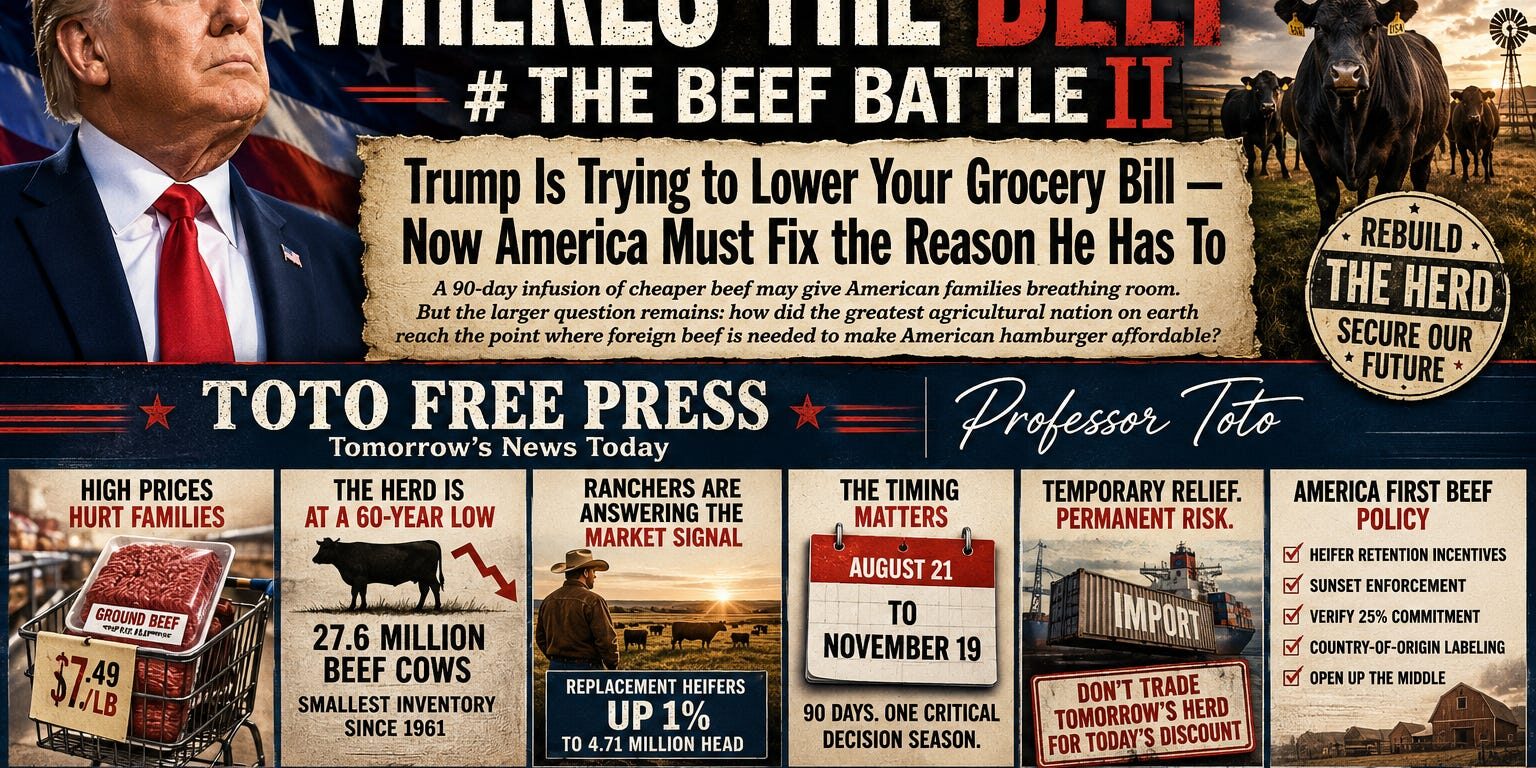
TOTO FREE PRESS — Tomorrow’s News Today Professor Toto
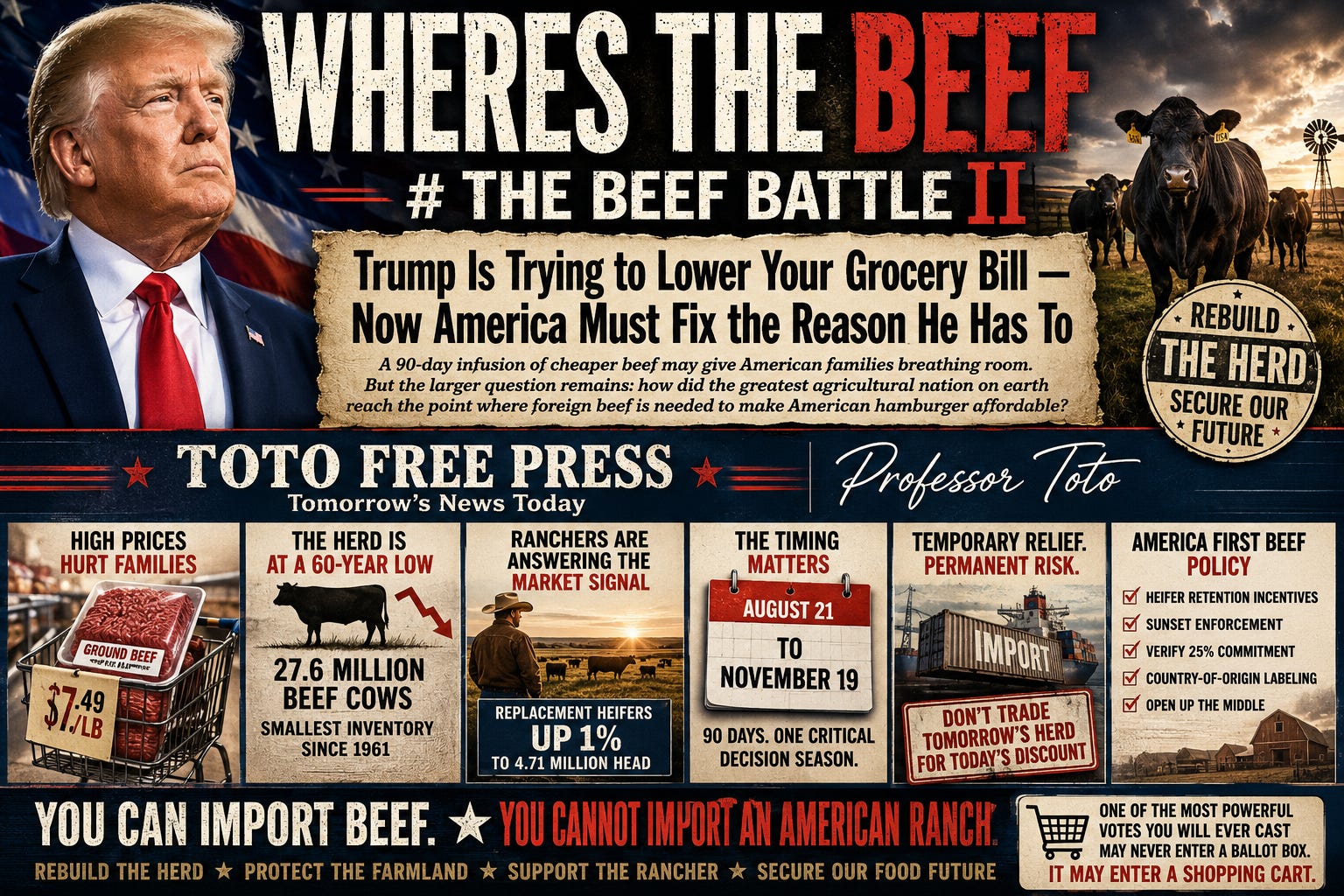
Beef is too expensive.
There’s no sense pretending otherwise.
American families feel it every time they walk into a grocery store. Ground beef used to be one of the economical ways to feed a family. Now it’s another package that makes Momma stop, stare at the price, and start doing arithmetic in the aisle.
President Trump understands that reality, and on August 21 he moved on it. As announced, the United States will temporarily allow up to 300,000 metric tons of product for ground beef to enter for 90 days without the normal out-of-quota tariff, with a commitment that the product be sold 25 percent below current market prices.
I understand exactly what the President is trying to accomplish. Give American families some breathing room. Good.
How in the world did America get here?
How did one of the greatest agricultural nations God ever blessed reach the point where we need additional foreign beef to make hamburger affordable?
How did the American cattle herd become historically small? How did independent ranchers end up battling drought, fire, flood and brutal weather while facing higher costs for land, equipment, feed and financing? How did productive farmland become subdivisions, warehouses and data centers? How did so much processing power end up concentrated among a handful of enormous corporations?
Donald Trump didn’t create this problem.
HE INHERITED IT.
But a temporary solution to an immediate problem must never quietly become America’s permanent agricultural policy.
The herd is telling us something
America entered 2026 with approximately 27.6 million beef cows — the smallest beef-cow inventory since 1961, according to USDA’s January report.
Think about that. Our population has exploded since 1961. Our beef-cow herd has gone backward to the Kennedy administration.
The 2025 calf crop came in at 32.9 million head, down 2 percent — a record low.
That matters, because cattle cannot be manufactured. Washington cannot pass an appropriation on Tuesday and produce a million mature cows by Friday. A rancher makes a decision today whose consequences don’t reach a grocery store for years. Does he sell the heifer, or keep her? If he keeps her, she has to mature, breed, gestate, calve. That calf has to grow. Only then does she become part of America’s beef supply.
You cannot legislate around a biological clock.
And here is the part almost nobody is reporting
High prices are painful. They are also information.
When cattle prices climb, the market is telling producers one thing: we need more cattle. And ranchers respond. They stop selling heifers into the feedlot and start keeping them back for breeding.
That is precisely what had begun to happen.
In the January 2026 inventory, beef replacement heifers were up 1 percent, to 4.71 million head. After years of contraction, ranchers had finally started holding females back. Analysts still don’t expect the national herd to actually expand until 2028 or later — that’s how long the biology takes — but the turn had started.
Read that again, then read the calendar.
The market signal was finally working. And a wave of below-market imported product was announced right on top of it, in August, at exactly the season when producers are making retention decisions for the coming year.
This is my concern in one sentence: I don’t want a 90-day grocery discount purchased with a five-year hole in the American cattle herd.
Don’t take my word for it — take theirs
I’m not the one saying this loudest. The cattlemen are.
Colin Woodall, CEO of the National Cattlemen’s Beef Association, responded to the announcement bluntly: “flooding the market with government-subsidized, below-market beef is not the way to rebuild the American cattle herd.” He noted that cattle markets “turned sharply lower this morning, to the detriment of farmers and ranchers,” and warned that the timing — this critical season for herd decisions — could “throw cold water on the prospect of herd expansion.”
That is not a globalist think tank. That is the largest organization of American cattle producers in the country, watching the price signal they’ve waited a decade for get stepped on.
The President said it himself
Now let me show you the sentence almost nobody quoted, because it is the most important thing said all week — and it came from President Trump:
“This deal will reduce prices for Americans while giving space for our Great American Beef Herd to grow again.”
Read it twice.
The President did not say cheap beef forever. He did not say permanent imports. He said the point of this deal is to give our Great American Beef Herd room to grow again.
That is the right goal. That is an America First goal. Nobody forced that sentence out of him — he set the standard himself.
So let’s do him the honor of taking it seriously.
Because if herd growth is the objective the President named, then herd growth is the yardstick the policy has to be measured by. Not cable news. Not the comment section. Not whether it makes anybody feel good on a Friday.
Did the American herd get room to grow?
And that is where we run into something that has to be dealt with honestly.
The timing problem
Here is the trouble, and I want to be precise, because precision is what separates an argument from a tantrum.
The President has two goals in one sentence. Lower prices now. Grow the herd. Both are good. Both are worth having.
But look at how a herd actually grows.
A herd grows when a rancher keeps a heifer instead of selling her. That is the whole ballgame. He gives up cash in his hand today for an animal that won’t produce a dime until 2028. Nobody makes that trade out of patriotism. He makes it because the market has convinced him the wait will be worth it.
And what convinces him?
Price.
The price is the only letter the market ever mails him.
Now put the calendar on the table.
In January, replacement heifers came in up 1 percent, at 4.71 million head. After years of shrinking, ranchers had finally started keeping daughters back. The letter had arrived. They were reading it.
Then on the morning of August 21, according to NCBA, cattle markets turned sharply lower.
And late August through November is precisely when those decisions get made. Fall calf runs. Bred heifer sales. The moment a man stands at the chute and decides whether she gets bred back or gets shipped. The 90-day window runs to roughly November 19 — straight through the heart of it.
So here’s the honest summary:
The President’s stated goal is herd growth. The mechanism he chose softens the exact signal that produces herd growth. And it lands in the exact season when that signal does its work.
That is not corruption. That is not betrayal. That is a timing problem — and timing problems have fixes.
So fix the timing
I’m not asking the President to reverse himself. I’m asking him to finish the sentence he started.
If you are going to soften the price signal, then replace it with a policy signal. Pair the relief with the rebuild:
-
Guarantee the sunset in writing. Ninety days means ninety days, with no extension. A rancher can plan around a wall. He cannot plan around a maybe. Uncertainty kills retention faster than a low price does.
-
Run a heifer-retention incentive alongside it. If the market can’t pay him to keep her for the next 90 days, then policy should. This is the single highest-leverage thing Washington could do right now.
-
Audit the 25 percent. Publish who verified it and what happened if it wasn’t met.
-
Enforce country-of-origin labeling. If Americans are going to be asked to buy American, let them see which package actually is.
-
Open up the middle. Show us what happens between the cow and the cart.
Do those five things and the President’s own sentence comes true. Skip them, and the first half of his sentence eats the second half.
“Worse than socialism”? No. And that label is costing us the argument.
Which brings me to the reaction from our own side.
Congressman Thomas Massie posted: “Worse than socialism! Dumping foreign beef in U.S. markets can temporarily lower prices but it won’t incentivize American farmers to raise more beef.”
He wasn’t alone. Senators Deb Fischer, Pete Ricketts, Steve Daines and Tim Sheehy pushed back. So did Marjorie Taylor Greene, who said the plan makes it “even harder for American beef ranchers and producers.” Congressmen Mike Flood, Adrian Smith, Dusty Johnson, Kat Cammack and Troy Downing weighed in too. This is not a fringe complaint. Cattle-state Republicans are genuinely upset, and they have standing to be.
But I have to say this plainly, even to friends:
Worse than socialism is wrong. Not slightly wrong. Categorically wrong.
Socialism is the state owning the means of production and setting prices by command. What actually happened here is the federal government removing a tax it had imposed. That’s it. A tariff is the intervention. Waiving one is the government doing less, not more.
You cannot spend a decade arguing that tariffs are muscular conservative policy and then turn around and call the removal of a tariff socialism. Pick one.
And the 25 percent? That is a negotiated commitment, not a price control. A price control has a statute behind it, a ceiling, a penalty and an enforcement arm. This has a handshake. That’s precisely my complaint — but notice it’s the opposite complaint from socialism. My objection is that there’s too little enforcement, not too much state power.
Then there’s the word itself.
Socialism in agriculture is not a 90-day tariff waiver. Socialism in agriculture is Soviet collectivization. It is grain requisition. It is the Holodomor, where millions of farmers starved on some of the richest soil on earth. It is Venezuela’s “fair price” laws emptying the shelves. It is Zimbabwe seizing farms and destroying a breadbasket in a decade.
When we hang that word on a temporary import quota, we spend it. And the day America genuinely needs that word to mean something, it will have been worn down to nothing.
Now — is there a fair version of the criticism? Yes, and I’ll give it its due. When government negotiates a target price and hands selective tariff relief to a chosen sector, that is industrial policy, and industrial policy does pick winners. Conservatives are right to be uneasy about it. That’s a real argument. It just isn’t the argument Massie’s headline made.
Here’s what’s frustrating: Massie’s second sentence is correct. “It won’t incentivize American farmers to raise more beef” is exactly right. It’s what NCBA said. It’s what I’ve been saying since last fall. He buried a true argument underneath a false label — and the label is all anybody heard.
The accurate name for what’s happening isn’t socialism.
It’s a market distortion with a timing problem.
Less catchy. Considerably more true. And a whole lot harder for anybody to wave away.
If we want to win this fight, we have to describe it correctly. You don’t fix a broken clock by calling it a communist.
Cheap and affordable are not the same thing
America has learned this lesson before.
For decades we were told offshoring was brilliant economics. Why make it here for ten dollars when somebody overseas will make it for six? Consumers got cheaper products. Corporations got fatter margins. Everybody celebrated — until the factories closed, the equipment disappeared, the skilled workers retired, the towns hollowed out, and our supply chains ran through nations thousands of miles away.
Then Washington started using words like reshoring and supply-chain security and strategic manufacturing.
Why? Because America finally learned that the lowest price is not always the lowest cost. Sometimes the difference between the two is called independence.
We cannot afford to learn that lesson twice.
You can reopen a factory. You can buy another machine. You cannot instantly recreate a cattle herd. And once farmland becomes a subdivision, a warehouse or a data center, there is a very good chance America never gets that ground back.
You cannot import an American ranch
This is personal to me. Three generations. We’ve sold it, traded it, hauled it.
So I don’t see cattle prices as numbers crawling across the bottom of a television screen. Behind those numbers are families. A cattle price decides whether another pasture gets leased. Whether a tractor gets financed. Whether a heifer gets retained. Whether a son or daughter believes there’s enough future left in agriculture to stay.
Or whether a family finally stands on ground that has held them for generations and says two words:
SELL IT.
And when that happens, understand what we’ve lost.
YOU CAN IMPORT BEEF. YOU CANNOT IMPORT AN AMERICAN RANCH.
You cannot import three generations of knowledge. You cannot import the town that depended on it. You cannot uncure concrete.
Now let’s be fair — and precise
Some folks will read this and say: Toto, America has always imported beef. They’re right, and I’m not going to pretend otherwise.
The United States has imported lean trimmings for years, largely because our fed-cattle system produces fatty trim that has to be blended with lean to make the hamburger Americans actually buy. Imported lean is not some new betrayal. It’s been part of the grind for a long time.
So my objection is not that imported beef exists.
My objection is scale, price suppression, and timing. Three hundred thousand metric tons entering tariff-free, explicitly priced below the domestic market, in the exact season when ranchers decide whether to rebuild — that is a different animal than routine trade, and it deserves to be argued on those terms.
What happens between the cow and the cart?
The rancher isn’t the only player. Between the pasture and Momma’s grocery cart stand the feedlot, the packer, the processor, the distributor and the retailer. American meatpacking is heavily concentrated among a handful of enormous companies.
Concentration is not proof of wrongdoing. But it absolutely deserves scrutiny when the rancher says I need enough to survive and the consumer says I can’t afford the hamburger — about opposite ends of the very same transaction.
So Professor Toto wants to know: what’s happening in the middle?
The announcement says the product will be sold 25 percent below market. Excellent. Here is my question, and I want you to notice that nobody has answered it:
Who enforces that?
As of this writing, no enforcement mechanism has been published. No audit. No reporting requirement. No penalty. Just a stated commitment.
Where does that 25 percent actually go? Does it reach the American mother? Does it show up on the shelf? Or does some portion evaporate somewhere between importer, processor, distributor and retailer?
Those aren’t accusations. They’re questions. And Americans have every right to demand answers before this window closes.
What to watch over the next 90 days
Bookmark this. The window closes around November 19. I intend to hold this list up against reality, and I’d encourage you to do the same.
-
Does retail ground beef actually fall? Not wholesale — retail. Watch the BLS ground beef price series, not press releases.
-
Is the 25 percent ever verified? Ask who audited it, and what happened if it wasn’t met.
-
What happens to feeder cattle futures? That’s the market pricing what ranchers expect next year.
-
Does heifer retention stall? The January 2027 inventory report will tell us whether the rebuild survived this.
-
Does 90 days stay 90 days? Extensions are how temporary becomes permanent.
-
Did the herd get room to grow? The President’s own test. Everything else is commentary.
The real America First beef policy
The long-term answer isn’t cheaper imported beef. It’s more American beef.
Rebuild the herd. Protect productive farmland. Make ranching profitable enough that the next generation stays. Encourage independent processing capacity. Ensure competitive markets. Cut needless regulatory weight off small producers. Strengthen domestic agricultural infrastructure.
And recognize something that should have been obvious all along:
A NATION THAT CANNOT FEED ITSELF IS NOT TRULY INDEPENDENT.
Food belongs beside energy, manufacturing, medicine and defense as a matter of national security.
But Washington cannot do this alone
Here’s the part we don’t like hearing.
It’s easy to demand that politicians save the American farmer. It’s harder to look in the mirror. We cannot demand an American food supply while refusing to support the Americans producing it. At some point our purchasing habits have to agree with our politics.
This is exactly why we built Patriots Buying Club. We didn’t want to just complain about the system — we wanted to build an alternative: American-raised, grass-fed and grass-finished beef, sold directly to Americans who want their money underwriting the food system they say they believe in. You can find us at www.byebyewalmart.com.
We’ve complained about multinational corporations, vanishing family farms, consolidation, and what’s happening to rural America.
Fine. But complaints don’t keep a rancher in business.
CUSTOMERS DO.
The President can negotiate tariffs. Congress can rewrite farm policy. USDA can encourage expansion. Regulators can scrutinize concentrated markets. Not one of them can make Americans intentionally buy American agriculture.
We have to do that.
And remember what we said about prices carrying information? Purchases carry it too. Every deliberate purchase of American-raised beef sends the market one message:
WE WANT MORE OF THIS.
Yes, American grass-fed beef sometimes costs more. Which raises the only question that really matters here: what is American independence worth?
Use the 90 days
The President said this deal should give our Great American Beef Herd space to grow again.
Then let’s give it space. Actually give it space — not as a line in a post, but as a policy with a retention incentive behind it and a hard wall at the end of it.
Let’s use this breathing room wisely — not to build another permanent dependency, but to rebuild a real American cattle industry.
Rebuild the herd. Protect the farmland. Strengthen independent processors. Support the American rancher. Build alternative distribution networks. And above all, buy what American farmers produce.
Because America First cannot just be printed on a hat. It has to become an economic decision. A farming decision. A purchasing decision.
And ultimately, a dinner-table decision.
I said it ten months ago in THE BEEF BATTLE: How Globalists Are Playing the Food Card to Corner Trump and Control You. I’ll say it again now, and I’ll keep saying it no matter who occupies Washington:
FOOD INDEPENDENCE IS NATIONAL SECURITY.
Support American ranchers. Buy American beef. Build American food independence.
PATRIOTS BUYING CLUB American-raised. Grass-fed. Grass-finished. www.byebyewalmart.com
Because one of the most powerful votes you will ever cast for the future of the American farmer may never enter a ballot box.
IT MAY ENTER A SHOPPING CART.