

Class—
WATCH THE CLOCK.
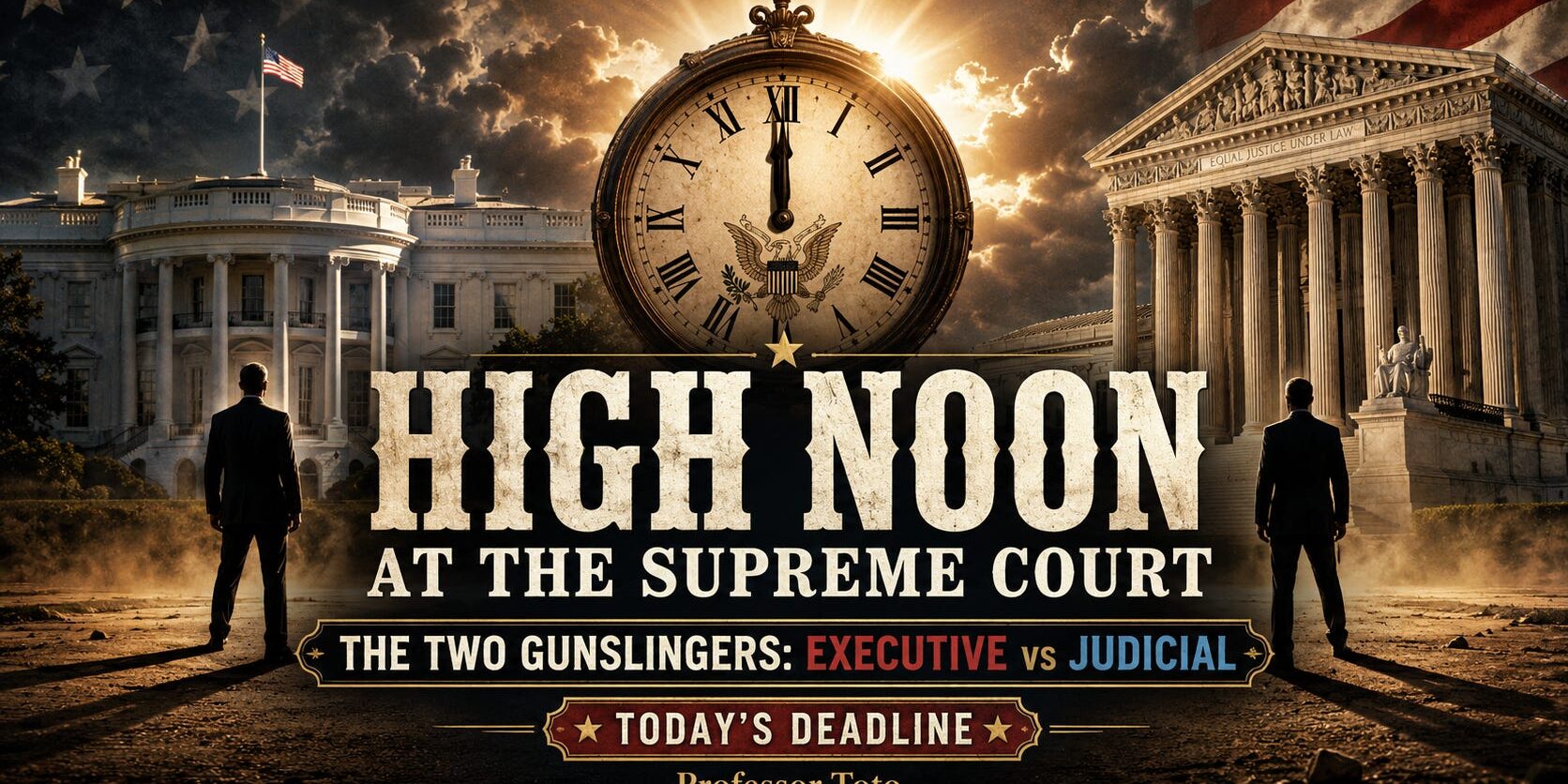
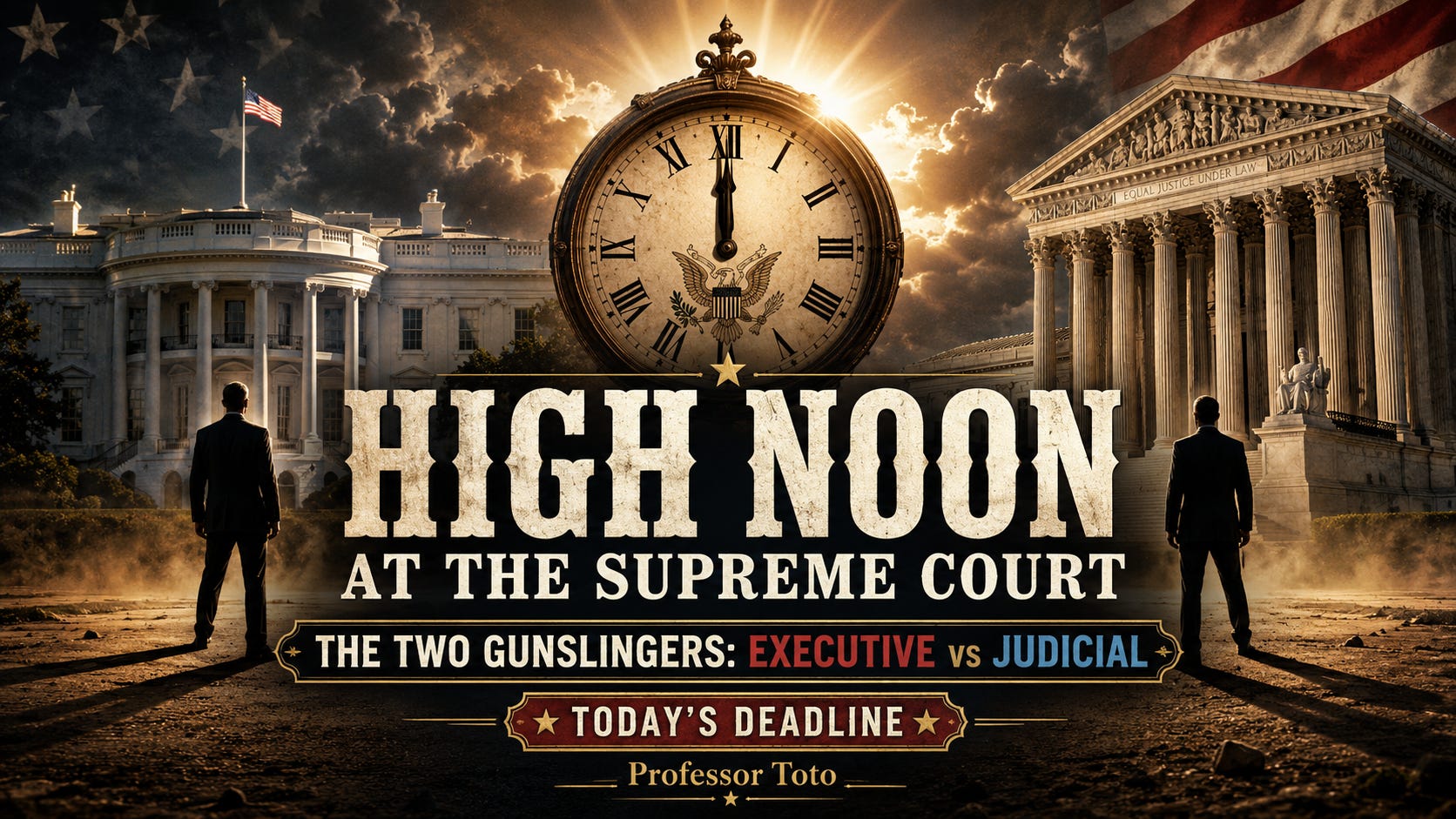
At HIGH NOON TODAY — 12:00 p.m. Eastern Daylight Time — something happens at the Supreme Court of the United States.
Now, before CNN calls me a conspiracy theorist because they cannot read a docket, let Professor Toto tell you exactly what happens at noon.
The Supreme Court is not scheduled to issue a ruling at noon.
Rather, Chief Justice John Roberts ordered the opponents of President Trump’s White House construction project to file their response to the Trump administration’s emergency application no later than 12:00 p.m. EDT today, August 18, 2026.
That is right there on the Supreme Court’s own docket.
Case No. 26A203 — National Park Service, et al. v. National Trust for Historic Preservation. The administration filed its emergency application for a stay, and Roberts ordered the response due AT HIGH NOON TODAY.
After that filing comes in, the stage is set.
And, class, forget the chandeliers.
Forget the gold trim.
Forget the jokes about Donald Trump wanting a ballroom.
Because something much larger has walked into the courtroom.
The Executive Branch and the Judicial Branch are staring at one another across Constitution Avenue.
Two gunslingers.
Hands near the holsters.
And somewhere between them sits one of the most important questions in our constitutional system:
WHO GETS TO DECIDE HOW THE PRESIDENT OF THE UNITED STATES IS PROTECTED?
FIRST — WHAT THIS CASE IS REALLY ABOUT
President Trump began constructing a massive replacement for the old East Wing of the White House.
Yes, it includes the famous ballroom.
But according to the emergency application filed by Solicitor General D. John Sauer, the project is also an integrated military and presidential-security complex.
The administration describes hardened construction extending five stories underground, bomb shelters, medical facilities, military structures, missile-resistant components, drone protection, ballistic and blast-resistant glass, secure communications capabilities and other defensive infrastructure.
Read that again.
THIS IS NOT SIMPLY A DANCE FLOOR.
The administration represents to the Supreme Court that the project is designed as part of the physical protection and continuity-of-government infrastructure of the presidency.
And this is where the story becomes explosive.
A federal district judge ordered the above-ground ballroom construction stopped.
The D.C. Circuit Court of Appeals upheld that injunction 2–1 on August 7.
The majority’s position is straightforward:
The White House belongs to the American people. Congress possesses constitutional authority over federal property. According to the majority, the President has not demonstrated sufficient statutory authority to undertake this massive structural alteration without congressional approval.
In their words, the President is essentially a “temporary tenant” rather than the owner of the White House.
That phrase may go down in history.
Because the Trump administration has now marched straight into the Supreme Court and answered:
The President of the United States is not somebody’s tenant.
He is the elected head of the Executive Branch.
And now we have our showdown.
THE FIRST GUNSLINGER: THE JUDICIARY
The courts say:
STOP.
You cannot dramatically alter federal property simply because the Executive wants to do it.
Congress controls the purse.
Congress possesses enormous constitutional authority over federal property.
Congress has historically funded and authorized major White House construction.
And therefore, according to the D.C. Circuit majority, presidential security cannot become a magic sentence that makes congressional authority disappear.
But there is another fact everyone discussing this case needs to know.
THE COURT DID NOT BAN ALL SECURITY CONSTRUCTION.
That would be inaccurate.
The injunction specifically permits underground bunkers, bomb shelters, military and medical infrastructure, along with above-ground construction considered “strictly necessary” to protect those facilities, the President and White House security.
And there sits the constitutional grenade.
Who determines what is strictly necessary?
A Secret Service professional?
A military commander?
The Director of National Intelligence?
The President?
Congress?
Or—
A FEDERAL JUDGE?
THE SECOND GUNSLINGER: THE EXECUTIVE
The Trump administration says the court has crossed a dangerous line.
Its Supreme Court application argues that the various components of this project are integrated together and that separating the “security” pieces from the “ballroom” pieces is not practically possible in the manner contemplated by the injunction.
And then the administration raises the argument that should make every American stop talking about chandeliers for five minutes.
According to the government’s filing, senior military, intelligence and security officials support immediate completion of the integrated project. The administration argues that a federal judge should not be determining how much presidential protection is sufficient when the Executive’s security apparatus says more is required.
The filing also points to an increasingly dangerous threat environment surrounding the presidency and argues that stopping construction would itself create security and operational problems at an active White House construction site.
And Judge Neomi Rao—the dissenter in the D.C. Circuit decision—essentially agreed with that concern.
Her dissent argued that the court had improperly placed aesthetic interests over the safety and security interests of the President, his family, staff and White House guests.
Now we arrive at the question Professor Toto wants his class thinking about.
IMAGINE WITH ME
Forget Donald Trump for sixty seconds.
Presidents come.
Presidents go.
PRECEDENTS STAY.
Imagine America five years from now.
Ten years from now.
Twenty years from now.
There is a different President occupying the White House.
Different party.
Different ideology.
Different world.
Intelligence agencies begin receiving warnings.
Drones.
Missiles.
Biological threats.
Perhaps something we have not even invented yet.
The Secret Service says:
Mr. President, we need this protective structure immediately.
The military agrees.
The intelligence community agrees.
Homeland Security agrees.
But somebody files a lawsuit.
And somewhere in America a federal judge decides:
No.
You may build this part.
But not that part.
This wall is necessary.
That structure is unnecessary.
This defensive system may proceed.
That integrated structure may not.
And then—
THE WHITE HOUSE IS ATTACKED.
People die.
A foreign dignitary dies.
Perhaps a President dies.
Perhaps continuity of government itself is threatened.
And America discovers afterward that the security professionals had warned that the complete integrated protection system was necessary.
Now answer Professor Toto’s question:
WHO ANSWERS FOR THAT DECISION?
Does the judge?
Does Congress?
Does the President?
Does the Secret Service?
Because this case forces us to confront something much larger than Trump.
When constitutional powers collide with immediate presidential security, who possesses the institutional competence—and the constitutional authority—to make the final call?
BUT PROFESSOR — DOESN’T CONGRESS MATTER?
Absolutely.
And this is where serious people must resist turning every constitutional dispute into red-team versus blue-team nonsense.
There are actually three branches standing on this street.
But today two of them are staring directly at one another.
The judiciary says it is not inventing congressional authority.
It says it is enforcing it.
The appeals court’s position is that the Constitution places federal property under congressional control and that Congress has not delegated the sweeping authority the administration claims here.
The Executive answers that Congress has already enacted laws providing sufficient authority for White House alterations and improvements and that the courts are reading those statutes far too narrowly.
There.
THAT is the case.
Not:
TRUMP WANTS A BALLROOM.
But:
HOW MUCH AUTHORITY HAS CONGRESS ALREADY GIVEN THE PRESIDENT?
And—
HOW FAR MAY A FEDERAL COURT GO IN RESTRAINING THE EXECUTIVE WHEN NATIONAL SECURITY IS INVOKED?
That is worthy of the Supreme Court.
AND NOW WE COME TO HIGH NOON
Look at your clock.
12:00 P.M. EASTERN.
AUGUST 18, 2026.
Chief Justice John Roberts ordered the response filed by that hour.
The government’s emergency request is sitting before the Supreme Court.
The injunction is presently scheduled to take effect August 21 unless further judicial action intervenes. The administration has asked the Supreme Court for immediate relief while the larger litigation continues.
So understand the chronology.
TODAY AT HIGH NOON IS NOT THE VERDICT.
It is the deadline that places the competing arguments before the Court and moves this constitutional gunfight toward its next moment.
And then nine Justices may have to answer a question far more consequential than:
Do you like President Trump’s ballroom?
The question hiding underneath it is:
WHO COMMANDS THE PRESIDENT’S HOUSE?
Congress says federal property belongs to the people.
The judiciary says it has authority to enforce those boundaries.
The Executive says the courts are interfering with presidential protection and responsibilities entrusted to the elected President.
And somewhere in the middle of all three—
stands the Constitution.
PROFESSOR TOTO’S WARNING
Class, here’s the mistake Americans repeatedly make.
They judge constitutional power according to whether they like the man currently exercising it.
That is childish.
Never ask:
“Do I trust Donald Trump with this power?”
Ask:
“Do I want EVERY FUTURE PRESIDENT to possess this power?”
And never ask:
“Do I trust this particular judge?”
Ask:
“Do I want EVERY FUTURE FEDERAL JUDGE possessing this authority?”
That is how grown people study government.
Because Trump will leave.
These judges will leave.
You and I will leave.
But the boundary drawn between the Executive and Judicial Branches could remain long after every person involved in this case is gone.
So today—
at HIGH NOON—
watch the Supreme Court docket.
Not because America needs another ballroom.
But because America needs to know exactly where one constitutional power ends—
and another begins.
Two gunslingers have walked into the street.
EXECUTIVE.
JUDICIAL.
Congress is standing behind the courthouse door.
And the Supreme Court may soon tell us—
WHO HAS TO HOLSTER THE GUN?
Class dismissed.
— Professor Toto
TOTO FREE PRESS — Tomorrow’s News Today