

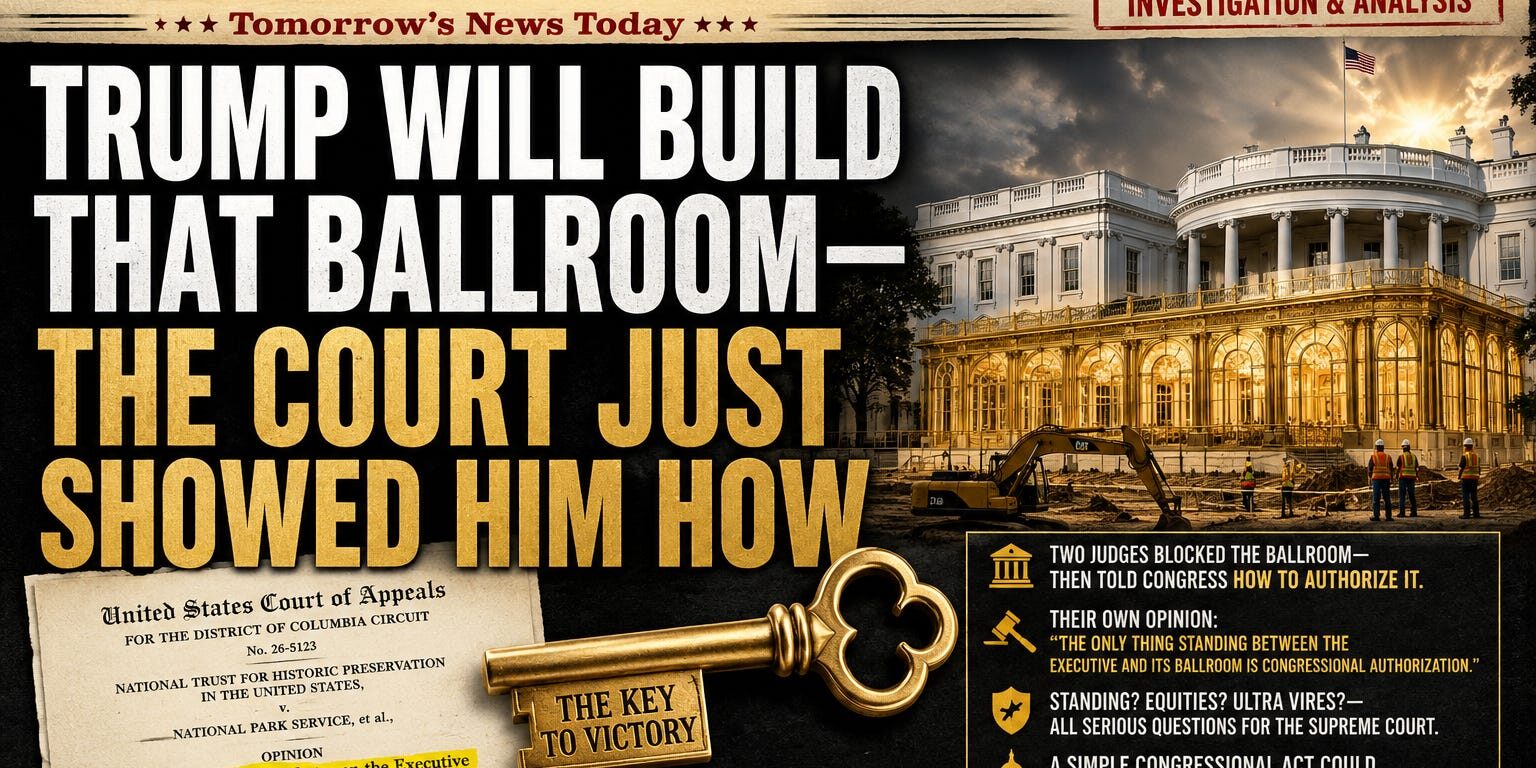
TOTO FREE PRESS — Tomorrow’s News Today Professor Toto | Toto-Town, Gulf Coast of Mississippi
Class — sit down. Sharpen your pencil.
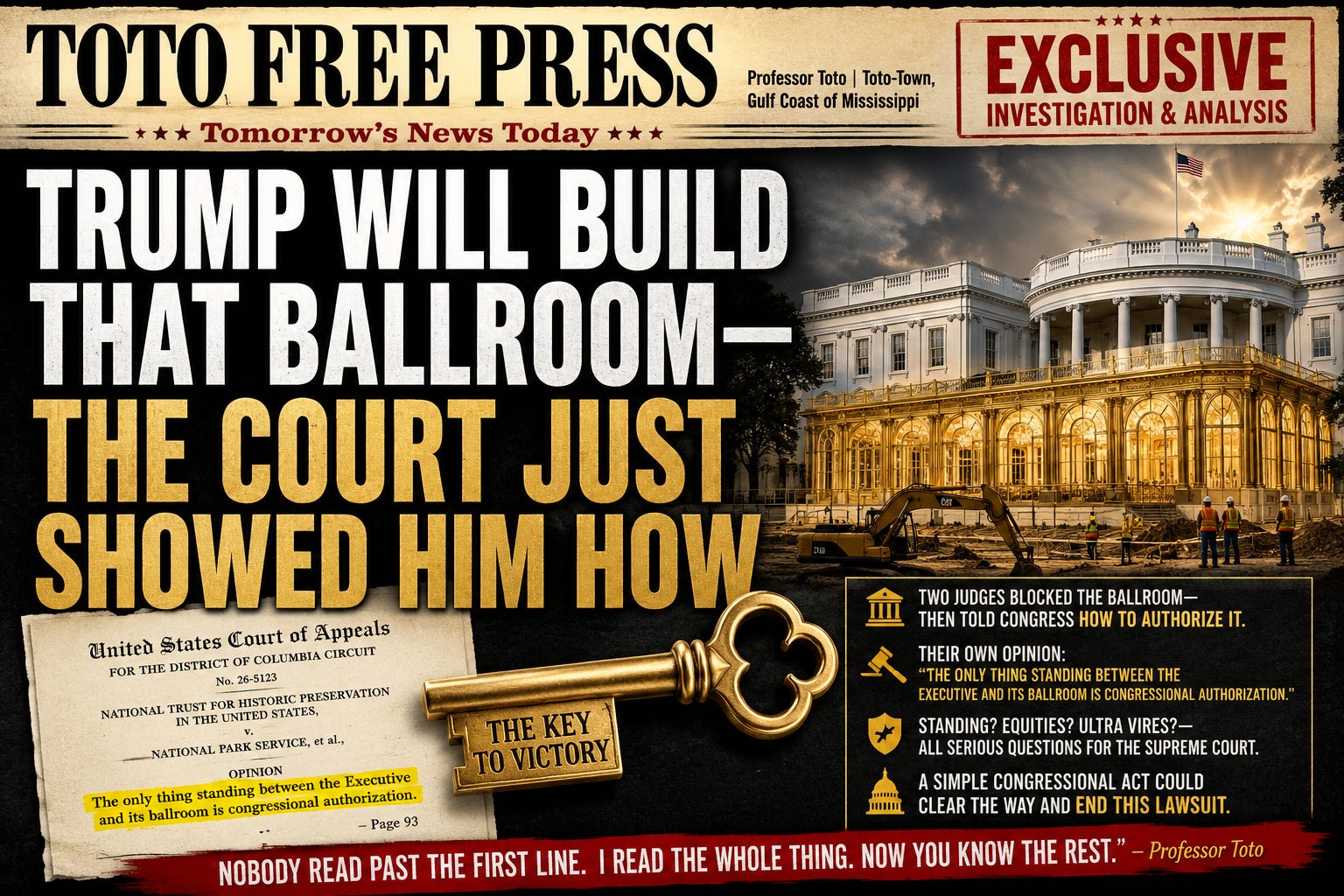
They are dancing in the streets of Washington tonight. Two judges wrote a sentence, and the whole rotten chorus sang it in unison: “Each President is a temporary tenant, not the owner.”
They put it on the chyron. They put it on the coffee mug. They read ONE LINE and declared the war over.
They did not read the rest.
I did.
And I am here to tell you what nobody on your television has the courage or the competence to say: THEY DID NOT STOP THAT BALLROOM. They stalled it. And in stalling it, they wrote down — in their own opinion, in their own hand — the exact instructions for how it gets built.
Four doors, class. He needs ONE.
Let’s walk through them.
FIRST — THE LIE THEY SOLD YOU
Before the doors, kill the lie. Because the story you were fed this weekend was false in three separate places.
Lie number one: “Construction stopped.” It did not. That injunction stops ABOVE-GROUND work on the ballroom. It expressly PERMITS the bunkers. The bomb shelters. The military infrastructure. The medical facility. The waterproofing, the sealing, the structural reinforcement. The below-ground fortress the President is building under that house is going up RIGHT NOW, tonight, while they celebrate.
Lie number two: “The court said he can’t build it.” The court said the OPPOSITE. Page six. Their words, not mine:
“This ruling does not even necessarily mean that the Defendants may not ultimately construct the ballroom.”
Read that again, class. The court that supposedly killed the ballroom said the ballroom is not killed.
Lie number three: “It’s over.” They stayed their own ruling for FOURTEEN DAYS so the President could go to the Supreme Court. Judges do not hand you the ladder if they’re sure you’re at the bottom of the pit.
That’s the media. Three lies before breakfast. Now let’s do the LAW.
DOOR ONE — THE WOMAN WHO TAKES A WALK
Start with the question nobody asked. Who sued?
The National Trust for Historic Preservation. They don’t own the White House. They don’t run President’s Park. Congress specifically FORBADE them from acquiring so much as a square foot inside a national park.
So how did they get in the courthouse door?
One member. One woman. One walk.
Her name is in the record. A professor who strolls past the White House about once a month, looks at it, enjoys it — and says a new ballroom will hurt her aesthetic, cultural, and historic interests.
That’s it, class. That is the entire foundation of this lawsuit. Not a dollar of injury. Not an acre of property. Not a right taken. A CHANGED VIEW.
Judge Neomi Rao called it exactly what it is — the aesthetic displeasure of a single passerby, elevated above the security of the President of the United States.
And here is why this door swings WIDE OPEN.
She will still take her walk. She will still study her architecture. She will still attend her meetings. Nothing she does becomes impossible. Something she LOOKS AT becomes different — and she wants a federal judge to freeze construction at the President’s house until it looks the way she prefers.
That is not an injury. That is a preference with a lawyer.
And this Supreme Court has spent a DECADE slamming that door shut. TransUnion, 2021 — no concrete harm, no federal case. Alliance for Hippocratic Medicine, 2024 — they threw DOCTORS out of court for injuries built on watching what other people do.
Never — not once in the history of this Republic — has the Supreme Court held that a stranger’s opinion about the appearance of the President’s own residence buys her a veto over what gets built there.
If it had, every crank in America owns a construction permit.
And understand what this door means. If the President wins here, he wins WITHOUT the Court ever ruling on a single brick. No holding on the ballroom. No holding on the Property Clause. Case dismissed, injunction vacated, cranes turn. The whole thing evaporates because the plaintiff was never entitled to be in the room.
That’s door one. Write it down.
DOOR TWO — THE PARADOX THEY CANNOT ESCAPE
Now watch this. This one is beautiful, and it is built entirely out of their own opinion.
The President can’t be sued under the ordinary administrative law. The Supreme Court settled that in 1992 — the President is not an “agency.” So the Trust had to reach for the emergency hatch: an ultra vires claim.
And that hatch is TINY. The majority tells you exactly how tiny. Here is the standard they wrote down themselves, page sixty-one. To win, they must show the President acted on a reading of the statute that is —
“utterly unreasonable” — a “patent misconstruction” of the law.
Utterly unreasonable. PATENT misconstruction. Not “we disagree.” Not “close call.” So wrong that no reasonable judge could ever hold it.
Now hold that up against one fact.
Judge Neomi Rao — a sitting judge of the United States Court of Appeals for the District of Columbia Circuit, who sat in that same courtroom, read those same briefs, studied that same statute — concluded the President is LIKELY RIGHT.
So I have a question for Judge Millett. I have a question for Judge Garcia.
How is it a PATENT MISCONSTRUCTION when the judge sitting next to you adopts it?
You cannot have it both ways, and I want the class to see the trap close.
Either that statute — which says in black letters “alteration… improvement… of the Executive Residence at the White House” — is genuinely debatable. In which case it is NOT “utterly unreasonable,” the hatch never opens, and the injunction dies.
Or it is so obviously wrong that no reasonable jurist could hold it. In which case one of the three judges on that panel is not a reasonable jurist.
PICK ONE.
They cannot. That’s not Toto’s rhetoric — that’s their own standard, measured against their own panel. And that, class, is what a Supreme Court petition is made of.
DOOR THREE — ONE SENTENCE FROM CONGRESS
Here’s the one that made me put my pencil down.
The court said the President is missing ONE ingredient. Not the Constitution. Not permission from a preservation society. One thing: express authorization from Congress, under a statute passed in 1912.
And then those judges did something extraordinary. They spent PAGES cataloguing — chapter and verse, out of the Statutes at Large — exactly how that authorization has been granted every time in American history.
-
1815 — Congress authorizes FIVE HUNDRED THOUSAND DOLLARS to rebuild the President’s House after the British burned it.
-
1823 — nineteen thousand dollars. The south portico.
-
1829 — twenty-four thousand seven hundred sixty-nine dollars and twenty-five cents. The north portico.
-
1902 — sixty-five thousand one hundred ninety-six dollars. THE WEST WING.
-
1909 — forty thousand dollars. THE OVAL OFFICE.
-
1945 — one point six five million. An addition to the Executive Mansion.
-
1949 — two million dollars and a commission. Truman gutted the place to the studs.
Class — do you hear what I just read you?
THE WEST WING TOOK AN ACT OF CONGRESS. THE OVAL OFFICE TOOK AN ACT OF CONGRESS. The room where the President of the United States signs the laws of this nation — a line in a bill. That’s all it ever was.
So the whole case against this President reduces to one thing: he doesn’t have his line yet.
A rider. TEN LINES. “The Executive Residence at the White House is hereby expressly authorized to construct…” — and the entire legal theory holding up that injunction has nothing left to stand on. Because the ONLY thing the National Trust ever proved was the ABSENCE of a yes.
Supply the yes, and they’re arguing with air.
They did not bury this ballroom, folks. They handed Congress the shovel — and then printed the instructions on how to dig.
DOOR FOUR — THE 1912 LEASH
Last door, and it’s the one the lawyers will fight over.
The statute they’re using against him was written in 1912. It says nothing — not one syllable — about the President of the United States. When an executive official was asked about it back in 1926, he explained it was meant to stop OTHER government offices and the general public from squatting on park land.
An anti-squatter law.
And two judges in Washington just took that 1912 anti-squatter law and turned it into a LEASH ON THE PRESIDENT inside the house where he lives and works.
The Supreme Court has a rule about this. When Congress means to bind the Chief Executive with a general statute, it says so. It doesn’t whisper it. It doesn’t leave it to a court to discover a hundred and fourteen years later.
The D.C. Circuit’s answer was to cite one of its OWN cases from 1996. Class — the D.C. Circuit citing the D.C. Circuit is not the Supreme Court. And whether a general statute silently binds the President is exactly the kind of question that gets FOUR VOTES on First Street.
AND ONE MORE THING THEY MISSED
Free of charge, because I read the footnotes.
The government’s lawyer made a concession at oral argument — and the majority admits, in writing, that its whole merits analysis rests on it. Their words: the ruling resolves the case “on the Defendants’ own terms.”
On their own terms. Not on the Constitution. Not on two centuries of history. On a concession about how the CHECKS WERE ROUTED — the private money was sent as a donation to the Park Service, which dragged in a conservation statute that says you must PRESERVE historic objects.
That’s the chain that stopped the crane. Not the Property Clause. The plumbing of the checkbook.
Lawyers don’t appeal their way out of a bad concession. They RESTRUCTURE out of it. And there is more than one lawful way to hold a dollar in Washington, D.C.
HOW THIS ENDS
So let them dance tonight.
They have a preliminary injunction — not a verdict, not a trial, not a judgment. They have a plaintiff whose entire injury is that she doesn’t like the view. They have a “patent misconstruction” that a federal appellate judge finds persuasive. They have a 1912 anti-squatter statute doing work it was never built to do. And they have an opinion that says, out loud, that the ballroom may yet be built.
Meanwhile the bunkers go in. The steel goes down. The clock runs.
He does not need all four doors, class. HE NEEDS ONE.
And the men who wrote that opinion handed him the map, the shovel, and the instructions — all because they could not resist the pleasure of calling the President of the United States a tenant.
And Now You Know…THE BEST OF THE STORY !!!!
📚 FROM THE PROFESSOR’S DESK
If tonight’s lesson stirred something in you, the long-form teaching lives in the books:
-
BEFORE THE BEGINNING
-
BLOODRIGHT
-
THE COLORS OF COVENANT
-
HIDDEN MANNA MORNINGS
All by Shane Vaughn — search them on Amazon. Get one for yourself, one for your pastor, and one for that relative who still thinks everything is fine.
The long-form teaching lands first right here: professortoto.substack.com. Subscribe. It’s free.
TOTO FREE PRESS | Professor Toto | Where the Republic Meets the Word Toto-Town, Gulf Coast of Mississippi | © First Harvest Ministries