


Folks, you hear it more and more.
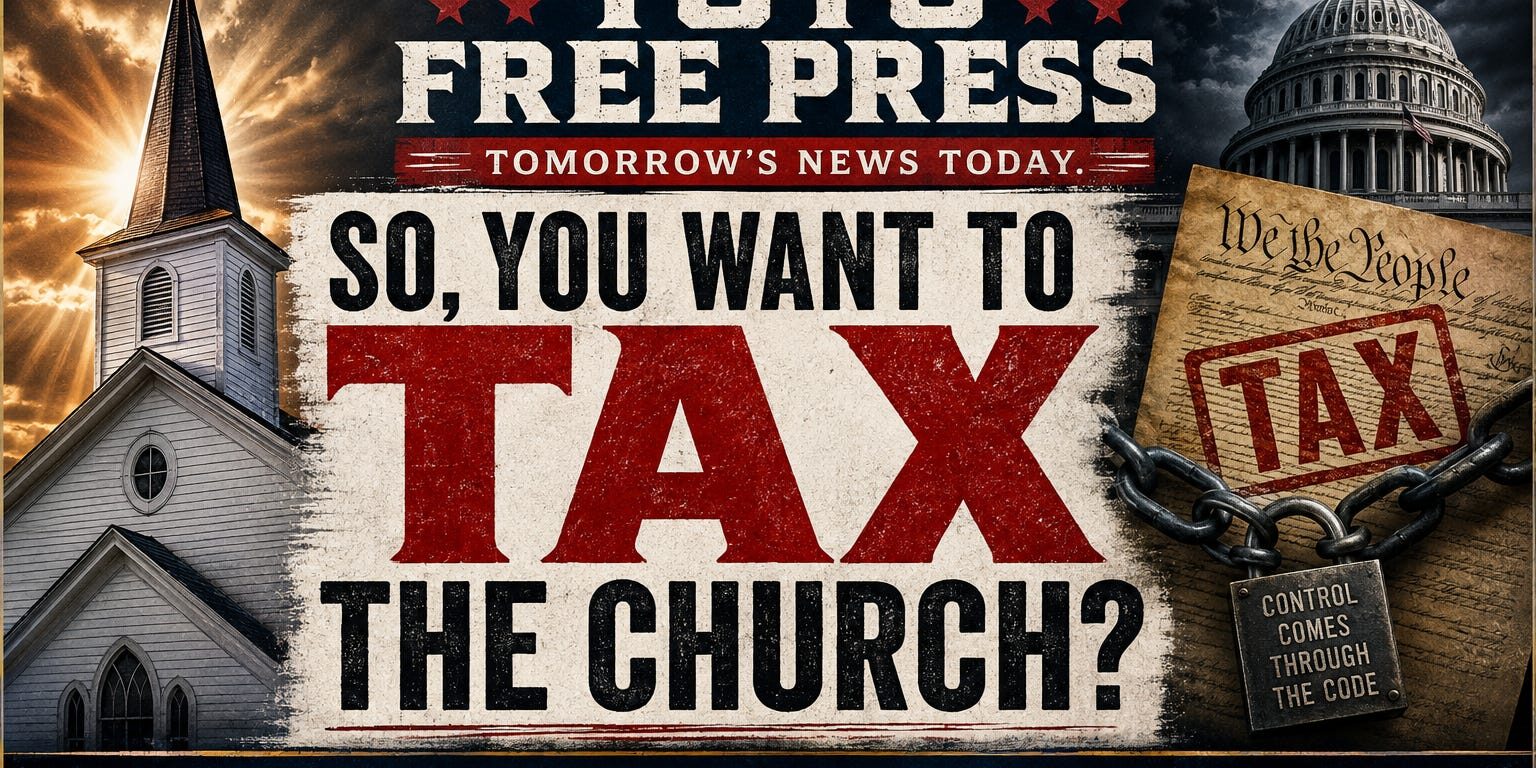
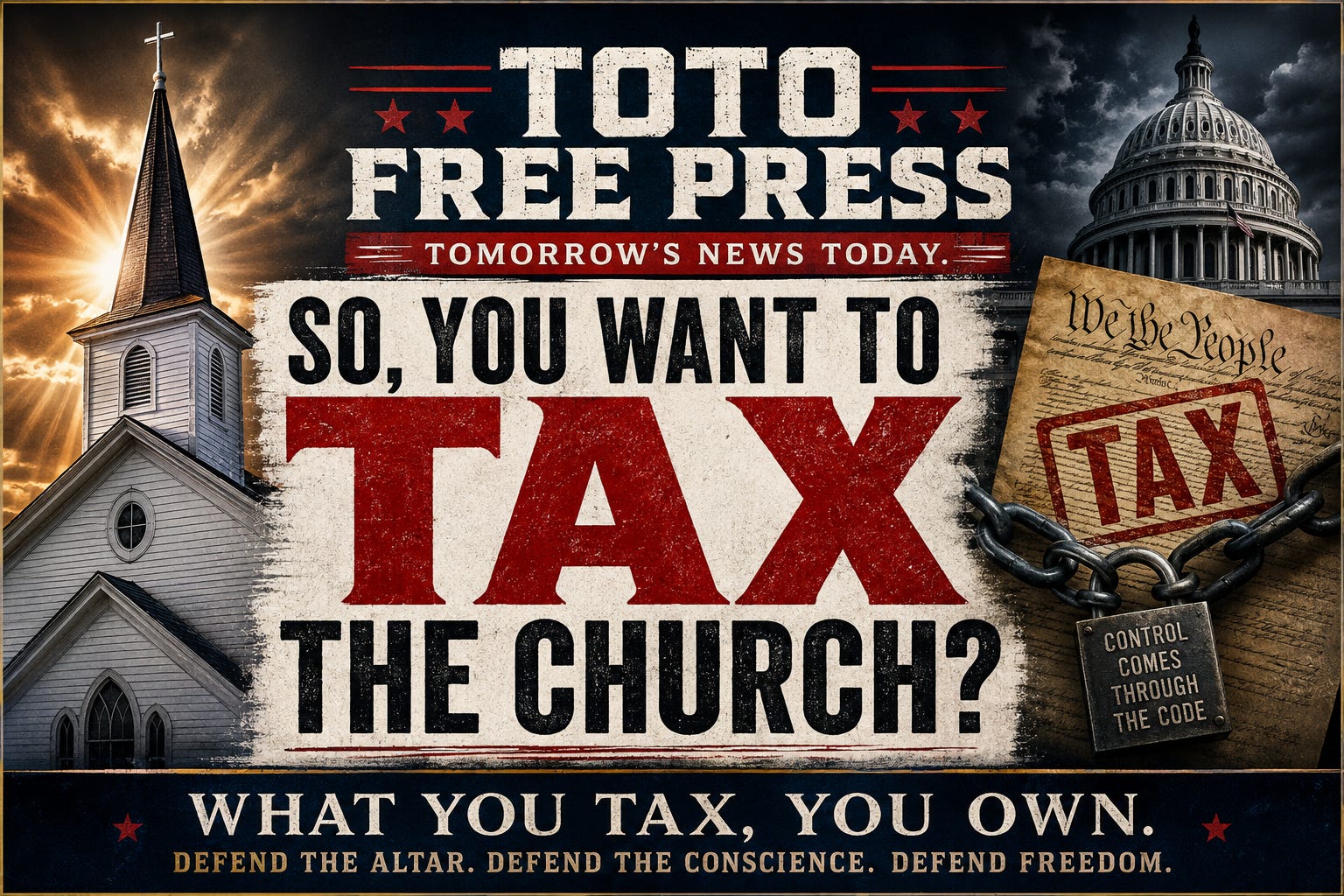
“Churches should pay their fair share.” “Why are we subsidizing religion?” “That property sits there generating nothing — tax it.”
It used to be a fringe position you’d find in a letter to the editor. Now it’s an op-ed page staple, a ballot measure, a city council agenda item, a fundraising line. Two days after the Supreme Court’s 2015 marriage ruling, a New York Times columnist published a piece in Time arguing that the moment had arrived to end religious tax exemptions altogether — and specifically that congregations refusing to bend on doctrine should forfeit theirs. That was eleven years ago. It was treated as provocative then. It is treated as reasonable now.
Colorado voters were asked to strip property-tax exemptions from churches and nonprofits back in the nineties. It failed. Somebody will ask again, and the next time the vote will be closer.
What You Tax, You Own
Here is the whole argument in one sentence, and I want you to sit with it.
When the state taxes a thing, the state is declaring itself lord of that thing.
That’s not rhetoric. That’s the mechanism. Taxation is not a fee. Taxation is a claim of dominion. It is the government saying: this falls under my authority, therefore I take my portion off the top.
You want proof? Look at your own house.
You think you own your property. Cute. Stop paying the tax and see how fast you find out who the actual landlord is. The county doesn’t send a collections notice — it sends a sheriff, and it takes what it says was always its own. You never owned it. You were renting it from the state and calling yourself a homeowner.
Now apply that same logic to the house of YAHWEH.
The moment a state taxes the church, that state has declared itself lord over the church. Not a partner. Not a neighbor. Lord. And there is no version of that arrangement where the church remains the church.
That is why this one line has never been crossed in America. And every American — atheist, agnostic, Baptist, Buddhist, doesn’t matter — ought to get on their knees and thank heaven it hasn’t.
The Church Is a Nation
The church is not a club that the government generously permits to exist. The church is a sovereign entity. It answers to YAHWEH and to His Son YAHSHUA the Messiah — and to nobody else wearing a badge, a robe, or a lapel pin.
It has its own citizens. It has its own law. It has its own courts of discipline. And yes — it collects its own revenue. It’s called the tithe, and it has funded the work of YAHWEH since Abraham, without one dime of appropriation from any Congress that ever sat.
Marriage belongs to YAHWEH. The Sabbath belongs to YAHWEH. Immersion belongs to YAHWEH. The table belongs to YAHWEH. These are not civic programs the state licenses out to religious vendors. They are His property. No government on this earth has standing to lay a finger on them, and the day one does, we are no better than North Korea with better teeth.
Ask yourself something. Picture your town with every church building emptied and repurposed. No steeple on the corner. No quiet reminder that there is a higher law, an all-seeing eye, a day of accounting coming for every man who ever held office.
You don’t want to live in that town. Neither do the people trying to build it.
“Render Unto Caesar” Does Not Mean What They Told You
They love to throw that verse at us. They have never once finished the sentence.
Render unto Caesar the things that are Caesar’s — and unto YAHWEH the things that are YAHWEH’s.
That is not a verse about compliance. That’s a verse about jurisdiction. Caesar has a lane. YAHWEH has a lane. Caesar’s coin bore Caesar’s image, so give it back to him. But you bear a different image, and so does His assembly — and Caesar has no claim on either one.
So when somebody tells me the church shouldn’t speak to politics, I want to know what Bible they’re reading.
Cry aloud, spare not, lift up thy voice like a trumpet, and shew my people their transgression.
That is not permission. That is a job description.
John the Baptist walked up to a sitting head of state and told him his marriage was unlawful. That is the church speaking to the political order. It cost him his head, and he’d do it again. Nathan did it to David. Elijah did it to Ahab. Amos did it to the whole rotten commercial establishment of the northern kingdom.
The moment you tell the church it may not speak to the sins of the nation, you have already taxed it. You’ve just done it with a muzzle instead of a bill.
And Here Is How the Trap Actually Works
Now watch this, because this is the part that turns a tax argument into a speech argument. And it just played out in a federal courthouse — most of you never heard about it.
In 1954, a sitting senator named Lyndon Johnson slipped an amendment into the tax code.
And I want you to know exactly how that happened, because the origin story tells you everything.
Johnson was a freshman senator in a bruising Texas primary. Some well-funded conservative nonprofits were campaigning against him — running the line that a vote for Johnson was a vote for socialism. He looked for a way to shut them down, and when he was told their activity was perfectly legal, he wrote a rule instead. On July 2, 1954, he offered it as a floor amendment to a pending tax bill. No committee hearings. No debate. A voice vote. Signed into law that August.
And here is the detail that ought to stop you cold: churches were never the target. A staffer said years later that Johnson never had churches in mind at all. No congregation in America had done a thing to provoke it.
Churches got swept in for one reason — their exemption is written in the same section of the code. Seventy-two years of muzzled pulpits, and the muzzle wasn’t even meant for us. We were standing too close to somebody else’s grudge. It says a 501(c)(3) — and that includes churches — may not participate or intervene in any political campaign for or against a candidate. Do it, and your exempt status is on the table.
Seventy-two years. Seventy-two years of pastors preaching with one eye on the IRS. Softening the sermon. Dodging the name. Hedging the application. Not because the argument was weak — because the money was hostage.
Then in 2024 a coalition of religious broadcasters and two Texas churches finally sued, arguing the Johnson Amendment violates the First Amendment.
And on July 7, 2025, something remarkable happened. The IRS didn’t fight. It filed a joint motion for a consent judgment — a settlement — agreeing that when a house of worship in good faith speaks to its own congregation, through its customary channels, on matters of faith in connection with religious services, that is not campaign intervention under the tax code. The filing said such speech does no more than a family discussion about candidates.
Church folks celebrated. Headlines everywhere. “IRS backs down.”
Then on March 31, 2026, the judge threw the whole case out.
Not on the merits. He never reached the merits. He dismissed it for lack of subject-matter jurisdiction under the Tax Anti-Injunction Act and the tax exception in the Declaratory Judgment Act — federal statutes that forbid courts from issuing rulings that restrain the assessment or collection of taxes. His reasoning: because the Johnson Amendment lives inside the tax code, any order blocking its enforcement necessarily interferes with tax administration. And critically — even both parties agreeing could not create jurisdiction the court did not have. The IRS wanted to settle. The churches wanted to settle. The court said it lacked the power to bless it.
Dismissed without prejudice. The plaintiffs are appealing to the Fifth Circuit. The Johnson Amendment stands.
Now, folks. Sit up.
Do you see what just happened? Do you see the architecture?
They did not pass a law forbidding pastors to speak. They would never get away with that — it would be struck down in a week. Instead they buried the speech rule inside the tax code, where the courthouse doors are bolted shut from the inside.
And this — right here — is the very reason FIRST HARVEST MINISTRIES INTERNATIONAL and THE APOSTOLIC ASSEMBLIES, of which I am the founder, have never been 501(c)(3) and never will be.
Not as a protest. As a matter of jurisdiction.
You cannot accept the shelter and then act astonished when you discover the shelter has a door, and the door has a lock, and somebody else is holding the key. The moment an assembly applies to a federal agency to be recognized as what YAHWEH already made it, that assembly has conceded the very point — that there exists an authority on this earth competent to approve or disapprove the house of the Living God.
I fail to see how any true assembly of YAHWEH could ever be involved with such a thing. Not one. And now you’ve seen the courthouse doors bolted from the inside, you understand why: the bridle was never hidden. We just stopped calling it a bridle and started calling it a benefit.
And so the church is left in a box with no exit:
-
You cannot get a ruling before you speak, because the Anti-Injunction Act bars a pre-enforcement challenge.
-
You can only get into court after the IRS moves against you — meaning after you’ve already put the ministry, the building, and the payroll at risk.
-
And even when the government itself says it agrees with you and wants to settle, the court says it hasn’t got the authority to make that stick.
The broadcasters’ own general counsel put the principle plainly: nobody should have to place himself in legal jeopardy in order to protect a constitutional right.
That is what weaponizing the tax code looks like. Nobody kicks in the sanctuary door. They just make sure the courthouse door stays locked. The restriction is enforced not by punishing you, but by making the threat permanent and the review unavailable. You will obey out of uncertainty, and it will cost the government nothing.
And now consider what happens if the “tax the church” crowd gets its wish and the exemption goes away entirely. Every congregation in America becomes a taxable entity, permanently inside that same code — every sermon a potential compliance question, every assessment a potential message. They’ll tell you this is only about money. It never was. The tax is how they get a hand on the church. What they’re after is what gets preached in it.
Europe Already Ran This Experiment
And before anybody tells me this is paranoid, understand: we don’t have to guess what a taxed church looks like. It exists. You can go see it.
Germany operates a Kirchensteuer — a church tax. It runs 8 to 9 percent of your income tax, depending on the state. It is not collected by the church. It is collected by the Finanzamt, the government tax office, straight out of your payroll, and then forwarded to your registered religious body — with the state keeping a cut, a couple of percent, as a handling fee. In 2024 that machinery moved over €13 billion.
Sounds like a windfall, doesn’t it? Now look at what it costs.
The government is the collection agent. The government is the paymaster. Your religious affiliation is a data field on your civil registration. And if you want to leave your church, you don’t tell your pastor — you file a declaration with a state office. That is what it has come to. In Germany the state administers your membership in the body of Messiah.
You want to know why the assembly in a system like that never becomes a thundering prophetic voice against the government? Ask yourself a simpler question first. Who signs the check?
That is not an accusation. That is an org chart.
The established churches of Europe have been running this arrangement for centuries — taxed, subsidized, folded into the civil apparatus. They kept the buildings. They kept the vestments. They kept the beautiful liturgy and the cathedral tours. What they surrendered was the one thing that made them dangerous: the standing to tell the government it is wrong.
That is what taxing the church buys you. Not revenue. A department.
“But What About My Deduction?”
That’s the question that always comes next, and it’s the hook the whole system hangs on. So let’s take it apart.
“But Toto, I want my giving to be tax-deductible.”
It already is. Section 508(c)(1)(A) of the Internal Revenue Code — enacted in 1969, not last year — exempts churches, their integrated auxiliaries, and conventions of churches from the requirement to apply at all. A qualifying church is treated as tax-exempt from the moment it is formed. Not from the moment a bureaucrat blesses it. Contributions are deductible without any determination letter ever being issued.
But let’s stop pretending the letter is required. It is not. Congress said so in 1969. Go read it.
COVID Settled It For Me
When they told me to close the doors of the house of YAHWEH, I told them exactly where they could file that order.
Not because I’m a tough guy. Because there is a greater law. We obey the law of the land right up to the line where the law of the land commands us to defy the law of YAHWEH — from which all lawful authority descends in the first place. That’s not rebellion. That’s the whole basis on which any government has legitimacy at all.
Pharaoh signed an order to kill the Hebrew children in the birth room. The midwives ignored it. Scripture does not record YAHWEH’s disappointment in their civil disobedience. It records that He dealt well with them and built them houses.
Any man who bends to a lawless order against the commandment is a coward, and the title Christian does not fit him.
And when the mandates came, the Toto’s Army and this ministry were among the first in the nation writing religious exemption letters that actually held up — while credentialed attorneys were producing letters that got shredded on the first review. Doctors. Nurses. Officers. Teachers. Thousands of them kept their livelihoods.
Why did ours work when the lawyers’ didn’t? Because I wasn’t writing a legal brief. I was writing from the supreme authority of the assembly of the Living God and from an established, documented doctrine: we do not put into these bodies what the Scriptures forbid. We don’t eat what He called unclean. We were never going to accept an untested injection on a bureaucrat’s say-so either. That’s not a preference. That’s doctrine, held long before anyone had heard of a mandate — and that’s exactly why it stood.
One Piece of Paper, Four Different Weapons
While we’re overturning tables.
Marriage is an institution of YAHWEH, established in a garden before there was a state, a clerk, a courthouse, or a fee schedule. He built it, He defined it, and He alone holds the deed. You don’t drive downtown for an immersion certificate. You don’t file an application to break bread. So how did we ever arrive at a place where a county employee decides who is married?
I’ll tell you how. Not in one grab — in four, each one training you for the next.
The paper itself is old. Colonial Massachusetts was recording marriage licenses around 1639, and Connecticut, Delaware, Maryland, North Carolina, and Virginia all had license requirements in the colonial period. It started life as a formality. Then it got picked up and swung four separate times.
Weapon One: Who May Marry (1661)
Virginia banned interracial marriage in 1661. Now — how do you enforce a law like that across a whole colony? You don’t need police. You don’t need informants.
You already hold the pen. The clerk simply declines to issue.
That’s the entire enforcement mechanism. By the time licensing was universal in this country, that license was one of the primary instruments for enforcing anti-miscegenation law, and it stayed that way until 1967.
Understand what that means. The instrument every pastor in America now treats as a harmless administrative step spent three centuries functioning as a racial screening device. Couples that YAHWEH joined were told by a man behind a counter that they were not married — and the churches went right along with it, because the churches had already conceded that the counter decides.
That’s Weapon One: the power to refuse.
Weapon Two: Your Body Is the Price of Permission (late 1930s)
This is the one nobody talks about, and it’s the one that ought to raise the hair on your neck.
Beginning in the late 1930s, Surgeon General Thomas Parran ran a national campaign against syphilis — and a central plank of it was requiring a blood test before a marriage license could be issued.
Read that slowly.
The state took an institution YAHWEH created, and made your entry into it conditional on submitting your body for a government-mandated medical procedure. No test, no paper. No paper, no marriage — as far as the state was concerned.
Now. Where did we see that principle again in our own lifetime? No injection, no job. No injection, no classroom. No injection, no seat at the table.
Folks, that is not a new idea they invented in 2020. They had already practiced it on the wedding license eighty years earlier, and the church raised no objection at all — because by then the church had accepted that permission to marry was the state’s to grant.
That’s Weapon Two: the power to attach a condition to your body.
Weapon Three: The Money Gate (1939)
Here is where Social Security actually walks on stage — not as the inventor of the license, but as its enforcer.
The original 1935 Act paid the worker and nobody else. It was the 1939 Amendments that added dependents’ and survivors’ benefits, shifting the whole program from protecting an individual worker to protecting a family. And the moment Washington began cutting checks to wives and widows, it needed an official rule for who counted as one.
That’s the hinge, folks. In 1939 the county marriage license stopped being a local record and became a federal turnstile.
And once that precedent was set, everything else got bolted to the same sheet of paper — pensions, insurance, tax filing status, immigration, the hospital room, the inheritance, the custody order, the school form.
The state never invented marriage. It didn’t even invent the license. It found a formality already sitting on a clerk’s desk, chained your family’s survival to it, and let three generations conclude that the paper is the marriage.
That’s Weapon Three: the power to starve you out.
Weapon Four: The Power to Redefine (2015 and onward)
And now the one that finally woke people up — forty years too late.
Here is the iron law of jurisdiction, and I want it tattooed on every pastor in America: whoever holds the pen holds the definition.
For three hundred years the church handed the state the pen and called it cooperation. We told our young couples to go get the paper first, and then come see us for the pretty part. We made the state the gatekeeper and reduced the assembly of the Living God to a ceremony provider.
Then one day the pen-holder changed the definition of the word — and the church stood up to object and discovered it had no standing. None. You cannot spend three centuries conceding that Caesar defines marriage and then act shocked when Caesar defines marriage.
We didn’t lose that fight in 2015. We lost it the first time we told a couple the county had to approve them.
And the same authority runs the other direction, which nobody wants to discuss either: the state that claims it may join also claims it may dissolve. Every divorce court in this country operates on the assumption that a bond YAHWEH established can be terminated by a docket number and a filing fee.
That’s Weapon Four: the power to define, and to destroy.
So no, I’m not telling you to burn your license. Get one if it protects your wife at a bedside or secures a benefit she will need. Render that much unto Caesar and lose no sleep.
But never once confuse the receipt with the covenant. Only the assembly of the Living God has authority to join or to annul a covenant of marriage.
That is sovereign territory. And the state has been trespassing on it since 1639, screening at the door since 1661, taking blood since the 1930s, charging admission since 1939 — and rewriting the sign over the entrance ever since.
Let’s Take the Honest Questions
Because not everybody beating this drum is an enemy. Some of you are thinking out loud, and you deserve a straight answer instead of a sermon.
“Churches use the roads. They call the fire department. Why shouldn’t they pay?”
They do pay. Every assembly in America pays sales tax on what it buys in most states. Every church employee pays income tax. And every minister pays self-employment tax on ministerial income — SECA, out of pocket, no employer splitting it with him. The church is in the economy up to its neck.
What isn’t taxed is the property set apart for worship — for the same reason the county doesn’t tax the courthouse. You don’t tax what you have no jurisdiction over.
And notice how far that argument would actually go if anybody meant it. Universities use the roads. Museums use the roads. The soup kitchen uses the roads, and every one of them is exempt. Nobody is out campaigning to tax the soup kitchen. The church gets singled out for one reason — and it isn’t the fire department.
“Isn’t this just special pleading? Why should religion get a privilege nobody else gets?”
Because the assembly of YAHWEH is not one more institution. It is the one institution on this continent whose entire function is to maintain a loyalty that outranks the state. That is not a privilege. That is the reason the First Amendment exists.
And this is not a modern argument. James Madison made it in Virginia while fighting a proposed tax to fund teachers of religion. His argument was that a man’s duty to his Creator is “precedent, both in order of time and degree of obligation” to the claims of civil society. Read that again — precedent. It came first. Government is the newcomer here, and a newcomer does not get to tax the elder claim.
The free exercise clause does not protect religion because religion is pleasant. It protects religion because a government that can set the terms of worship has eliminated the only rival authority capable of checking it.
“What about the crooks? The jet-and-mansion ministries?”
Then go after the crooks. The tools already exist. Private inurement is already prohibited — an assembly may not be operated for the private enrichment of the man at the front. If somebody is funneling widows’ offerings into a Gulfstream, that is already actionable under existing law, and the IRS has never lacked the authority to look into it.
What you don’t do is burn down the exemption for every storefront congregation, every country church with forty members and a leaking roof, and every inner-city assembly feeding a neighborhood — because a handful of showmen embarrassed you on television.
Enforce the law you have. Don’t hand the government the deed to the whole house because some tenants are thieves.
The Line
So here is where I land, and here is where First Harvest has always stood.
The church is holy. The church is set apart. The church is a nation unto itself — Mount Zion, a city with its own foundations — and it is governed by no monarch, no ministry of information, no revenue service, and no election result.
We will obey the law of the land. We will pay what is lawfully Caesar’s. And we will not shut up. Not during a pandemic, not during an election season, not when the assessment notice comes with an eagle on the envelope.
To everybody out there campaigning to tax the church — and there are more of you every year, and you are winning the argument in rooms where nobody bothers to answer you — I’d ask you to think past the first step. You are not proposing to collect a fee. You are proposing to make the government the landlord of the conscience. And landlords set terms.
We already have a live demonstration of what that looks like. A speech restriction sitting inside the tax code, unreviewable in advance, enforceable by rumor, and immune even to the government’s own attempt to settle it.
That’s with the exemption still standing.
Now imagine it gone.
Tax the church, and you don’t get revenue. You get a church that belongs to you. And a church that belongs to you is not worth having — not to me, not to the assembly, and I’d argue not to you either.
Because on the day the last steeple is just another taxable parcel, there will be nobody left in this country whose job it is to tell the government it is wrong.
And Now You Know… THE BEST of the Story.